Showing posts sorted by relevance for query dynastic. Sort by date Show all posts

Sunday, June 05, 2005

The Dynastic Centerpiece Model


I started this weblog to air my idea about the "Dynastic Centerpiece" model that DC uses (consciously or not) to help turn its characters into icons. But nobody was reading it back then! So now I'd like to take a minute to bring that idea back to the forefront.

DC is re-applying what I'll call the "Dynastic Centerpiece" model to its icons. In the Dynastic Centerpiece model, a hero is not a single character but the centerpiece of his/her own array of good forces. Using basic concepts (such the Kid Sidekick, the Junior Counterpart, the Black Sheep, the Elder Statesman, the Female Counterpart, the Animal Companion, the Romantic Interest, the Civilian Companion, the Authority Figure, etc.) a constellation of characters is clustered around the central figure, which helps make him/her seem even more important.

Against them is arrayed an "anti-dynasty" of villains similarly created according to familiar archtypes (The Arch Enemy, The Lunatic, the Heroworshipping Villain, the Civilian Enemy, the Untouchable Crime Lord, the Magician, the Evil Opposite, the Femme Fatale, the Mental Challenger, The Physical Challenger, etc).

"Loner characters" not tied in with others are attractive and may have many interesting stories in them. But, because connectivity creates relevance, such characters usually don't feel important. If you eliminate them, nothing happens. If you eliminate a character richly connected with others, their world falls apart, particularly if that character is the centerpiece around which the others revolve. So by making a character a "dynastic centerpiece" and allowing a mythos to accrete around it, DC makes its character seem more important to us. Likewise, because DC head honcho Dan Didio (wisely) wants to re-establish Superman, Batman, and Wonder Woman as DC's most important characters, he is remaking the DCU so that its other characters revolve around them.

Each characters dynasty is not a cookie cutter of the others. The model is flexible enough to allow variety and individuality; Black Canary doesn't need a Snoopy Reporter Girlfriend and the Flash doesn't need Zipper the Flashhound. But there are definitely a number of recognizable, broad archtypes that are common in the model, because they flow naturally from the human psyche. Laugh if you want at things like "kid sidekicks", but our innate drive to mythologize a popular character by "filling out the pattern" is pretty strong.

The Golden Age sowed the seeds of the Dynastic Centerpiece (DC) model. It pioneered archtypes like the Girlfriend Who Doesn't Know, the Kid Sidekick, the Funny Friend, and the Civilian Authority. But the DC model came into its own in the Silver Age.

During the Silver Age, the Dynastic Centerpiece model was used to build a mythos around all the characters, as a matter of course. Done right, it can give the character the unstoppable momentum of a freight train. Superman is the most extreme example (for good and for ill), with some of his supporting characters even becoming the centers of their own little dynasties (specifically, Jimmy Olsen, Lois Lane, Krypto, and the Legion). Overdone or done poorly, the DC model can break down under its own weight like an overburdened wagon (we call this the Beppo Syndrome, and it gave the dubious benefits of Element Girl, Vicki Vale, and Zook).

Granted, you may not always like how such a pattern's being use. But, like it or not, characters who lack the pattern have trouble standing on their own. It's no coincidence that the likes of the Atom, Plastic Man, Martian Manhunter, Firestorm, Black Canary, despite their powers and pedigrees, don't carry the weight of icons like Superman or Batman, or that one of the main things that the revivals of Starman and Green Arrow did was to use pre-existing and new characters to "fill out" the pattern as much and as quickly as possible to build a dynasty around their stars.

One of the reasons that the JLA has such mythic power is that we feel it as the gathering of icons each of whom is the centerpiece of its own whole mythos, not just a gathering of individuals (like, say, the Avengers is). During the revitalization of the JSA, the writers/editors have played on this phenomenon by strengthening the ties of each member to larger mythos of which he/she is a part.

So together let's play the Dynastic Centerpiece game! In past posts, linked below, I chatted about the dynasties that exist (or could) around some heroes. What do you think about them? And, if you'd like, let's talk about what other heroes might have beneficial dynasties build around them.

The Martian Manhunter

Jesus (all in good fun, folks!)
Wonder Woman
Flash
Batman
Green Lantern
Black Canary
Animal Man

Friday, June 06, 2008

The Villainous Tarot

Our recent conversation about composing an "anti-Trinity" has brought me back to the idea of villain archetypes.

The idea of villainous archetypes certainly isn't new, or unique to comic books. But when part of your central schtick is "one hero with many foes", then devices that help distinguish those foes become useful. Conceiving of archetypes among villains then helps you create new ones: you can see where the "gaps" are in the hero's villainry and create a character to fill it.

This concept is similar to the Dynastic Centerpiece Model we talk about here. In the DCM, we find patterns between a Dynastic Centerpiece and his or her helpers and supporting cast. In what I will call the Villainous Tarot, there's a set of archetypes that DC villains fall into it, in which, like the Dynastic Centerpiece Model, the members are defined in terms of their relationship to the central hero. The more fully that "Tarot" is filled out, the potentially richer the hero's Rogues' Gallery is.

Filling out the Villainous Tarot isn't a sure-fire thing. If you fill it with crappy villains, then your hero will still have a crappy Rogues Gallery. BUT-- and here's the key thing -- quantity (or, more accurately, variety) is more important than quality. More on that later!

But first, let's take a look at a sample for the Trinity...


Batman Superman Wonder Woman
Mocker Joker Prankster Angle Man
Crime Lord Penguin Lex Luthor Veronica Cale
Opposite Number Killer Moth General Zod Devastation
Twisted One
Two-Face Bizarro Silver Swan
Mental Challenger Riddler Mr. Mxyzptlk Dr. Psycho
Physical Challenger Killer Croc Parasite Cheetah/ Giganta
Gadgeteer Penguin Toyman
Sexual Challenger Catwoman Maxima RIP
Evil Genius Hugo Strange Lex Luthor Dr. Poison / Egg Fu
Manipulator Mad Hatter
Dr. Psycho


These are just some of the more obvious villainous archetypes. They aren't mutually exclusive (one character may fill more than one role) nor unique (one role may be filled by more than one characters). Nor is there any necessary hierarchy among these archetypes; for various reasons, a hero may wind up with an "archenemy" who's a Mocker (the Joker), an Evil Genius (Lex Luthor), or an Opposite Number (Zoom). Nor are these roles immutable; villains can evolve from one role to another (as Hugo Strange once evolved from Evil Genius to Opposite Number or Twisted One) or occupy different roles as the situation demands (e.g., the Penguin as Gadgeteer or Crime Lord). Role can be usurped; the attempt to create Devastation as an Opposite Number for Wonder Woman didn't stick long-term, and the new "Super-Manazon" that DC appears to be planning will now take that role instead.

And this is why the variety, overall, is more important that the quality. Quality is easy to fix. If a villain in a particular role is crappy, all it takes is one issue to give them an upgrade or make them more interesting. As long as a villain has any recognizability, they can be given a new paint job (e.g., Catman, Egg Fu, Black Hand). It's harder to introduce new villains and make them stick than it is to revitalize them.

When I asked you to come with an "anti-Trinity", you each chosen a different set of villains, and, consciously or not, your choices were influenced by what role the villain plays in that hero's Villainous Tarot. Some of you chose villains with the same role, so that they would all have a common goal to give your team unity. Some of you, on the other hand, chose villains with three different approaches to give your team variety. It's like in Risk, when to get extra armies you can turn in either three of the same card, or one card each from the three different types. Re-examine your own choices with the Villainous Tarot in mind, and see what it tells you!

Just like the Dynastic Centerpiece model, the Villainous Tarot can highlight weaknesses in the mythos of a hero. Try filling in the grid above for another hero. The problems are immediately apparent. Most of Flash's villains are, essentially, gadgeteers (and one trick gadgeteers, at that). Small wonder, then, that they've largely been lumped together what amounts to one threat with a variety of faces ("The Rogues"). No one's taking the role of the Mocker of Green Lantern (except for, you know, me and the rest of the internet). Black Manta has to fill five or six slots in Aquaman's tarot, and if you want to have a serious laugh (or a serious headache, depending on your attitude) try and fill that grid in for Green Arrow or the Martian Manhunter.

The nice part is that, in pointing out gaps, the Villainous Tarot spotlights opportunities. As previously mentioned, somebody at DC obvious thought something along the lines of, "Hey, Batman and Superman each have at least Opposite Number, maybe more; shouldn't Wonder Woman have one, too?" Angle Man's not really Wonder Woman's Mocker, just the closest she has to one; he could be pushed more in that direction, and new villains could be placed in his original roles as Mental Challenger, then Gadgeteer. Wouldn't someone Grimbor-like be an amusingly ironic foe for Wonder Woman, perhaps as an enslaver of trafficked women? Or old villains could be re-purposed to fill those roles; wouldn't Circe be more effective as a Mental Challenger for Wonder Woman, rather than as a tepid Mocker of her values?

The specifics of what is done what role or which character are merely details, and you could make a wide variety of interesting and valid choices. I wouldn't want to see every hero's Rogues' Gallery become cookie-cutter predictable, but I would like to see writers and editor take greater advantage of some obvious opportunities to fatten up their hero's Villainous Tarots!

Tuesday, May 13, 2008

The Real Reason J'onn J'onzz will Die

There are lots of reasons why Martian Manhunter's going to die (and why DC's been trying to send him to the chopping block since before Identity Crisis): intrinsic difficulties with the character, inability to maintain his own title, a *snort* Rogues' Gallery even more ridiculous than Green Arrow's.

But here's the REAL reason:

Click image to see it full-sized.
And please don't "correct" me about Green Arrow being an original Leaguer;
do you really think I don't know these things already?


J'onn has not been developed as a Dynastic Centerpiece.

Cue the groaning because, yes, it's the Return of My Pet Theory, the Dynastic Centerpiece Model. Now, you can quibble with the specifics of the diagram above (Neptune Perkins?!), but don't bother, I won't engage you. Focus on the central point: the other Justice Leaguers are Dynastic Centerpieces and J'onn is not.

It didn't have to be this way. DC could have tried to build a dynasty around J'onn. In the Silver Age, DC's editors and writers were consciously aware that they were building a mythos around characters, adding a new element every few months. But nowadays, I can never tell whether DC is aware of the Dynastic Centerpiece Model (or whatever else you might wish to call the concept), and whether it's being applied (or not) intentionally (or not). When good writers were working on Aquaman, Hawkman, and Firestorm, they clearly were building dynasties; it didn't save the titles in the short-term, but they certainly had the right (long-term) idea.

It seems so simple. Trim his powers a bit (particularly telepathy... that's a story-killer). Give him the old "Ultra-Boy" limitation. Instead of casting him as a bottomless well of power like Superman, portray him as a "limited charge" player, like Green Lantern. Let him become Marco Xavier as a new secret identity. Cluster around him some characters he's been linked with before in his varied career or who otherwise make sense, and let them interact with one another in new combinations. Give him a brief, like chasing down villains who are on the lam from their regular fictionopolises. Put him back where he belongs, in the incendiary capital of the world, Apex City.

Imagine Martian Manhunter stories that don't focus on frickin' long-dead Mars. Imagine Martian Manhunter stories where he's solving external problems rather than grappling with his own alienation and insanity. Imagine a Martian Manhunter cast of characters of this sort:

You can swap out any of the particular players here,
but tell me you wouldn't find this group intriguingly bizarre.
Oh, and throw in a Dachshund named Jupiter II and Plastic Man;
how could such a thing fail to sell?


Face it; no one will miss J'onn when he's gone. Oh, sure, they'll miss him, but nothing will fall apart without him, and that's the real reason he's so easy to get rid of.

The other Leaguers have "families" that are built around them, that would not cohere without them as the centerpiece (if you need evidence of that, read pre-Rebirth Green Lantern, the last 23 years of Flash, or this month's issue of Aquaman). J'onn doesn't have a "family"; just co-workers in the JLA, and, to be painfully frank, they've got families of their own. Their lives (and titles) will press on just fine without JJ around. If you want the Martian Manhunter to stick around he has to be the center of some dynasty, not just the Odd Man Out in the Justice League.

Tuesday, June 21, 2005

The, um, Meta-Dynastic Model, I guess

An Absorbascommenter wrote me a private email about the idea of applying our "Dynastic Centerpiece Model" to teams instead of individuals. Let's!

For those who've just joined us, the Dynastic Centerpiece (DC) model is the loose application of a set of character archtypes to building a mythos around a central figure, a "dynastic centerpiece". Here's an example: Centerpiece (Batman), Junior Version (Nightwing), Sidekick (Robin), Black Sheep (Huntress), Elder Statesman (NONE), Animal Companion (Bathound), Female Version (Batgirl), Authority Figure (Commissioner Gordon), Civilian Companion (Alfred), etc. This model applies to many of DC's iconic characters to varying degrees.

To some degree, I guess, it applies to supergroups as well. Centerpiece (JLA), Junior Version (Outsiders), Sidekick (Teen Titans), Black Sheep (JLElite), Elder Statesman (JSA), Animal Companion (I'm not sure the Legion of SuperPets counts!), Female Version (expand the Birds of Prey a bit...), Authority Figure (DEO), Civilian Companion (nothing there).

Tuesday, March 29, 2005

Religious Icons

Okay, I know it seems like all I can talk about (lately) is superheroes as Dynastic Centerpieces, but that's just not true. And I'm now about to prove it by discussing religious figures ...
um, as Dynastic Centerpieces.

As any fan of DC's dirt knows, the legend of Alan Moore's departure from DC after his groundbreaking run on Swamp Thing is that editors nixed his story using Jesus as a character. They SAID they were afraid of public reaction, but I think the real reason was they couldn't get the rights to the character. That's the trouble with Creator-owned characters, you know.
Anyway, what if DC had acquired the rights to Jesus (say, by suing for copyright infringement because he could do almost everything Batman can)? I think the cast of The Adventures of Holy Man would have been something like this...

Dynastic Centerpiece: Mild-mannered carpenter, Jesus Nazareth, adopted son of Mary and Joseph ("Ma & Pa") Nazareth, sent to earth by his real father from the distant and cool-to-draw place of Heaven. He controls the Holy Ghost, which is kind of like the Thunderbolt, only not as fun visually.
Junior Counterpart: His cousin, John Baptist, whose water-based powers enable other people to breathe under water and command the loaves & fishes.
Female Counterpart: His mother acquires superpowers of healing and intervention as "Mother Mary".
Kid Sidekick: Judas. Was his last name Olsen, or is that my imagination?
Romantic Interest: Mary Magadelene. ("Hm. 'Mother Mary', 'Mary Magadelene' ... strange how so many important people in my life have the initials MM!")
Elder Statesman: That would be God, I think.
Civilian Companion: Peter Rock.
Animal Companion: The donkey. Definitely the donkey.
Black Sheep: Muhammed. Go ahead, flame me.
Authority Figure: Pontius Pilate. Hey, authority figures don't have to like the good guy.
Contextualizing City: Salt Lake? Just kidding. Jerusalem City, of course.
It's all very Shazam Family, isn't it? Going with that, we'd get comic relief from
Fat Holy Man Jerry Falwell, Tall Holy Man Robert Schuler, Hillbilly Holy Man Billy Graham, Uncle Holy Man Jean-Paul, and Hoppy the Holy Easter Bunny.
Dynastic Centerpiece models; they're not just for comic books any more!

Sunday, March 27, 2005

DC = Dynastic Centerpiece

DC is re-applying what I'll call the "Dynastic Centerpiece" model to its icons. In the Dynastic Centerpiece model, a hero is not a single character but the centerpiece of his/her own array of good and evil forces. Using basic concepts (such the Kid Sidekick, the Junior Counterpart, the Black Sheep, the Elder Statesman, the Female Counterpart, the Animal Companion, the Romantic Interest, the Civilian Companion, the Authority Figure, etc.) a constellation of characters is clustered around the central figure, which helps make him/her seem even more important. Against them is arrayed an "anti-dynasty" of villains similarly created according to familiar archtypes (The Arch Enemy, The Lunatic, the Heroworshipping Villain, the Civilian Enemy, the Untouchable Crime Lord, the Magician, the Evil Opposite, the Femme Fatale, the Mental Challenger, The Physical Challenger, etc).

In the Silver Age, a Dynastic Centerpiece model was used to build a mythos around all the characters as a matter of course. Done right, it can give the character the unstoppable momentum of a freight train; overdone or done poorly, it can break down under its own inertia like an overburdened wagon (the Beppo syndrome, as it were). But because the archtypes are strong concepts built-in to the human psyche, the drive to mythologize a character by "filling out" the pattern is always there. You may not always like how such a pattern's being used, but, like it or not, characters who lack the pattern have trouble standing on their own. It's no coincidence that the likes of the Atom, Plastic Man, Martian Manhunter, Firestorm, Black Canary, despite their powers and pedigrees, don't carry the weight of icons like Superman or Batman, or that one of the main things that the revivals of Starman and Green Arrow did was to use pre-existing and new characters to "fill out" the pattern as much and as quickly as possible.

One of the reasons that the JLA has such mythic power is that we feel it as the gathering of icons each of whom is the centerpiece of its own whole mythos, not just a gathering of individuals (like, say, the Avengers is). During the revitalization of the JSA, the writers/editors have played on this phenomenon by strengthening the ties of each member to larger mythos of which he/she is a part (the current storyline is a stunning example).

Wednesday, December 27, 2006

The Phantom Stranger Dynasty!

As a result of buying the Phantom Stranger Showcase, I've been posting a lot about PS here lately. How could I not? He's mysterilicious.

Devon suggested to me that I apply the Absorbascon's patented "Dynastic Centerpiece" model to Phantom Stranger; and so I shall!


Dynastic Centerpiece: The Phantom Stranger

Although there are lots of mystic DC characters, I don't think any of them really have a dynasty built around them. Oh, there are hints of it: Blue Devil and Zatanna each have "kid sidekicks" or "junior counterparts" in Kid Devil and Zatara. But there aren't any full-blown dynasties, and maybe that's part of what's kept such mystic characters on the periphery.

You'd think that one of the mystics who hangs out with superheroes regularly, like a Dr. Fate, would be the best bet for building such a dynasty. I submit the irony that the Phantom Stranger -- one of comics' pre-eminent loners -- comes the closest to becoming a Dynastic Centerpiece. After all, he is a member of Justice League... .


Junior Counterpart: the Ghost of Vibe

Just kidding! Still, how fabulous would it be to have a ghostly breakdancing Puerto Rican gang member as the Phantom Stranger's junior partner? Answer: Very. I can just picture PS giving one of his sententious orations while Paco mockingly vogues behind him.

My actual nomination is a different ghost entirely: Deadman. Like the Stranger, he wanders around, mucking about in other people's private lives, then moves on. He makes a nice contrast, too; the Phantom Stranger appears to be just a man with lots of supernatural sound and fury, whereas Deadman is a very regular, plain-talking guy who just happens to be a ghost.


Female Counterpart: Madame Xanadu

Like the Phantom Stranger, Madame Xanadu has no apparent past. Whereas the Stranger always seems to know what is happening, Xanadu, a fortune-teller, specializes in knowing what will happen.

And, like a good female counterpart, Madame Xanadu has a sassy independent streak. There aren't a lot of people who stand up to the Phantom Stranger; she's one of them.


Kid Sidekick: Song the Buddhaboy

Song is the young Tibetan flautist whom PS saves from falling off a cliff. He's a tough customer, he's devoted to the Stranger, and his brother's the Dali Lama, which might occasionally come in handy.


Black Sheep: Dr. Terry Thirteen

It's actually pretty obvious, when you think about it. The "Black Sheep" isn't bad per se; he's just the person who swims against the very grain that the rest of his dynasty swims with.

No one fits that description better than Dr. 13. He reduces the most supernatural-appearing situations to common phenomena; the Phantom Stranger, on the other hand, lends a mystic importance to even the most mundane of settings.

Besides, Dr. Thirteen has always been associated with the Phantom Stranger. In fact, the Phantom Stranger was originally a supporting figure in Dr. Thirteen's stories, a relationship that reversed itself when the PS got his own series in 1969.


Civilian Companion: Cassandra Craft

Cassanda Craft is the blind seer who took the Phantom Stranger home when he got his clock cleaned in the Manhattan subways. PS can navigate the mountains of Tibetan and battle demons, but can't manage to avoid get mystically mugged on the Manhattan subway.


Elder Statesman: Dr. Occult

Elder than the Phantom Stranger? What on earth does that mean, when no one knows how old he might be? Well, that might be meaningless within the comics, from our perspective lots of characters are older than the Phantom Stranger, since he first appeared in 1952.

Dr. Occult first appeared in 1935. In a sense, he was the Golden Age's "Phantom Stranger": an (apparently) normal man with (comparatively) normal clothes but great (and vague) mystical powers. He's the ideal person to serve as the "Elder Statesman" of the Phantom Dynasty.


Animal Companion: Detective Chimp.

We already know they're friends; it was Bobo who saved the Phantom Stranger when the Spectre turned him into a mouse. One function of an Animal Companion is to add a lighter, more "human" touch to a hero's dynasty; Bobo's earthiness would be a helpful counterbalance to PS's famous portentiousness/sententiousness.


Authority Figure: ????

First off, let me clarify something for those of you of certain generation: no, by "????" I do not mean Malachi Throne.

What I mean is I'm not quite certain who this should be. In our model, the Civilian Authority Figure is non-superhero who contacts the dynastic centerpiece and asks for help or otherwise helps spur action. Think "Commissioner Gordon". Who on earth (or elsewhere) would serve as the Phantom Stranger's Commissioner Gordon?

At one time, I would have been tempted to put John Constantine in this role. That was his original role in the Swamp Thing saga: directing Swamp Thing (or others) to mystic troublespots without so much engaging in the action himself. But I'm pretty sure that, as a headliner with a title of his own, he's pretty much grown beyond that.

Ah, but there is another character! He's currently unused, doesn't participate in things first hand, and has a history of calling in others to tackle situations. And he lives in Georgetown: Baron Winter. Like PS he appears normal, but his origins are shrouded in mystery. Unlike PS, who can never stay in one place, Baron Winter has to stay in one place: he's magically trapped in his own house.

Baron Winter would be a good Commissioner Gordon for PS. That is, if such a thing is ever necessary, given that the Phantom Stranger is famously self-actuating. Part of what makes the Phantom Stranger cool is that he simply shows up in a place where he's needed. It's one of his powers.


Contextualizing City: LOL!

That's just not the way the Phantom Stranger rolls. The whole world is his city.

Thursday, August 17, 2017

METAL

So, ordinarily long about now I'd be posting about something like, say,

"THIS TIME" is one of the most amusing and redundant qualifying phrases I have ever read.


But current comics have trumped that urge. Specifically, the utter insanity that is the whole "Metal" crossover.  Now, there's all sorts of lunacy I could discuss in a crossover that has evil Batmen modeled on various JL characters coming from the dark multiverse on the blacked out flipside of Grant Morrison's Multiversity map to attack our multiverse.

I mean... this ALONE.

 But, instead, I'm going to focus on Hawkman's role.  Or, more accurately, what the writers seem to be using the crossover to do with him.

As longtime readers of the blog will know, I started this blog for exactly two reasons.  One: I didn't enjoy anyone else's blog enough, so I figured I should write one I would enjoy.  Two: to discuss my pet literary theory, the Dynastic Centerpiece Model (specifically, that in order to become and remain iconic, any comic book protagonist needs to be the centerpiece of his or her own constellation of locations, issues, and related characters).  It's not a revolutionary concept, it's not an original concept; in fact, it's rather obvious.  But it's truly amazing how many characters have been doomed by writers willing to ignore it or actively flaunting it.  For a character to have any hope of becoming iconic, you must build a world tailored around him/her, rather than merely trying to fit the new character into a pre-existing universe. 

Not all the potential elements of such a world have to be in place.  Not every hero needs to collect a permanent full set of tropes: The Older Authority Figure, The Junior Partner, The Civilian Love Interest, The Comic Relief, the Ethnic/Other-gendered Counterpart, The Physical Threat, The Mocking Foe, The Intellectual Threat, The Dark Mirror, et al.  For example, rarely does Batman have a Civilian Love Interest (notwithstanding Vicki Vale), Wonder Woman a Male Counterpart (notwithstanding Warkiller), the Martian Manhunter a Junior Partner (notwithstanding Miss Martian).  And not all of the elements used in building a world around a dynastic centerpiece  have to be completely original; they can be ones that were previously unaffiliated but can be repurposed by serving a role in the main character's mythos. For example, to build a world for the CW's Flash, its creators re-purposed, of all people, Vibe (Cisco Ramone) and Killer Frost (Caitlin Snow). Completely ridiculous and counter-intuitive...yet wildly successful.

I've long thought that DC would benefit from the mental exercise of picking X number of iconic characters and then "arranging" ALL other characters "underneath" them.  Some of you are already typing "but but but the wonderful variety and diversity of the multiverse would be spoiled by trying to box in into arbitrary lines of business....!"  To which I say:


The DCU Online game does pretty much exactly that: superheroes under Superman, magic heroes under Wonder Woman, normal heroes under Batman; boom.  Heck, I have to do it just to organize my Heroclix collection.  

That process alone -- organizing my Heroclix collection -- has made it very clear to me how success/failure in apply the principle of Dynastic Centerpiece Model to certain characters has result in the success/failure of the character.  I have to have TWO boxes for Flash Foes. But my box for Martian Manhunter Foes required some pretty broad interpretation of "foe".  The Atom and Hawkman don't even have separate boxes for their foes, and, under a recent effort of get custom figures for some of their enemies, ALL of BOTH the Atom and Hawkman related figures together didn't fill up a box.

But "Metal" seems to be aiming to fix that for Hawkman.  


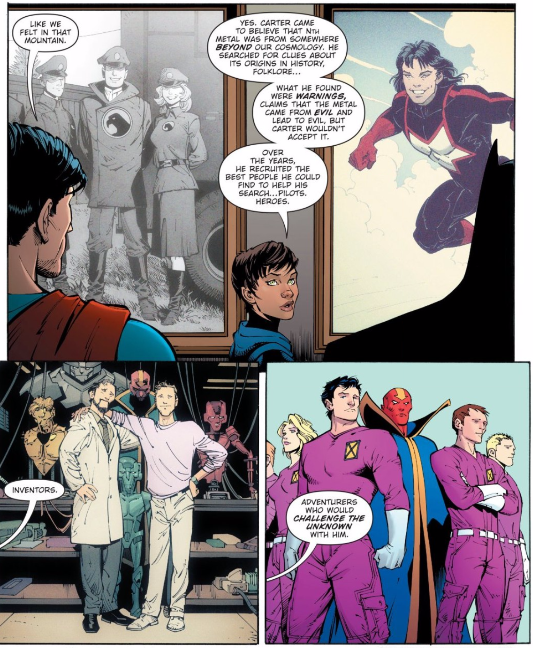
There is, as I mentioned, a GREAT deal going on already in the Metal crossover (like the Joker trying to save the multiverse).  But, here on one page, the writers have put the Blackhawks, the Challengers of the Unknown, the Metal Men (with Will Magnus), Red Tornado (with T.O. Morrow), and, of all people, the Will Payton Starman, under Hawkman's metaphorical wing.  Already all those characters (not among my favorites, as you may know) are suddenly more interesting to me because they are part of a larger story.  

I still recall the amazing period around 2005 when Palmiotti & Gray did wonders with Hawkman and Hawkgirl and their suddenly awesome rogues gallery; but it all fell apart out of their creative hands.  I'm hoping that with "Metal", DC is going to put Hawkman at the center of new dynasty of adventurers.  

Sunday, March 27, 2005

Are You Sleeping, Brother J'onn?

The interesting thing about the Absorbascon's new toy, the Dynastic Centerpiece model, is its potential use to build a mythos around a character without a dynasty. Take, for example, the ultimate also-ran, the Martian Manhunter.

"Poor J'onn", as everyone knows, couldn't maintain a series to save his life...by himself. But if DC really put its mind to it, they could, without even making up new characters, build a Dynasty with J'onn as the Centerpiece that would not only enable him to have his own title but, eventually, would nearly demand it. A quick stroll through the DC Encyclopedia provides the raw material, simply waiting for Geoff Johns to arrange it one day while sitting on the toilet (or the J'onn, if you prefer cheap Golden Age puns).

The Martian Manhunter's role in the DCU is easily unique: he is the Ultimate Outsider (J'onn is unfailingly ALIEN, no matter how long he's been here) as Ultimate Insider (he's a shapechanger, reads minds, can turn invisible, and "JLA" is his middle name). So the dynastic themes are disguise, espionage, invisibility, detective work, infilitation (physical and mental), alienation and belonging. The Martian Manhunter mythos could become the home for a lot of unused or underused outre figures. There are plenty of pre-existing choices:

Dynastic Centerpiece: J'onn J'onnz
Junior Counterpart
: The Elongated Man (as long as we don't have to watch him talk to his dead wife), or Xer0 (a black basketball player who doubled in disguise as a white secret agent)
Female Version: Gypsy, Mirage, or Aruna (shapeshifting Indian girl; she was in "Batgirl", trust me, it's in the Encyclopedia)
Kid Sidekick: Gypsy (hey, if she's not in MM's dynasty, who would be?), Risk, Hero (the gay guy from the Ravers), or even Cassius Payne (Clayface's kid)!
Black Sheep: The Question, The Human Target, Praxis (remember him?)
Civilian Companion: Slam Bradley (the noir detective, like John Jones was)
Elder Statesman: Phantasmo (oh, just look it up), a retconned "The King", Nathaniel Dusk, Hamilton Drew (already associated with Elongated Man), Darwin Jones
Animal Companion: Detective Chimp (although he seems to be spoken for), Sam Simeon (another character who uses his mental powers to go undetected among humans), Rex the Wonder Dog (hey, he's a "property" they need to do something with him!)
Authority Figure: King Farraday, Mr. Bones
Contextualizing City: Midway (with its "neither fish nor fowl" halfway between Gotham and Metropolis image), wacky Delta City (home of Vext), National City (home of Xer0)

Add in the "anti-dynasty" (also easily supplied the Encyclopedia) and the series practically writes itself.

Wednesday, September 12, 2007

Least Likely to Change: Aquaman

I blame many things. I blame Atlantis. I blame King Arthur. I blame the people at DC, all of whom should know better. I blame Aqualad.

But I sure don't blame Aquaman himself.

Oh, how Aquaman has changed. The Golden Age Aquaman was powerful and confident. Golden Age heroes always seemed to have the confidence of experience, right from the get-go. Perhaps that's because, though they were new as heroes, they were still men. Unlike the Earth-8ers, the little twenty-somethings DC keeps giving their titles to, Peter Parker's Revenge Squad against DC. The current Aquaman (whom DC had the nerve to name Arthur Curry, just like the real one) is yet another Young Person Struggling to Find Himself and His Place in a World He Never Made. Golden Age heroes weren't struggling to find themselves; they were struggling to help others. Golden Age heroes didn't live in a world they never made; they made the world, or, at least, re-made it.

Can the current Aquaman punch through a battleship? Does he command the creatures of the sea? Is he as at ease out of the water as he is in it? No, none of the above.

The original Aquaman had only a tangential connection to Atlantis, and owed his abilities to the efforts of his father and his own hard work; to him, Atlantis was "lost", and he made his home in one of their old abandoned temples. Although I'm no fan of the current Aquaman, I'll give his creator much credit for wanting to return those elements to Aquaman. Atlantis, I think, is where everything started to go wrong.

Aquaman "discovered" Atlantis in the Silver Age, and it became both his Krypton and his Metropolis. In short order, Aquaman went from being the King of the Sea, who protected humans from crime and difficult on the ocean, to being King of Atlantis, protecting Atlanteans from humans. It was a fatal error, and one that has slowly poisoned reader's ability to identify with him ever since.

Here's where I share an ugly secret. I have gone on and on the blog about the success and importance of the Dynastic Centerpiece model, woven theories about how it should be applied to characters who don't have it, and criticized writers for not understanding it.

Well, you know what? The Dynastic Centerpiece model killed Aquaman, just as surely as video killed the radio star. His Contextualizing City took over the plots, his Sidekick infected the tone with negativism and powerlessness, and his Female Counterpart (even his infant son!) was arguably portrayed as more powerful than he was. So, long before it had gone so far, that editors and writers decided to scrap the character entirely, he was a pale version of his Golden Age self.

The Bronze and Iron ages weren't any help either. Constant comparison with other heroes on Superfriends damaged his rep, his storyline became a soap opera rather than an adventure, his origin was savagely slaved to magic and porpoises, his involvements in international politics and war became increasingly Namorian rather than Aquamanly, his hand got chewed off, his powers became magical (as did those of his Sidekick), until finally it was such a mess that DC thought it best to let Kurt Busiek try to return Aquaman to some of his original schtick (plus several enormous helpings of Conan's).

For the record, Devon disagrees with me, but only because he's not really counting the current Aquaman as Aquaman, saying that "the real Aquaman will be back", the one who took care of Sub Diego. I'd like to have that kind of faith, but I'll believe it when I see it. DC's blown, even blocked, several opportunities and attempts to bring back the real Aquaman. Oh, he's been sighted (most recently in Alex Ross's Justice), but he until he's the current version of Aquaman and Artie Junior is either his Youthful Counterpart or dead, you won't find me voting for Aquaman as the Least Changed from his Golden Age version...

Monday, September 03, 2007

Least Likely to Change: Flash

On the one the one hand, the Flash has pretty much the same schtick he's always had: he's fast.

On the other hand...

Let's start with one basic fact: the modern Flash is not the same person as the Golden Age Flash. That, in my book, automatically disqualifies a character from being "least changed", as long as people like Bruce Wayne, Clark Kent, and Diana from Paradise Island are still around. The modern Flash is a different person that the Golden Age one. Other than becoming a villain, I'd be hard pressed to think of a bigger change then, well, WHO YOU ARE.

Some will pooh-pooh my position as needlessly conservative. The character is "the hero who's the Fastest Person Alive", they'll say, and whether it's Pietro Maximoff or Johnny Chambers doesn't make a big difference. I understand their position; it's rooted in a view of the heroes as instantiations of mythostructural archetypes. But my reply remains "Piffel!"

Their position is based on the idea that it's the hero identity, not the private one, that matters. That the costume is what matters, not the person in it. Call me old school if you like. But I do not, and have not wavered one iota in my position that Bruce Wayne, Clark Kent, Hal Jordan, et al.-- those are their real identities. Those are actual people (um, I mean, "actual people in the comic books", of course!) who choose to put on costumes to fight crime and protect others.

If I hear one more person regurgitate the post-modern pap that "Bruce Wayne died when his parents were killed" or "Kal-El wishes to blend in with earthlings out of loneliness", I'm going to slap him. Real people have parents, develop crushes, go to school, pay bills, have sex; just like Bruce Wayne, Clark Kent, et al. We don't identify with Batman and Superman; we identify with "normal" people (!) like Bruce Wayne and Clark Kent and then thrill when they don their costumes to become Batman and Superman. Golden Age writers understood that; most modern writers don't.

Batman and Superman didn't decided to become Bruce Wayne and Clark Kent; it's the other way around. They had a choice of what to do with their powers and circumstances, and they made it. Don't deny them that humanity, that nobility. Without it, they aren't heroes, no matter what they can do, just emotionally crippled nutcases. Do that to your Marvel heroes, if you want, but leave your filthy deconstructionist paws off the DC heroes. Don't make Baby Adam West cry.


So...

The Golden Age Flash was Jay Garrick, a happy-go-lucky chemist and college grad, who acquired his powers as a result of an accident when he was performing an experiment.

The Modern Flash is Wally West, the nephew by marriage of Jay's unrelated successor. Wally isn't a college grad. Last I heard, he was a mechanic, although for most of his career (including right now), his money just seems to come from nowhere, or maybe the Speed Force. Like it forms into his costume, maybe the Speed Force magically fills up Wally's bank account, as if it were Zephraim Cochran's Companion. Wally, at least as he's been written outside the JLU, is anything but "happy-go-lucky".

The Golden Age Flash wore a jogging outfit and a shiny Mercury hat; he did everything with a smile. The Modern Flash wears skin-tight Speed Force (tm) brand spandex that covers his head and his hands, and a cowl with wings over the ears; he does nothing with a smile.

The Golden Age Flash, still pretty much unchanged and in great shape, continues to fight crime as a member of the Justice Society, having new adventures, still smiling and serving as an example to the younger generation of heroes. In fact, he served as a mentor to Kid Flash, when the Modern Age Flash, rather than mentor the kid, shipped him off to be raised by an elderly dynastic relative. I mean, the second time the Modern Age Flash, rather than mentor the kid, shipped him off to be raised by an elderly dynastic relative.

The Modern Flash, who's famous for stories that get nowhere fast or that run in circles, was so tapped out as a character that they killed him off and brought him back, and almost nobody noticed. Now, desperate for something to do with the guy, they've made him the head of a thinly disguised Incredibles knock-off, so that if we're not interested in him, maybe we'll at least be interested in his kids.

And, like most parents, he doesn't smile a lot.

The Golden Age Flash's powers came from science. Yes, really really bad, absurdly inaccurate science. But science nonetheless.

The Modern Flash's powers come from a New Age mystical source, called ...
  • the Green?
  • The Lady of the Lake?
  • The Morphogenic Field?
  • The Red?
  • The Ether?
  • The Hoary Hosts of Hoggoth?
  • The Clear?
Gosh, why can't I remember it, it's something really clever like, oh, yeah:

"the Speed Force".

Call me old-fashioned, but I'll take Bad Science over Bad Mysticism any day.

In short, the only thing about the Flash that's remained the same since the Golden Age is the name of the hero and the fact that he runs fast. I guess for some people, that's enough; I'm just not one of them.


How much do YOU think the Flash has changed?

Monday, February 04, 2008

Green Arrow Minus Green Arrow Equals Nothing


Let's talk about this, shall we?

We all know I'm not the biggest Green Arrow fan in the world. In fact, I'm sitting in my study with my dog, and it's still fair to say that I'm not the biggest Green Arrow fan in this room.

But I do enjoy Black Canary/Green Arrow, and how the book has help humanize and redeem him for me. I have always been kind of peeved how his absentee fathering of Connor Hawke has been sloughed over or whitewashed. This most recent issue tackled it head on, and showed that, no matter what anyone else thinks about it, including Connor, Ollie feels guilty about it, and deservedly so. That's once of the most decent, human things done with Green Arrow for some time.

That said, I am cheesed by the hacky plot non-resolution of Connor's shooting. He's not dead. But neither is he alive.

Boo! Hiss! Get off the fence! The only thing in the middle of the road is roadkill!

Honestly, I have no strong feelings about Connor himself. If someone had ever had the guts to make him gay (or stopped a certain someone from preventing him from being gay), I might care more. But they didn't.

Sure, I like him more than I like Ollie, but what human being wouldn't? Connor was calm, loving, fun, competent, etc. But for the most part, I just think of him as another failed "Earth-8" style replacement for a Silver/Bronze Age icon.

He is, however, a GREAT Heroclix figure.

Sadly, I feel that Connor has been offed, at least partly on account of the cruelties of the Dynastic Centerpiece Model (which longtime readers will recognize as one of my pet concepts). DC has been (re-)building a dynasty around Black Canary (Female Counterpart) and Green Arrow (Centerpiece). Red Arrow (Junior Counterpart), Speedy II (Youth Sidekick), Black Lightning (Ethnic Counterpart); they all had a place... .

But Connor didn't. Red Arrow fills the Junior Counterpart slot, and with some 60 years of seniority, isn't easily dislodged from it. Connor literally had no role to fill in the Green Arrow dynasty, once his original role (as replacement Centerpiece) was taken from him.

Personally, I think that's a mistake. One of the slots in the Dynastic Centerpiece Model is the "Black Sheep". I think that's where Connor should have fit in. Not because he's the "naughty" version of Green Arrow. Quite the opposite; Ollie's the jerk, so Connor made a perfect "white sheep", so to speak. In the same way Wonder Woman has a Male Counterpart (Hercules, by they way) in her dynasty rather than the regular Female Counterpart, in the Green Arrow dynasty, Bad Boy Ollie Queen would have a "White Sheep" in his family: Connor Hawke.

Usually he was written that way, too. Why wasn't that enough to warrant keeping him? I guess Judd doesn't read my blog (*Silver Age sob*!).

But setting all that aside: killing him is one thing. Bringing him back from death's door (which has been done several times already) is another. Repairing his body but leaving him brain dead as a result of some absurd "poisoned bullet" macguffin, however, is nothing. Unless Winick goes somewhere fantastic with this (like he did with Ollie getting stabbed in the throat by his bride on his wedding night), it seems like a grand cop-out. Show of hands if you're confident Judd's going to go somewhere fantastic with this...!

Let's see, as I recall the recent storylines for Black Canary and Green Arrow, they've been:

  • "Humanize the Series Principal #1 by showing his reaction to losing someone close" story, when Dr. Light & Co. blew up Ollie's house and everyone in it;
  • "Humanize the Series Principal #2 by showing her reaction to losing someone close" story, when she thought that the girl, Sin, was dead.
  • "Humanize the Series Principal #2 by showing her reaction to losing someone close again", when she seemed to have killed her husband, Ollie.

Was it necessary, wise, or imaginative to follow those immediately with a "Humanize the Series Principal #1 by showing his reaction to losing someone close" story, where Green Arrow loses Connor?

Does Judd really only have one story to tell us? If that's the case... well, I enjoyed it the first three times. Now, it's time for someone else to write a different story... .

Monday, December 25, 2006

Comments for Christmas

There are many things I want for Christmas. An announcement about Vibe: Sword of Detroit. A Chuma the Afrobot action figure. A crushed velvet cape.

But there's something I want that only you can give me. It's the same thing every blogger wants: comments.

If you've ever written a blog or anything like it, you know how much of yourself you put into it. Nothing is more depressing to a blogger than birthing a post that then receives no comments. Is it any wonder that so many bloggers throw in the towel when they get the sense of performing to an empty house?

A lot of people don't comment on past posts because they think the time to do so has passed. Not so at the Absorbascon, where the posts are truely timeless. I get notified of every comment made, regardless of whether the post is recent or not.

Below is list of posts I made that I poured my heart into (or, at least, took the time to type) that never got any comments. Boo hoo!

You can fix that by giving me... Comments for Christmas! Nice ones, if it's all possible. And this is the chance for all you hundreds of lurkers out there to reveal yourself and give me a shout!

Monday, March 27, 2006

Patterns of Villainy

Exactly one year ago, I first posted my thoughts about the Dynastic Centerpiece Model, the set of archtypes clustered around a central hero that are so common in DC comics (the "Batman family" for example).

One idea that I threw out at the time but never followed up on was that villains in certain archtypes also attach themselves to the "Dynastic Centerpiece", that is, the hero. I meant to get it, but then I discovered Vibe, and noticed something odd about Hal Jordan's head, and then the haiku thing started and ... well, time flies when you're having fun.

Perhaps now that I actually have a reader or two on occasion, I can get some help thinking about the Antagonistic Archtypes of DC (and, I'm sure, other comics and literature).

Off the top of my head, these are some of the likely categories, followed by some quickie examples...

The Mocker: The Joker, the Trickster, the Prankster
The Heroworshipper: Hugo Strange, Cicada, the Silver Swan, Black Manta
The Untouchable Crime Lord: The Penguin, Lex Luthor, Veronica Cale
The Former Ally: Sinestro, Two-Face, Silver Age Lex Luthor, the new Red Hood
The Dark Reflection: Killer Moth, Zod, Devastation, Rival, Inertia, Prof. Zoom,
The Femme Fatale: Catwoman, Encantadora, Star Sapphire, the Cheetah
The Mental Opponent: The Riddler, Mxyzptlk, Ares, Hector Hammond
The Physical Opponent: Mongul, Blockbuster, Giganta, the Shark


Am I off base? What other villainous archtypes do DC heroes tend to have in their "anti-dynasties"? Remember, I'm not looking for merely a shtick; lots of heroes have villains with freezing powers, but that's not an archtype. We're looking for some that defines a storytelling role or a relationship with the hero.

Saturday, August 27, 2005

A Heap of Mallow and Company

In honor of the glorious and generous Marionette, who has helped complete my life by presenting a biography of Marsha Mallow, I reprise my blog entry of April 19 on Fat Funny Friends..

High-Carb Companions
, or, Where did all the fat people go?

One of our favorite toys here at the Absorbascon is the "Dynastic Centerpiece" model, that is, the idea that DC's iconic characters become iconic partly because a 'dynasty' of other characters with prescribed roles (e.g., "Kid Sidekick") are built around them. One option in the model used to be The Fat Friend.

Perhaps it would be more accurate to say "Funny Fat Friend", for these figures were almost always
played for laughs. Batman had Alfred (yes, he was originally quite the tubbo and was strictly comic relief), Jonny Quick had Tubby Watts, Plastic Man had Woozy Winks, the Legion had Bouncing Boy, Green Lantern Alan Scott had Doiby Dickles, Wonder Woman had the (relentlessly fabulous and unrepentently fat) Etta Candy. Even Lois Lane had a Funny Fat Friend, her roommate Marsha Mallow (who you'd think had to have been Silver Age, but, no, we're talking 1970s, folks!).

Where did they go? Alfred went to a fat farm (no, really ... he did), Tubby disappeared, Woozy has been covered up by DC in a desperate attempt at superheroic legitimacy for Plas, Bouncing Boy has yet to be seen in this week's Legion reboot, Doiby Dickles is living on a distant planet (it was a Young Justice story; anything could happen), and Etta, the worse victim of the anti-fat conspiracy, went on a diet, got married, AND disappeared (only to return last month in a WW cameo). Marsha Mallow? Not sure; I think, using the fortune she made on Ebay
by selling her name to the highest-bidding drag queen, she hired a gigolo who digs Big Beautiful Women and moved to Santa Prisca to avoid taxes. I'm sure I saw her as a background figure in a "Question" story once....

Now, maybe the reason for their disappearance is simple. Maybe DC got rid of them because comic relief characters went out of style, or
because having Funny Fat Friends was too much like making fun of fat people, which isn't cool. That's all understandable.

But Funny Fat Friends served their purpose in the Dynastic Centerpiece model and I think we've lost something of value with its absence.
Funny Fat Friends were pretty darned intrepid. Spunk is not reserved to those with Olympic-level musculatures, and the F3s made that clear. Woozy Winks, in his passive way, was almost as powerful as Plastic Man. Doiby Dickles was a serious scrapper, and Etta ... ! Woe betide any fool goosestepper who tried to take on Ms. Candy. Just for giggles, she'd beat the snot out of you, paddle you in front of her girlfriends, and make you sing "I'm Forever Blowing Bubbles", all while eating a box of chocolates. Woo-woo, indeed.

Funny Fat Friends (F3s) didn't suffer from "negative self-images." They respected the heroes without being slavishly in awe of them. They didn't question their own ability to contribute to any venture, despite being paired with people who could use their magic rings to overturn battleships. On the whole, they enjoyed their adventures, a luxury our stone-faced hero sometimes didn't have. Okay, so they weren't very funny by our standards. But they were fun!


Funny Fat Friends weren't funny on account of being fat but despite it.. Oh, sure, they would occasionally use their heft to their amusing advantage in a tussle, but no one thought lesser of them for it. In fact, they showed that Fat (and otherwise imperfect) people could still be quite cool. Hey... they hung out with the world's greatest heroes; how much cooler than that do you get? Etta Candy is 900 times cooler than Snapper Carr (heck, Marsha Mallow was cooler than Snapper Carr).

Even more realistically, they showed that imperfect people existed. When's the last time you saw someone in comics without a washboard stomach? When's the last time you met someone with one? In the real world, people built like Killer Moth and Dr. Light wouldn't be supervillains, they'd be supermodels.

With the loss of the F3s, we lost from our stories their message:
You don't have to be super or perfect to be confident, make a contribution, and have fun.

Saturday, May 14, 2005

Death by Redundancy

According to Devon (who erreth not) at Seven Hells, Arsenal appears to be a traitor. Not a hoax! Not a dream! Not an imaginary story!

He abadons the poor reservationers who raised him as their own to run off with a rich dilettante. He becomes a heroin addict. He knocks up a foreign assassin. He works for a shadowy spy agency. Roy ain't exactly snow white, so the idea that his betrayal might be real is believable.

He's got another thing going against him: the Dynastic Centerpiece model. Long-time readers of the Absorbascon will recognize the Dynastic Centerpiece model, whereby DC takes a central hero and builds around him or her a "dynasty" of related characters in archtypal roles (e.g., "Kid Sidekick"), vasting increasing the hero's iconic value.

Since his resurrection, Green Arrow has been the focus of much dynasty-building. But with girl-Speedy as his Kid Sidekick and Connor Hawke as his Junior Counterpart, a squeezed-out Arsenal doesn't really have a role to play. Either his new role in Arrow Dynasty is as Black Sheep or, more disturbingly, he's being Todd-ified into The Former Sidekick Gone Bad.

And the writer of Green Arrow and of the Outsiders is ALSO the writer who's recreated Jason Todd as The Former Sidekick Gone Bad. Would you be surprised if Judd Winick is copying himself and doing the same thing with Roy Harper?

Monday, May 09, 2005

The Animal Dynasty!


Speaking of formally lame characaters later revamped to greatness...

Let's revisit the Dynastic Centerpiece Model, this time in the company of... Animal Man!

Since Grant Morrison's fame-making revamp, poor Buddy Baker's been confined to walk-ons and cameos in other people's books (although, as the picture above from Hawkman shows, he's still got oomph enough to pronounce his name as logo; logo-mojo is strong DCU juju).

How would Buddy play out as the centerpiece of a heroic dynasty? Pretty darned well, actually!

Dynastic Centerpiece: Bernhard "Buddy" Baker. He never came back from dead, but he did grow his own arm back, which shows considerable sticking power. Actually, wait, he did come back from the dead, after his spirit stopped bouncing around various animals, but no one was reading his comic by then, so I think it doesn't count.
Female Counterpart: Mari McCabe (Vixen), of course. Duh. Like Buddy she can channel the powers of animals, but she relies on a magic totem to do so and doesn't seem as adaptive or creative in the use of her powers.
Junior Counterpart: None other than Gar Logan (Beast Boy). Able to turn into any animal he wants, he's a perfect junior counterpart because his powers are similar but different in how they manifest themselves.
Kid Sidekick: Hm, Beast Boy might have to do double duty. But there's a Charlton character DC might press into service: Nature Boy. They'd have to tone down his powers pretty dramatically so he wouldn't overshadow his mentor. Or simply make him unconfident and incompetent (we call this "Garthification" after a forgotten member of Aquaman's supporting cast, a.k.a. "Swimmy Olsen"). WAIT! Much better choice: Bomba The Jungle Boy, which DC is already culpable for, I mean, created themselves. Oh, yes, "Buddy & Bomba" is even more euphonious than "Batman & Robin"!
Elder Statesman: Jane Goodall? No, I know: Congo Bill (Congorilla)! This wacky "predecessor" to the Man With Animal Powers needs a place in the DCU again.
Black Sheep: B'wana, oops, I mean, Freedom Beast. Morrison already put this in place tidily.
Authority Figure: Clyde Beatty? No, he's dead. How about the mayor of (what remains of) San Diego? YES, it seems DC is ignoring that fact that Animal Man was living in San Diego when half it fell into the ocean to become Sub Diego. Geoff Johns, please fix this during the next commercial break, will ya?
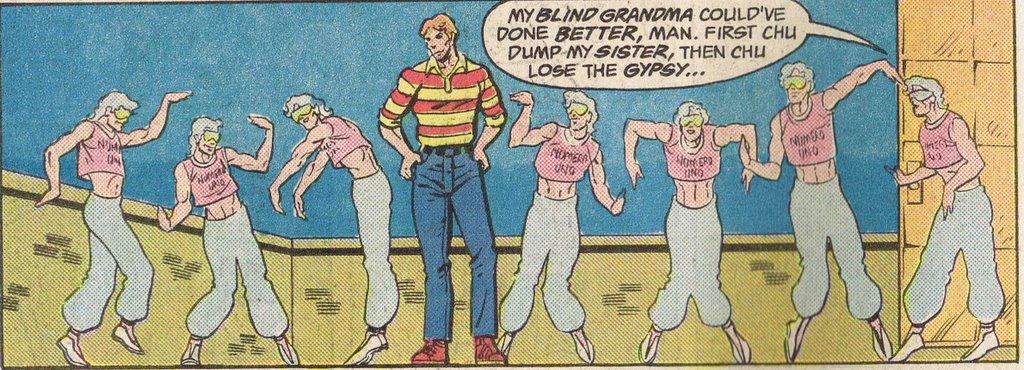
Contextualizing City: Well, it was San Diego because of the zoo, but that's gone now. They say he's living in Montana (which would explain why no one ever sees him). Would you buy... Nashville? Don't laugh; it's got what's becoming the largest zoo in the country.
Civilian Companion: Roger Denning. You know. The guy with the receding hair line who pushed him to do the superhero thing.
Animal Companion. Oh, dear! I don't think that would work, would it?
Denominative Epithet: The Man With Animal Powers is accurate but not very colorful. Any ideas? The Menagerie Man? The Human Zoo? The Ark of Justice? The Red Knight? The Zoonic Avenger?
Signature Exclamation: Leaping Lizards! Taken? Really? Then let's vote on "Noah's Boat!" versus "St. Francis!"

Thursday, April 21, 2005

The Atomic Dynasty!

It’s time to give the Dynastic Centerpiece treatment, in which we surround DC heroes with a ‘dynasty’ of characters to improve their iconic status, to the Atom, who, as you may have heard, has had a spot of trouble lately.

To those of us born in the previous century, the themes around the concept of the Atom are pretty clear: Science. Tinyness (and its opposite). Blowing Stuff Up.

Dynastic Centerpiece: Ray Palmer, atomic physicist. Duh.

Junior Counterpart: Al Rothstein (Atom-Smasher). Change his name to Leviathan or it will sound very weird. Al certainly could use some mentoring, wouldn’t you say? Beside, Ray lived in his ear for a while, so they know each other.

Sidekick: Grant Emerson (Damage). As the son of the original Atom, he’s a must. DC’s not doing anything with him and a kid with that kind of power needs an adult superhero around.

Elder Statesman: Because the original Atom’s not around, we’ll fill in with Daniel Dunbar (Dyna-Mite). Last seen hanging with Old Justice, he’s got a power-punch (like the original Atom), he’s a science-hero (like the current Atom), and he blows stuff up (like Damage). Besides, DC needs to make amends for replacing his brain with Hitler’s in the “Golden Age” Elseworlds. Emily Post frowns on replacing people’s brains with Hitler’s.

Black Sheep: Josh Xan (Mongrel). Angry guy with an angry name. At large since the Bloodlines crossover debacle, he’s worked repeatedly with Hawkman (like the Atom), zaps stuff with his hands (like the power-punchy guys, only it’s “darkforce” from “negative mental thoughts” because he’s ANGRY), and used to work for a shadowy government agency, which is always a useful plot device. He brings both sex appeal AND comic relief because he wears every single signal of rebelhood in the DCU (ponytail, earring, torn jeans, black tee, motorcycle gloves, Lobo-like belt buckle, and ratty trenchcoat). And did I mention that he’s angry?

Female Counterpart. The mysterious Doll Girl (sadly, Elasti-Girl is spoken for). Unlike the rest of this gang, she’d actually have a workable secret identity, so they could do some stealth work.

Civilian Companions. Several natural choices. Colleague Prof. Alpheus Hyatt (the Time Pool Guy). Paul Hoben, Jean’s former partner, who, in a pinch, knows how to use the size-belt. Norm Brawler, the Atom’s biographer. Supergoober and technogeek Snapper Carr, who could rent a room in Ray’s house.

Romantic Interest: No, not Eclipso. Enrichetta Negrini, Ray’s former lab assistant from Italy. She should be a fellow instructor by now.

Contexualizing City: Academic Ivy Town and its metropolis, toney Calvin City.

Authority Figure: Chief Baxter is the historical choice, but a science-type is needed, too. Maybe Kitty Faulkner at STARLabs?

Funny Fat Friends: Nobel-prize winning physicist and Kid Flash’s grandfather, Ira West. He’s not really fat, but he’s absent-minded and that’s funnier.

Animal Companion: A trained bee? Just kidding. Besides, any animal companion would eventually eat Doll Girl. It would, however, amuse me if Ray had an ant farm.

Obligatory Guest Stars:

The Human Bomb, still alive and ticking since 1942. Picture him and Damage stumbling around while Atom and Doll Girl are trying to do espionage; priceless.
Elasti-Girl. Admit it. Like me, you desperately want to see Al Rothstein get pimp-slapped by a 50-foot B-movie actress wearing kicky purple go-go boots and gloves.
Mr. Terrific. He have Ray have already worked together, and Ray doesn't make him play nurse like Dr. Mid-Nite does.
Hawkman. Ray's best friend. He's also a bodybuilder in a mask and a leather harness. Visit any time, Carter.
Aquaman. If somebody filed a patent on your DNA and Ray Palmer were your friend, don’t you think you’d call him?
Green Arrow. Who do you think helps him build those stupid trick arrows?
Elongated Man. Hmmm…on second thought, that would be rather awkward.

The Atomic Dynasty! Now's there's a group whose adventures I'd tune in for. It's the most fun you can have, without an ant-hill sized kingdom of yellow-skinned warrior folk!