Why are there so many gorillas in comics books?There're probably no more than, say, 130,000 gorillas worldwide. In the U.S., there's only about 350. By comparison, there are over 51,000 dachshunds in the U.S. Gorillas are in the comics all the time; but how many times do you see a dachshund? Almost never, even though any fool knows
dachshunds are more dangerous than gorillas.
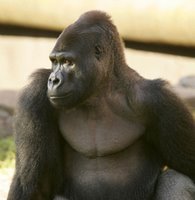
This is kind of info I have to keep from my dog, because, while a ticked gorilla is still throwing leaves around and having an ostentatious hissy fit, the wily dachshund will have already tripped you, crushed your trachea, and, as you suffocate, be sitting on your chest chewing on your ribs while farting in your face. And wagging his tail.
That first face? A gentle giant of a vegetarian, our simple minded cousin who wants only to live in peace and indolence with Jane Goodall and her Everything Bag by his side.
The second? Pure Evil with a Kung Fu Mouthgrip. There was no serpent in the Garden of Eden, folks; they just couldn't see the dachshund's legs. Forget that movie everyone's hyped about; when they come out with the sequel, "
Dachshunds on a Plane",
then I will be scared.
Yet gorillas, not dachshunds (or any other dog, for that matter), are the big threats in so many stories. Scores of gorillas, many of them bent on world domination. How many gorillas do you know in real life interested in world domination? Zero. Again, gorillas pale as a threat when compared to dachshunds,
all of which are bent on world domination. Charles Heston would've lasted about 3 seconds on the Planet of the Dachshunds, people.
Yet in the comics, no animal guest star comes even close to the gorilla. Even perennial favorites like horsies, birds, and sharks. Gorillas have them all beat, and can turn up anywhere, except, you know, in an Aquaman story.
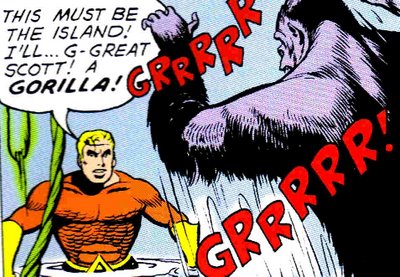
I think only
dinosaurs come close to the gorilla in their comic book Q Rating. And dinosaurs aren't a threat to anybody. Not like dachshunds, which are a threat to
everybody.
 Smart money's on Schatzie, folks. I know what really killed the dinosaurs.
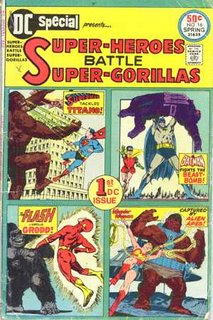 hy are gorillas everywhere in the comic books? Okay, I will tell you.
First, though, I need to qualify; when I say
"everywhere in the comic books", I mean,
"everywhere in DC comics" (and most of the older comics put out by other companies that DC later bought out or sued into submission for violating their copyright on the word "gorilla"). Marvel doesn't have gorillas; Marvel has zombies instead.
As our simian cousins,
gorillas symbolize for us our baser, animal selves, our impulses toward violence and aggression. Everytime a hero faces a gunwielding thug, a pavement-cracking monster, a domineering supervillain, he's facing a manifestation of
the antisocial human urge, the impetus toward violence for personal advancement at the expense of others. In short, as a rule, the antagonist in a most comic book stories is "the Evil Ape Within Us All". The hero represents our "better and wiser" selves, struggling to conquer the part of us that would shortsightedly harm society for personal gain.
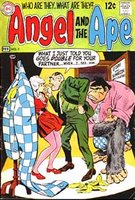
Thus, the comic book battle between Good and Evil is a symbolization of the inner struggle between the Angel and the Ape in our souls. Small wonder, then, that one of the most common tropes in comics is an initial meeting between two heroes where a misunderstanding leads them to fight, usually ending when both parties think better of it, check their natural aggression, and work out their situation intellectually, through talking together.
Similarly, it is understandably axiomatic that heroes (who represent the cooperative spirit of society) work well together and villains (who embody selfish individualism) do not. The inversion of this pattern, therefore, often packs a punch in comic book lore. Conflict and crosspurposes among the member of a hero team or cooperation by the members of a Rogue's Gallery stab at our innate fears that the society that sustains us is potential unstable. DC's made good currency of this lately with the Secret Society of Supervillains versus the dissolution of the JLA. In Alex Ross's
Justice, the Legion of Doom takes the threat one step further by not only banding together, but pretending to adopt humanity's best interests as its own.
Meanwhile, back in the jungle... . When a hero confronts a gorilla as his antagonist, he's facing the purest symbol of amoral, antisocial, animalistic selfishness. 
Mind you, I'm not saying that's
really what gorillas are like; as previously mentioned, gorillas aren't really
nasty at all (not like
the you-know-what, which I can't type now because the dog just walked in the room and, trust me, it knows when it's being dissed and I have no intention of ticking off something that
lives in my house and can eat bones). That's just what gorillas symbolize in our culture.
So when a comic book gorilla evinces intelligence, talks, plans, and uses higher abilities to plot its antisocial agenda, it becomes the personification of our fear that the Forces of Evil will finally get their act together, curbing their own animal natures just enough to advance their own agenda and become serious threats to our society.
This is why writing Gorilla Grodd as a rabid savage is stupid and boring. 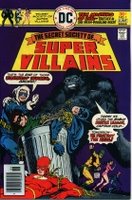
This is why it is very cool, on the other hand, that the well-written Gorilla Grodd ran the original Secret Society of Supervillains in the 1970s comic, on the JLU animated series, and (I'm betting) the new Society now that Alexander Luthor isn't in charge.
Anyway,
that is why there are so many gorillas in comic books.Or maybe they're just cool and pump up sales; who can say?


