Friday, April 13, 2012

Wolf Week #0

As long-time readers will know, one of our (least) favorite characters here at the Absorbascon is the Stupid Bronze Age Batman.

"If only I knew some form of... self-defense! Like any 23 year old female New Yorker would!"


The Golden Age Batman was a spooky, ingenius, smack-talking detective who pretty much invented Being Cool. The Silver Age Batman was absurdly unflappable, dealing coolly and casually with bizarre creatures from outer space and other dimensions, and was secure enough to put a cape on his dog. The later Iron Age Batman was five kinds of dark crazy-scary and slowly morphed himself into the omnicompetent Platinum Age Batman who needed nothing more than "time to prepare."

Like Clouseau, Stupid Bronze Age Batman is a master of easily penetrated disguise.


But in the middle of all that, from about 1970 to 1986, was the caustic, bumbling, overconfident and undercompetent Bronze Age Batman. Who, for some reason, no one seems to notice is an idiot. Really, the Stupid Bronze Age Batman is like Inspector Clouseau, blithely acquiring fame as a brilliant crimefighter with each stumbling misstep he makes, his idiocy hidden in plain sight.

"No nothin' "? Did Batman just say "no nothin' "?
Only in the '70s, folks; be glad you missed them.


How did he get away with this? Well, I credit the
Minor League Batman Theory. As much as I like Major League Baseball, I enjoy watching minor league baseball much more. Why? Because, thanks to the imperfections of the players, minor league baseball is MUCH more interesting; you never know quite what's going to happen.

Stupid Bronze Age Batman can't even get to first base without help.

Similarly, a flawless Batman doesn't allow for lots of suspense in a story. We certainly want Batman to be really cool and capable, yes; but if he's
too perfect, we don't identify with him, we don't fear for his safety, we don't thrill to his adventures. Perhaps the Stupid Bronze Age Batman's human imperfection was his literary strength. Think how much acclaim and popularity Scott Snyder's recent work on the character has won, in part by showing us a Batman who is overconfident, vulnerable, and possibly outmatched!

Well, we're certainly going to see a Batman who is overconfident, vulnerable, and possibly outmatched this week here at the Absorbascon, as we sit down to read the 1974 Len Wein story enitled...


...which first appeared in Baman #255 and surely won't appear anywhere else again, so enjoy it
here while you can.

Tuesday, April 10, 2012

Haikuesday with the Joker


Suddenly it's 1973 and you find yourself in the middle of one of comics' all-time classics, Batman #251.

There you are at the abandoned aquarium at the beach. You've dumped Batman and an old guy is a wheelchair into a shark tank, but in under two minutes Batman's escaped from his manacles, killed the shark, and rescued the wheeler. Batman is now wet, unhappy, and running after you.

Naturally, you should be crapping your pants and gibbering. There's no way you'd be smack-talking and telling Batman you're about to escape so you can punk him again some other day.

But you're not the Joker. Who not only does that but does it...

with haiku.


You'll get no battle
from me! I may be insane...
but I'm not crazy.

So I'll run away--
and live to put egg on your
face another day!


Not just any haiku, but a double haiku so face-flamingly fabulous that it became one of the Joker's most famous quotes of all time. How many times have you read that without even realizing it
was haiku? That's how good the Joker is.

What haiku can you compose in homage to the Joker's ice-cold genius?

Saturday, April 07, 2012

Fictionopolis Skylines #3

Here is the final poster in the series, "Fictionopolis Skylines #3", which includes Wonder Woman's Washington DC and Aquaman's Amnesty Bay.

I had to think a while before figuring out how to represent the invisible plane and aquatelepathy. The Bat-Signal is a lot easier, conceptually.

So now the entire series, once printed out and hung on my wall should look something like this (depending on how I arrange them; what do you think?):


Friday, April 06, 2012

Fictionopolis Skylines #2

The second in a series. This is, as I hope you will recognize, Metropolis and Central City.


If anyone thinks, by the way, that I am exaggerating the Central City skyline: you're wrong. That skyline is directly copied from a Carmine Infantino-drawn Flash story.

You'll notice that I am using similar styles, colors, and effects across the series to help them tie in together. I think this will improved the effect when the entire triptych is hung.

Thursday, April 05, 2012

Fictionopolis Skylines #1

You may remember that a while a go, I made some "travel posters" for famous DC cities. I enjoyed those, but lately I've wanted to revisit the idea, amp it up a bit, and use it as the basis for some art for my home. I have some BIG EMPTY walls crying out for some oomphy art.

This is the first in that series: "DC Fictionopolis Skylines #1".


It's not two sideways posters; it's one 2'x3' poster with two panels. The resolution here on the blog may not be ideal, but they are designed at print size, so I know that the images will be crisp when I have them actually made.

As I'm hoping I don't need to tell you, it depicts Gotham City and Coast City. There will be two more in the series. I'm either going to print them as posters at PosterBrain or just go straight to print-on-canvas.

Monday, April 02, 2012

Flash is the only DC Superhero


The Flash is DC’s only superhero.

Okay, perhaps that’s a bit of an overstatement. There are scores of lesser DC superheroes, of course. But he is the only iconic superhero, the only superhero at his level (except, you know… VIBE, who is beyond rules and categorization and levels and possibly space-time).

Batman is a detective in a detective genre. It’s not the most startling observation, is it? After all… Detective #27 (and all subsequent issues), you know. Yes, he’s fought the Rainbow Beast, and saved the world from the vampirous Mad Monk, and traveled through time. But those aren’t at the center of the character; he won’t be doing any of those in a Batman movie. Look, Sherlock Holmes fights snakes but that doesn’t make him a herpetologist (although the idea of shrieking queen Jeff Corwin playing a nervous-nellie Sherlock Holmes with the imperturbably handsome Josh Bernstein as his steadfast Watson amuses me terribly). Batman fights muggers and gangsters and crooks who are trying to avoid him. He does film noir voice-overs of his own internal monologue while his adventures are happening. And, as much as I adore them all, Batman’s foes are villains, rather than “super-villains”. To the degree to which they have special “powers” (such as Poison Ivy, Mr Freeze, Killer Croc, and certainly Clayface) they distance themselves from the heart of Batman’s rogues gallery.

Superman is a science fiction character. Is there any doubt or debate about this? He’s an extraterrestrial rocketed to Earth, most of his non-sucky villains are either space aliens or mad scientists, and he’s got a miniature city in a bottle. Multi-colored kryptonite, giant gorillas, extra-dimensional pests, time-travel, exploding planets, the Legion of Frickin’ Super-Heroes; really, what more proof do you need?

Wonder Woman is a fantasy character. By that I do not mean that she is the subject of gyno-amorous readers’ fantasies. I mean, just because she’s dressed like a majorette and wears fetters of submission and ties people up with rope and comes from an all-female society and was created by a well-known professional pervert doesn’t mean she’s a sexual fantasy, for Hades’ sake! But she’s definitely a fantasy character, occupying a fantasy world. She’s a scantily clad warrior-woman who comes from the Amazons of Greek myth. She has a magic lasso. From her very beginning, she was fighting Greek godlings, Queen Atomia of a subatomic world, and dwarf who conjured up slave-phantasms out of ectoplasm. And now that she’s a demi-god, she’s even more squarely in the otherworldly realm of fantasy.

Green Lantern is a space opera character. Oh, sure, he’s got some supervillains who’ve been thrown at him over the years but, really… Sonar and Goldface? Tee-hee! When your best earthbound villains are a shark and a quadriplegic you’re not a superhero, you’re either Roy Schneider or Peter Higgs. Face it, without the space opera, Hal’s mostly distinguished by his Ability to Withstand Great Blows to the Head. Even before Hal really started hanging out with “the Corps”, the space opera was built in the character at creation, as he got his ring for a dying alien corpsmember. Ever since Hal started meeting other (non-dying) Green Lanterns, his story has been all about underage space hotties, and incompetent immortal guardians, and unpronounceable planets populated by improbably-shaped beings whose entire societies exist only so that we can say, “hey, that’s Kay-Fangz, the Green Lantern who looks like a staple remover”. There are rival conceptual factions in the “spectrum corps”, far-flung protectorate covering multiple star-systems, and soap operatic relationship among the members of the GL Corps.

Aquaman, as I have previously elaborated on, is a Western character in a frontier setting, and apparently Geoff Johns agrees.

Martian Manhunter—well, H’ronmeer alone knows what Martian Manhunter is. He’s a detective, he’s a space alien, he’s a superhero, he’s a geisha, he’s a man, he’s a little girl. But whatever he is, DC has apparently decided he’s no longer iconic. Not only have they not included him in the newly rebooted Justice League, they’ve retroactivity removed him from it (adding insult to injury). At least when that was done to Wonder Woman it was “for her own good”; it was to preserve the idea that she had just arrived in “Patriarch’s World”. But in J’onn’s case it was simply so they could lock him away like a crazy aunt in their attic (i.e., Stormwatch). Regardless how many genres J’onn has accrued to himself, hoarding them like he does bizarre superpowers, it doesn’t matter: DC has, in effect stripped J’onn of whatever pretensions to iconic status he ever had, wasting the years of decades of interest the character acquired from his post-Crisis role in the Justice League in various media versions.

But Flash?

The Flash is an actual superhero. An otherwise regular guy who gains superpowers and fight crime with them. He fights villains who are mostly normal people with superpowers or the technological equivalent thereof. It’s cops and robbers but on the superheroic level. Francis Manapul is working Barry’s status as DC’s only iconic superhero for all its worth, building up the identity of his contextualizing city, fleshing out his supporting cast, refreshing and expanding his rogues gallery. Sure, he has lots of sci-fi elements, but they aren’t the core of his world; they are just the added elements that take him and his world from the mundane to the “super”. Manapul is helping keep the bizarre sci-fi in Flash grounded by linking it with real-world consequences (like Barry’s overuse of the speed force, and the actual ramifications of an enormous EMP pulse in an American metropolis).

Flash-fans, be proud; YOU are the only real DC superhero fans.

Thursday, March 29, 2012

STAY AWAY!

This isn't really the point of my post, but, as follow-up to my previous post on Batman-as-theater-actor, I share these two panels from the new Batman #1:


In which Dick asks Bruce for a review of his acting, and refers to Alfred's acting lessons.

But the real reason for my post is the following panel from the most recent issue of Justice League. It just hit me that I have never agreed with any single panel more.....

Present Day Baltimore: STAY AWAY!!!

Monday, March 26, 2012

Bat-theater and Super-Circus


Comparisons of Batman and Superman are a staple of “comic book literary analysis”. While only the comicscenti can consider, say, the measureless variety of the glory of VIBE, almost anyone who lives within a 100 miles of toilet paper can talk about some of the differences between Batman and Superman.

And about 50 percent of them DO. If I had dollar for every time I’ve read a newspaper article explain that Batman is the archetype for all non-“powered” heroes and Superman the archetype for all “powered” heroes, and every time someone has shared with me the “Gotham=NYC by day/Metropolis=NYC by night” observation, I’d be using the interest my fortune generated to run a personal MegaMillions lottery, every week.

Still, just as “every issue is someone’s first”, every person must discover the Batman/Superman dichotomy for himself, and so it’s an issue that always bears re-examination. My observation today certainly stems from all the regular contrasts between the two World’s Finest, but it’s still one I’ve never heard anyone make in quite this form:

Batman is the theater;

Superman is the circus.

Batman’s professional theatricality is well-known. His origin included pondering what costume he should wear for a frightening appearance. His “disappearing act”, that he uses on even his closest allies. The needlessly dramatic Bat-Signal. As Ra’s Al-Ghul says in the current Batman film trilogy, “I see you took my advice about theatricality a bit... literally!" Batman is a stage performer, waiting in the wings, timing his entrances, and even taking a bow. Like any actor, he is essentially a regular person, who makes himself extraordinary through his dramatic role in a plot, usually as the protagonist against an equally threatening antagonist. And, just like the theater, a Batman story is generally a night-time affair. Anyone else remember where Bruce's parents were right before they were killed...?

If Batman is theatrical, then Superman is circensic (that’s “circus-y” for you less Latinate types). It’s no coincidence that his costume is based on that of a contemporary circus performer; Superman is, at his most basic, a circus strong-man.


He can lift things that you cannot. Like the magic mentalist, he can “see through solid walls”. Like the aerialist, he can fly through the air with the greatest of ease. Although, Superman wears a costume, he’s not wearing to scare you or even to impress you; he’s wearing it to signal “I’m working now.” Like the circus performer, Superman’s attraction is really just What He Can Do That You Can’t. He is NOT an ordinary person, and his extraordinary deeds don’t really require a plot at all. Not surprising, then, that the Superman’s ringmasters – writers – often don’t feel a strong need to build a plot around him; some breezy persiflage that draws attention to the incredibility of what he’s about to do is sometimes all you’ll get. That’s a lot harder for the “directors” of Batman’s plays to get away with.


Like Batman, Batman’s villains lurk in the wings of Gotham preparing to make a dramatic entrance, followed by a quick exit, lest the curtain fall on them at the Act’s end. As characters, they are not aware of the audience, only of the other actors in the play. Most of what Batman does isn’t seen by the citizens of Gotham, just by us from beyond the Fourth Wall. Most of what Superman does IS seen by the public; that’s almost the point. Superman foes, they usually just burst into the center ring of Metropolis (or high above it), in broad daylight. They are well aware of their audience: the gawking spectators below, yelling, “Look! Up in the sky!”


And the Man of Steel, with little other prologue needed, leaps into the ring to accomplish the superhero equivalent of bending the steel bar, pulling the locomotive with his teeth, or lifting the elephant.


Since the only thing required for his act is a
Great Feat That Needs Accomplished, the ringmaster often does away with even an antagonist for Superman. He’s just as likely to be dealing with a natural disaster or technological accident as with a real “villain”. That almost never happens with Batman; people don’t watch theater to see actors fight forest fires, they want to see characters in personal and ideological conflict with one another. Small wonder that Superman’s villains are generally considered less developed, motivated, and compelling than Batman’s.


I have mentioned in a previous post that in the Fleischer cartoon, Superman never talks; he is man of Action, just like a circus performer. Batman, however, as a stage actor, needs to talk; heck, what do you think Robin was really for? To give Batman someone to talk to about the plot.

Superman’s supporting cast includes, essentially, other ring-performers (Supergirl,-dog,-monkey,-horse, -cat,-boy) and “ringmasters” (that is, reporters, whose job is mostly to point at other people doing stuff: “Hey, look! Another great Superman story for the front page!”). Batman’s supporting cast includes a former actor (Alfred) and the police’s media frontman (Gordon). And…

Robin, the Boy Wonder. Which helps us realize why Dick Grayson, circus aerialist, was the glue that held the World’s Finest team together. Dick Grayson is the intersection of Batman’s theatrical approach and Superman’s circensic approach. And in fact numerous comic book stories have made the point that Robin/Nightwing is kind of the intellectual offspring of both Batman and Superman’s approach to things. If the New52’s Dick Grayson could be written always with that in mind, combining the best of both world’s finest, Nightwing could become a breakout star of the reboot.


Thursday, March 15, 2012

Cast in Bronze


It occurred to me that some younger/newer readers might not recognize some of the Flash's current supporting cast.

Patty Spivot, his new love interest? Not so new.
Patty was introduced as Barry's lab assistant in September 1977, actually.


As Enrichetta Negrini was to Ray "The Atom" Palmer, so was Patty Spivot to Barry "The Flash" Allen (specifically, the Sexy Female Colleague Who is the Hero's Intellectual Equal But Not His Girlfriend and is Around Largely to Make the Girlfriend Jealous and Make Readers Think There's an Actual Change to the Status Quo Possible, But Really There's Not).


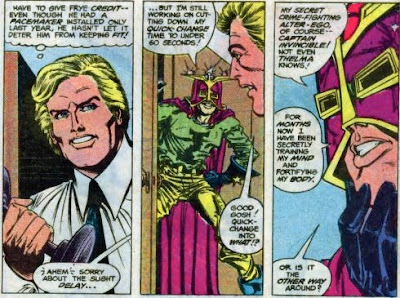
Captain Darryl Frye? Well, he's also from Flash's Bronze Age (appearing first in May 1980). He was comedy relief who hero-worshipped the Flash. He was also, well--how do I put this in a loving and supportive way....? He was...


a total lunatic, who dealt with his mid-life crisis by trying to become a costumed vigilante "Captain Incredible".

People talk about the Silver Age as "that time of wackiness" in comic books. To which I say, "Balderdash".


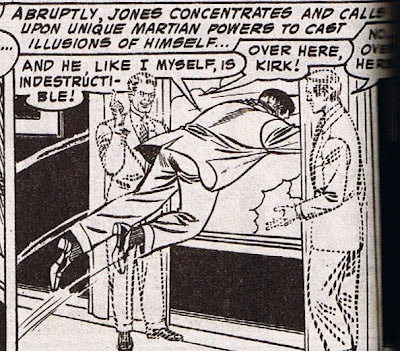
The Bronze Age's deep, all-pervasive, underlying absurdity was far more insane than the showy splashes of zaniness in the Silver Age. In the Silver Age, your boss/authority figure would only become a costumed vigilante temporary because he was being affected by mind-controlling alien fruit (1961) or to defy the mayor's orders and jerk Vicki Vale's chain (1957), because that's always fun. You know... normal reasons.

But in the freakin' Bronze Age, people smoked super-cigars (1974) and got hit on the head and reversed their own alter ego (1978). These things, unlike mind-controlling alien fruit and adopting a costumed identity as an F.U. to the mayor, are just insane. And Captain Frye was very much part of that.

Oh, and Captain Cold's sister, Lisa? In her modern incarcation, her job, like many a relative written by Geoff Johns, is to die tragically and inspire her family to greatness (in either Good or Evil). But in the Insane Bronze Age, she was -- wait for it --an ice skating themed villain, the Golden Glider.


Ladies and gentlemen, the Tonya Harding of Bronze Age Earth-1. Wait, did the narrator actually just call her skates "uncanny"...?!

Which is, of course, insane.

Monday, March 12, 2012

Haikuesday with the Trickster


Poor James Jesse.

Is he a victim of the reboot? It's unclear; he's not been mentioned as one of "Captain Cold's gang of rogues", but the presence of Axel Whathisface in the Flash certainly means that James Jesse is not currently operating as the Trickster. Yet he must have; how else would Axel have "inherited" the title and the gadgets?

Is James Jesse dead? Or reformed? Or still in prison?

Really. How do you deal with a crook who might very well be giving you money, rather than taking it?

Jesse occupied a unique place among the Rogues as the unpredictable wacko, and its not a role you can pass to another one of them. Meanwhile, Axel's pretty weak sauce; is Geoff Johns preparing for the original Trickster to make a dramatic comeback at some point?

Because there is no way that little punk Axel could make a getaway on soap bubbles...

WHILE haikuing about it.

"BUT NOT FOR VERY LONG"


They are made of a
special type of soap which will
hold you, as you say.


What haiku can you compose in praise of James "The Trickster" Jesse?

Friday, March 09, 2012

Heroclix Map: The Egyptian Desert


The Egyptian desert is a great locale for Heroclix battles. Many characters--such as Captain Marvel (oops, sorry, I mean, "Shazam"), Black Adam, Isis, Dr Fate, Metamorpho--have Egyptian origins or connections. And many heroes with no organic links to the Children of the Nile still have had aegyptian advenures, such as Wonder Woman versus the violent Bana-Mighdall, Batman versus mad King Tut, and Josh Bernstein versus megalomaniacal Zahi Hawass.

So here's a Heroclix map of the Egyptian desert! There's a dig site, a campsite, a quonset hut, some desert vehicles, and a little pyramid. They provide hindering terrain, some elevated (well, "negatively elevated") terrain, some interior terrain, and some blocking terrain. Just a little bit of everything.


This isn't the most elaborate or beautiful Heroclix map, but it does have one usual characteristic that I've been experimenting with: it's modular.


As you can see above, you can split the map into six equal segments without intersecting any objects or terrain features. As a result you can cut the map into those segments, then rotate and rearrange them in any way you wish to form a valid Heroclix map. So, instead of ONE map, you get...let's see, um.... 134,596? Something like that. I think. A lot, anyway. Much more than one.

There are certainly flaws with the concept. Even though the segments are as different from one another as I could make them given the setting, I'm not sure how much rotating or swapping the segments would actually change the gameplay. Also, while none of the objects are split by the segment cuts, the underlying sand pattern IS, and that's going to be noticeable when you shuffle the segments.

Still it seemed like enough of a novelty to want to share and to see whether any other such modular maps would be of interest to other players.


Read "Night Force"


It must be "Earth-3 Week" here at the Absorbascon, where everyone's behavior is the opposite of normal. First, I joined forces with Archie Andrews. Now, I'm telling you to read something by Marv Wolfman, of whom, it is fair to say, I am not generally a fan.


But as you may have noticed, DC has pulled out a surprise in the Second Wave: the return of Night Force.


Night Force was a horror series in the 1980s, written by Marv Wolfman and drawn by Gene Colan (of swimmin' with the Sea Devils fame). Make no mistake; I despise all of Wolfman's superhero work. But I'm a sucker for some Night Force, I'm afraid... .


When Night Force came out in 1982-83, I was out of contact and unaware of it until re-emerging into this place of existence in the late '80s. I stumbled on it at some small local comic book convention, probably hooked by the fact that the action centered here in Washington DC (where night Force's main character, Baron Winter, lives).


Baron Winters is, frankly, a hokey collocation of occult tropes. Past shrouded in mystery. No first name. Undeterminable age. Anachronistic clothing and habits. Can't leave his house under any circumstance for some unknown reason. Amoral manipulator. Talks to his pet leopard, Merlin, a LOT, and seems to think that Merlin talks back. Mysterious mansion that serves as some sort of null point in space-time (and where Zatanna's father died, very dramatically). Handpicked task of force of unwitting pawns, one or more of whom will die.


Trite? Sure. But, curse Wolfman, it works and I fall for it completely. It might become insufferably formulaic in the long run (like, say, the Pretender, whose every plot evolution could be timed with a stopwatch)... but, of course, it won't have a long run. It's a seven-issue miniseries, and you probably don't want to miss it.


Even though there was much in the original run one could disparage, it had impact and stuck with you. Despite being a bit hackneyed, Night Force was a pivot point in the transition from DC's '70s-style horror to the birth of the "Vertigo-verse". If you are liking "Justice League Dark" to any degree, you'll want to read the new Night Force, because, while Baron Winters hasn't been and never will be a big player on the psychic scene, he's a fixture, a sort of neutral Switzerland in the occult landscape. If you want to be an aficionado of the DCU's non-super-side, you need to be able to find your way to, and around, Wintersgate Manor. Although not, perhaps, the way out ... .


Thursday, March 08, 2012

Politics Make Strange Bedfellows

Politics –and similar exigencies--make strange bedfellows. Like the time Bronze Age Batman and the Joker and teamed up to solve the Penguin’s “murder” in Brave & the Bold. Or the time Lex and Superman worked together to fight famine in Africa in Heroes Against Hunger. Or when Captain America joined with Hitler to fight worldwide currency inflation. I forget which story that was.

Anyway, thanks to I find myself similarly wedded to the unlikeliest of bedfellows: Archie Andrews.


Thanks, Slay Monstrobot, for exposing this.


As longtime readers of the Absorbascon will know, Archie Andrew is my bête noir. His slow banishment of the heroic Shield from the pages of Pep, his mental enthrallment of the youth of America, his apostlehood of surrealism in comics—the depth and breadth of his evil are unfathomable and illimitable, unbounded as they are by either space/time or the Fourth Wall.


Yet, politics find me arm-in-arm with my Arch-nemesis in solidarity against… One Million Moms, who are boycotting Archie Comics and Toys-R-Us, which is carrying a comic in which Riverdaler Kevin Keller marries his boyfriend. First, a new editor’s notes. I do not know that there are actually one million moms in One Million Moms; I rather doubt it, the same way I’m not really concerned about any threat from Insane Clown Posse or The Butthole Surfers. Also, in the “present day” continuity of Riverdale, Kevin (like the rest of the Archie gang) is a highschooler, with limited dating experienced due to having moved around a lot with his military family. “Kevin’s Wedding” is an “imaginary story” of the future, just like the “Archie Marries Betty” and “Archie Marries Veronica” comics. I will also add that I am opposed to Kevin’s marriage because the story depicted him as a wounded veteran marrying his physical therapist, which is all kinds of professional wrong and which, as we have learned previously here at the Absorbascon, is the road to perdition.


That said, I am obviously not against gay marriage generally or against the general concept of Kevin getting married. Even if I were, I hope wouldn’t take the same stance as this pressure group/rock band One Million Moms ™. Because, even if ‘gay marriage’ is a thing you don’t like, it is still a thing that is happening in the real world—quite a lot—and as such is fair game for inclusion in comics. Of course, rape and murder happened quite a lot in the real world, but I wouldn’t want those in Archie Comics. But if you want to put gay marriage in the same box as rape and murder, One Million Moms, then further discourse on the matter would probably be fruitless. Meanwhile, good luck influencing Toys’R’Us, who I can only assume don’t give a darn what mothers thinks, or their brand name wouldn’t be a grammatical and orthographic horror-show.


By the way, if you get the chance, buy Kevin Keller #1; not only was it kind of touching it was freakin’ hilarious, particularly the Kevin’s Almost First Date and Reggie Gives Kevin a Makeover parts.


What I am really interested in talking about is NOT Kevin Keller, but about the fact that Archie—friggin’ ARCHIE—is leading the mainstream comic book pack on social issues. It’s great, and we should applaud the Archie Comics folks for their efforts to be modern, relevant, but still wholesome. What bothers me is that my preferred comics genre—DC’s ‘super’ titles—are so far BEHIND the curve in representing the realities of gay people being part of modern society.


Don’t get me wrong; I have been very happy to see that the Legion folks stepped right up to the plate and unabashedly portrayed Lightning Lass and Shrinking Violet as a couple (a tradition from the Giffen Five Years Later Era). And, of course, Kate Kane has her own title as Batwoman, where her personal and romantic life is very much integral to the story.


However, I cannot help feel that in the New52—so far—it feels like we have taken a step backwards in the portrayal of gay people from what preceded. In the Old52, we could at least point to a handful of gay men in the DCU; admittedly, no one as high profile as Batwoman, but still there were some. There is, to my knowledge, no one to point to in the New52. Naturally, the whole new DC universe is still unfolding and new characters (and old characters newly recast) are being revealed every week, so my observation may simply be premature. But, even if there are no main characters who are gay men, I’m still looking for some sign that gay marriage—a growing modern reality that even Archie Comics has acknowledged and incorporated into its universe—exists in the DCU. I’m not looking for a “Very Special Issue” about it; I don’t think it merits it. But as one occasionally sees straight married couples in the DCU during the course of a plot, one might expect also, at some point, to see a gay married couple as well.


I am aware that the issue is not without controversy in ‘the real world’. I am also aware that superhero comics, on average, do not court social and political controversy. However, I am also aware that DC didn’t wait until integration and ‘miscegenation’ were no longer issues before showing black Americans with white ones in their stories; or am I wrong in that?


I remember looking at the DCU when I was a kid as a more advanced placed, both scientifically and sociologically. Is that no longer the case? Am I now living in a world that’s ten years ahead of the DCU, instead of the other way around?


Archie Comics has always been about preparing young kids for the world they were going to grow into as teenagers. Is DC Comics now just about preserving for adults the world we grew up in as kids?

Tuesday, March 06, 2012

Haikuesday with Gene Colan and the Sea Devils!


Ah, the Sea Devils, the Homines Superiores of the Sea, the Demigods of the Deep, the Untersee Ubermenschen. I've always marveled at the Sea Devils, who, as repeatedly mentioned here at the Absorbascon, are paragons of humanity, as capable and impressive as the Challengers of the Unknown are incompetent and stumble-footed. Yet they get so little respect; why, they don't even have a page of TV Tropes (where even
Small Wonder has a page).

While excited for the new directions that the creative team is taking with Aquaman, I was sad to see that Aquaman's hinted "former team" will turn out
not to be the Sea Devils.

It's a pity. The Sea Devils are your classic four-man band (The Leader, The Girl, The Muscle, The Kid), a sort of underwater Fantastic Four without superpowers (other than super-awesomeness). They'd have been perfect "back-up singers" for Aquaman's adventures that preceded his discovery of Atlantis, and I would have loved to see the New52 Aquaman become the tentpole for the reintroduction of all DC's oceanic heroes. Alas.

The Sea Devils were so incredible, that, like Mr. Mxyzptlk or The Phantom Stranger, they pretty much do whatever they want, including violating the Fourth Wall...


and otherwise ignoring the barrier between their world and ours. Why, here's their own comic book artist-- Gene Colan -- joining them on one of their underwater adventures.


Wow. That's... wow. Could Namor or Dracula have dragged Gene Colan in their world? I don't think so.

Let alone induct Gene Colan into the joys of sweet, sweet octopus love?

I think not.

Speaking of "Wow", that's the name of the haiku that the amazing Gene Colan spouts as he and the Sea Devils escape one of their hourly close-calls.


We got away just
before that ancient ship was
swallowed up again!

Such is the ennobling effect of the Sea Devils on all who surround them, elevating them to the heights of human achievement, including casual haiku in the face of near destruction. What haiku can you compose in honor of the Sea Devils or Gene Colan?

Friday, February 24, 2012

The Inevitability of Vibe

So, for this post, you have my wicked friend Noah Van Google to blame. Noah’s an egger; he’s that kid who never got in trouble in school, but was always egging YOU on to see what would happen. Then when Hilarity/Horror ensued, the teacher turns on you and there sits Van Google, smiling sweetly with a little halo over his head.

So, Van Google recently decided to throw peanuts through the bars of my cage at the digital zoo by pointing out—on my FACEBOOK WALL—that Newsarama recently listed VIBE as Number One on the list of “The 10 WORST Justice League Members of All Time”. Okay, Noah; consider the bear baited.

Now, as long-time readers may remember, I have addressed this very issue when egged on to reply a comment by Steve Englehart listing Vibe as “one of the four worst Leaguers of all time”. So I feel no need to address that specific point further. Heck even, the writer of the offending Newsarama article conceded:

“…there's something charming about Paco Ramone's short-lived existence, whether it was his overconfidence or excitement about being a superhero in the first place. Vibe also has a particularly important place in Justice League history as being the first Leaguer to be killed in the line of duty, launching an unfortunate trend that would continue for a long time afterwards. If only he'd joined up with a different team that dealt with smaller problems, perhaps Vibe would still be with us today, and perhaps he would've evolved into a character people remembered as more than a gimmick gone wrong. Who's for a new Vibe ongoing series in the next round of DC New 52 launches?”

To my ears, that’s pretty much a concession that Vibe is not only NOT number one on the list, but shouldn’t be on the list at all. He certainly doesn’t argue that any of the others characters on the list should be brought back, let alone get their own series!

But I will take it one (or more) step further: I posit that not only will Vibe return in the New52, but that the return of Vibe verges on inevitable. And here are the reasons why…

Vibe is simple.

It's good Paco has a superpowers, because his career as an avant-garde interior designer was going nowhere.

Yeah, yeah, I hear you laughing. I’m not referring to Vibe’s IQ or personality; I am referring to Vibe’s concept. Vibration powers? Got it. While what exactly he can do with such powers is still open to exploration, there’s nothing intrinsically vague about them (as there is about, oh, pretty much every single member of Stormwatch except Midnighter & Apollo, but only because they are Batman & Superman expies). His personality—vivacious, optimistic street kid with a bit of a chip on his shoulder—is also fairly easy to understand, represent, and stomach (when properly portrayed). He’s pretty much a modern version of Robin (with superpowers).

Vibe is colorful.

Even sepia tones cannot dim the glory that is Vibe.

Both literally and figuratively, Vibe is a colorful figure. Now, you can dismiss this as unimportant. But the fact remains that wan and colorless characters simply do not do well in the long-run in comics. You can make fun of the shiny spandex types, but they remain after scads of less vivid—or, as they are so often style, “more realistic”—characters have faded from view. The costume, the dancing, the flair; face it, Vibe is a fun, larger than life character, and those are superhero comics’ stock in trade.

Vibe is a “Latino”.

Who's for a Vibe team-up with Mas y Menos? C'mon, 'fess up...!

I’m not one for ‘ethnic quotas’, certainly, but DC has definitely expressed interest in having their character roster reflect a more modern diversity in (American? World?) society. As a Puerto Rican (not Mexican, I’m always amazed when people get that wrong, including the writer of the aforementioned Newsarama article), Paco Ramone would fit easily into that plan. Certainly much better than that drunken caricature, Yolanda Montez, or that double-mockery, Extrano.

Vibe has a high Q factor.

Shut up, ghetto boy, who cares what you think?!

Like it or not…most people still know who Vibe is (was). Look again at that list on Newsarama. Aztek? Bloodwynd? Faith? Vague, indistinct, and unmemorable. Any time you want to discuss them—as rare as such times must be—you have to explain who they are, and probably have a lot of difficulty doing so. Despite having died years before any of those characters were introduced, Vibe is still known and discussed (for good or for ill). In fact, one of the Abscorbascommandos tells me Vibe will be one of the characters appearing in the upcoming “DC Shorts” as part of Cartoon Network’s “DCAnimated Hour”; I’ll bet you a can of Soder and a Big Belly burger that Aztek, Bloodwynd, and Faith will NOT be.

Vibe stands alone.

Of course, when you stand like that, it's obvious WHY you stand alone.

Much like the cheese, Vibe stands alone. And by that I mean, Vibe’s origin or existence do not hinge upon any other character or event, so he can be reintroduced at any point. This may seem like a small or silly point, but it isn’t. There’s a huge host of DCU characters you cannot say this about (e.g., Blue Beetle, Huntress, Nightwing, Donna Troy, Wally West, the Detroit Steel, the Elongated Man, Bart Allen, Power Girl, Mister Terrific, the Metropolis Steel); because their origins are tied into predecessor heroes or specific events from “the OldDC”, their reintroduction causes immediate problems, questions, or revisions. Vibe could be reintroduced next week as a newly emerging hero being recruited by, well, just about any group in the DC. Other than Stormwatch. Although the idea of Vibe blazing around the gloomy abstraktervolk of Stormwatch is hilarious; it would be like having Lady Gaga crash Dowton Abbey.

Vibe has potential.

That's a fetish for somebody. Um... me, in fact.

There’s lots that can be with Vibe’s power. Although still unique, his power has similarities to Black Canary sonic scream and Flash’s vibratory powers… ones that they have done pretty well with. First of all, his raw power is pretty substantial: the power to use harmonic resonances to shake a building apart, wreck a bridge, or start a tidal wave is overwhelming (though mostly destructive). But readers love imaginative applications of powers (such as the Flash’s use of superspeed to vibration through things or Mera’s recently displayed ability to suck the water out of people who make the mistake of pissing her off) and Vibe is ripe for those (make Vibe as able to sense vibrations as he is able to cause them, and you get a world of possibilities). And as a character (rather than just a superhero) Vibe has great potential as the kind of tough, wisecracking, happy-go-lucky hero that made the Golden Agers such exciting role models.

Vibe is redeemable.

Like a gay Puerto Rican Batman, all he needs to win your heart is time to prepare.

Most of the negative associations with Vibe, face it, have to do with two things: being part of the “non-A list” of the Detroit League and associating him with the breakdancing craze in the 1980s. The first one is easily dismissed—don’t put him in the JLA (at least not right away)—and the other is, frankly, silly and date. I hate to break it to all you dance-haters but… breakdancing may have entered popular consciousness in the 1980s, but it didn’t exactly disappear. Let’s start with Step Up (2006), Step Up 2 (2008), Step Up 3 (2010), and Step Up 4 (2012). Broaden that to Dancing with the Stars, So You Think You Can Dance?, America’s Best Dance Crew—you yourself may not be part of the dance scene, but I (and the alumni and faculty of Garling’s Greater York Dance Center) can tell you that plenty of people are.

Glory awaits those who redeem him.

I'm gonna do GOOD, Paco! For YOU!

Quick, what is Geoff Johns famous for? And, no, “severed limbs” and “weak endings” don’t count, wise guy. The answer is fixing the unfixable: Flash, Green Lantern, Hawkman, the Justice Society. When explaining how Geoff became such a towering figure in current comics, you’re not going to say, “Oh, he wrote this amazing story about X, or used X innovative writing technique”. You’re going to say, “He fixed X, Y, and Z, elegantly and definitively.” Because, while readers do like writers who create great new characters and stories, they like much more writers who make existing characters that readers already know into great characters with story potential—particularly those familiar characters and “guilty pleasures” who have fallen on hard literary times. You can joke about it all you want, Internet: but the writer who pulls it off will have the last laugh... and my thanks and admiration.