Wednesday, October 15, 2008

The Shield: Who He Is, and How He Came to Be, III

And now the final segment of the origin of ... THE SHIELD!


When last we left the Shield's origin, Joe Higgins, having discovered the secret of the SHIELD formula, strapped himself down on the Table of Pain and Pleasure for 12 hours to become THE SHIELD.
Forget exploding planets and bats in the study. THIS is an origin panel, people.

With no one to witness it except his faithful sidekick, the Green Chinese Lamp, Joe Higgins transforms into THE SHIELD. Even more amazing, the fluoroscopic rays interact with the chemicals to dye his blank costume into an American flag pattern, to which he need only add stars.

What are the odds?

Joe tests his powers as the Shield using every-day objects you find around the house, such as....


The Flame Room
The Kodak Insta-matic Machine GunThe Crushy-Walled Room and International Shadows Project InstallationAnd, last but not least...
the World's Largest Open WindowNo doubt a souvenir of his Dad's stint in Cy Coleman's Defenestration Follies of 1940.

Now confident in his superpowerhood, the Shield reveals himself to J. Edgar Hoover by changing clothes in front of him. And, no, I will not show you the panels; this is a family blog.


This is followed by an extended sequence of setting a trap for bad guys, then beating the crap out of them and hanging them off flagpoles, in order to reach the Big Bad: Hans Fritz.

As previously mentioned, the action quotient in Shield stories is high, but the level of discourse is not. So when Fritz escapes via a trap door (inGENious!), the Shield has clearly not yet prepared himself with a signature saying (as I have).
"Hey!" Joe, you really are a stupid American swine.

So, Joe simply kicks in the trap door with his famous pointy-toes of justice, then goes skittering along the underground passageway looking for all the world like Penelope Pitstop running from the Hooded Claw:

Then the Shield captures Hans Fritz in one of the great comic book sequences of all time...


First of all, to get out of the passageway, Joe doesn't just remove the exit door with his superstrength. No, no. This is THE SHIELD we're talking about here. To the Shield, there's only one way to deal with such an obstacle:
If Geoff Johns does not at some point reveal that the Shield is related to Hal Jordan, it shall be a tragically missed opportunity.

Follows then the Shield's patented "running leap at a plane taking off" maneuver.
Washington trivia: During the '30s and '40s, there were entire neighborhoods where all the buildings were yellow, orange, and lime because no one could afford any other colors.

The villain, however, is unimpressed and says the Golden Age equivalent of, "So, hang on the plane; whatever, dude." Then the Shield pulls another Shieldtastic trick that ranks just below setting himself on fire and launching himself at an enemy ship:
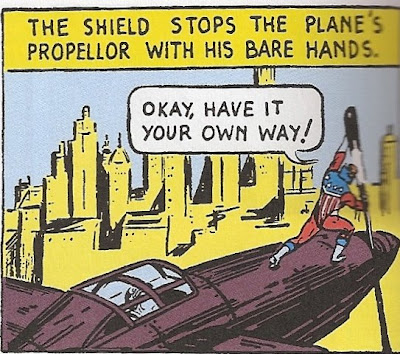
Props to you, Joe.

Maybe somebody else has done that, but I've never seen it. And did they do it with their legs, while humping a nosecone and snarking? I think not. The Shield rocks, people.

Having captured the men who framed his father, Joe offers his on-going services to J. Edgar Hoover, who accepts, provided Joe passes his "examination". Ahem.
Subtext? What subtext?

And so was born.... THE SHIELD.

Tuesday, October 14, 2008

If This Week Had Been a Comic Book

Here's what would have happened.

  • Aquaman saved a manatee but using his aquatic telepathy to guide it to safety in a few opening panels, but afterward was immediately called away to deal with a shadowy undersea conspiracy, the introduction of a new magical threat to Atlantis, and rumblings of a political uprising against his throne, none of which were resolved before the end of the issue, which Dan Didio then announced was the last one in the series.
  • When his spaceship was struck by a ring from outer space, Richard Garriott was transformed into a Red Lantern all of whose constructs are first-person shooters designed by a large anonymous on-line gaming community.
  • A set of live-action films about the candidates in DCU Decisions was released, which, although thoroughly ignored by actual movie-goers, received lots of attention from great metropolitan newspapers.
  • ViewTube started showing full episodes of the '60s cult classic, Space Cabbie.
  • While the Justice Society stormed Vandal Savage's stronghold to halt his plot to crash the American economy as part of a scheme of world domination, Bruce Wayne had Alfred activate the "Save the World Economy" contingency plan, which involved Lucius Fox writing a check to stabilize the stock market, shore up the world banking system, and continue R&D on Spawndex, the material from which Batman's cape is made.
  • Green Lantern's attempt to halt forest fires result in the destruction of seveal small towns, but do expose a hidden facility by an alien race never before mentioned in any issue, while Flash puts out the fires in one or two panels.
  • Kate Spencer would -- somehow -- be involved in the defense -- or prosecution -- of a prominent Senator, which would bring here into contact with the Freedom Fighters, first in conflict then in cooperation, and would be saved by a giant-sized Uncle Sam from an attacking mecha sent by the Senator's secret backers, Intergang. No trial memos would be involved.
  • Media watchers would reassert to no one in particular that television series are still alive and kicking, despite the growing trend of more and more people to wait the DVD Collection.

Monday, October 13, 2008

Jay, the Distinguished Flash


As I discussed in a recent post, I'm all for the Return of Barry Allen and the Humanization of Wally West. By "Humanization", I of course mean "the Slowing Down to the Speed of Sound". Kind of like how Confederate women used to refer to the war as "the Late Unpleasantness".

There are a few reasons for my position. First and foremost, naturally, is that the changes reassert the Dynastic Centerpiece Model (my pet theory, which originally sparked the creation of this blog) among the Flash family. Second, Wally's transsuperhypermegaultrametaspeed was -- and always has been - - a storykiller. Third, the original Flash (Jay Garrick, currently starring in the Justice Society of America) topped out at between 700 and 1000 miles an hour. Frankly, if that was good enough to Jay, it's good enough for Wally.

But, most pertinently for this post, returning Wally to his '80s era speed limit helps distinguish him from his principle, Barry Allen. This, then, brings us to the real point of my post.

We know how they'll distinguish Wally from Barry. But how should they distinguished Jay from Barry (other than merely being older)?

Well, a look at some of the original Flash stories gives us plenty of good ideas of how to write a Jay Garrick who's not only different from Barry Allen, but more in keeping with his original characterization...


Jay was rather snarky. Pardon me, as he was a Golden Ager, it would be called "being a wiseacre". This was one of the ways (the many, many ways) that Golden Age characters expressed confidence. Most writers wouldn't dare write the venerable Jay Garrick that way now, but I think it's a perfect way (one of many, many ways) to distinguish him from his fellow Flashes. Let Jay be "the Wiseguy Flash".

Jay was kind of spooky. And he used to use his speed to gaslight people or just scare the bejeezus out of them. This is not something Wally and Barry do, and it's a great schtick to give Jay. Let Jay be "the Spooky Flash".


Jay threw metal shards shaped like lightning bolts at people. Tell me that wouldn't shake you up. It also gives Jay what Heroclixers call "a ranged attack". Let Jay be "The Flash Who Throws Stuff at You".


Jay had his own visual style for superspeed. When Jay runs, let it look like this picture, like he used to. In fact, each of the Flash speedsters should have a different visual look to their superspeed. No, it doesn't make any sense. Not at all. But it looks cool. Let Jay be the "Pencil Line Flash".

Jay was a one-dollar whore. Just kidding! Jay used to steal clothes, borrow clothes, and generally denude people -- guys, really -- at superspeed all the time. There's a clothes-gag in almost every story. What a charming eccentricity to have, particularly in a gentlemen of his years. Let Jay be "the Haberflasher".


Jay sang. Well, really, all Golden Agers sang. And, yes, that includes Batman, Wonder Woman, and Superman. Within continuity, there are only a few Golden Agers remaining (e.g., Jay, Alan Scott, and Ted Grant). Alan's got a bit too much gravitas for public crooning and I can't imagine Ted's got much of a singing voice. Let Jay carry the torch, or rather the microphone, for the Singing Heroes of the Golden Age. Let Jay be "the Singing Flash".


Jay had a thing with "Mister". He called people "Mister Killer" and "Mister Kidnapper". He called inanimate objects "Mister". People called him "Mister Flash". Sure it was probably just a characteristic of Golden Age writing style, but, gosh, it sounds odd today. It's a charming anachronism. Let Jay be "Mister Flash".

Sunday, October 12, 2008

Friday, October 10, 2008

Loeb Hate DC

Can't talk now, but I'll give you an insight that came up at Big Monkey today:

JEPH LOEB IS BIZARRO-GEOFF JOHNS.

Discuss.

Wednesday, October 08, 2008

Things That Made Me Happy....

in my comics this week:

  • "Why?" Sometimes, I understand the appeal of Hal Jordan.
  • The Queen of Fables a perfect foe for the mythological Wonder Woman, and is her "Mxyzptlk".
  • Freddie the archeologist.
  • Mia uses her lipstick.
  • The highly symbolic irony of why Clark doesn't hear his name.
  • The Joker's fingerprints.
  • Mark's little brother Oliver scares me. A lot.
  • The Guardians are every Board of Directors you've ever known.
  • Gorillas who appear familiar with Aristotle's Poetics.
  • Superman defeating a snotty foe by simply beating the snot of out them, showing that violence is sometimes the answer.
  • Wonder Woman defeating a snotty foe by simply beating the snot of out them, showing that violence is sometimes the answer.
  • "Dead is good".
  • Batman versus Catman.
  • Speedy and Dodger's charming romance.
  • "I didn't even know I was capable of having a migraine."
  • Watch the various Lanterns and their Corps mutually cause one another.
  • "Money will be paid for each drop of agony they suffer." Gail really does have a way with the villains, doesn't she?
  • Hey, look, kids; Wonder Woman in bondage!
  • Connor is both more and less than alright, it seems.
  • Remind me never to go to a restaurant with Mongul.
  • Wonder Woman's meta-commentary on the delay in her movie.
  • "He's just a puffed-up egotist with no impulse control."
  • Not to be rude, but if Holly Shancoe's that stupid, shouldn't she be dead already?
  • Ornament-things. It's your new favorite word.
  • "Rock on" is perhaps the most amusing battle-cry I've ever heard.
  • I think that scarred Guardian may actually be dead.
  • Honestly, every single page of Action Comics, an utter masterwork in characterization and using characters as symbols.

Monday, October 06, 2008

Arkham Asylum Villains

Very soon -- but not soon enough -- the next set of DC Heroclix, Arkham Asylum will be out.

The set is full of gems, but I want to highlight a few of my favorite villain in the set.

BLACK MANTA

Yes, he is riding a shark with a frickin' laser beam on its head. Because that is how evil he is. There was a Black Manta in the very first set of DC Heroclix. But they were still getting the bugs out of the system, and he quickly gained a reputation as, point for point, the most useless piece in the game. Well, no one on the beach will be kicking sand is this one's face. The figure represents his eyebeams with the penetrating Psychic Blast and Energy Explosion, and his underwater prowess with Superstrength, Toughness. And his "Pirate" power lets him Perplex up his stats or those of another aquatic figure.

Like Black Manta, the Riddler appeared in the first DC Heroclix set and was of questionable utility. That won't be said of the new one, who is a masterpiece of capturing what a Batman villain does without making him a powerhouse. He has Stealth and Leap/Climb, which are pretty key when fighting the Batfamily. Mastermind and Exploit Weakness made him a threat at close range, and at a distance he's got some "riddle-related" powers. One givex him Outwit and Perplex at the same time; it's a special version of Perplex that allows him to lower an opponent's battle stat by 2. Those ultra-high-defense figures, like Jay Garrick, might be in for an unpleasant surprise when the Riddle catches them off guard with some puzzle, and they let down their defenses. And "Riddle Me This" is a special version of Incapacitate as a free action (with the possibility of double-incapping an opponent). The Riddler can seriously mess up your opponent's team, as long as you have other character to do the actual punching for him; which is exactly as it should be.

The villainous Riddler is 90 points. But there's also an LE version, Edward Nigma, which for 60 points represents the reformed Riddler, the private detective. It has the usual Riddlerish powers (Outwit, Incapacitate, Perplex, Leap/Climb, Mastermind).
The Penguin is another villain whose remake was badly needed, as his original version was useless. This time, they figured out that his crime umbrellas are an excuse to give him nearly any power, including Energy Explosion, a special joint power for Smoke Cloud and Blades/Claws/Fangs, and Defend. That Defend is going to make him popular on Batman Enemy teams, where he can lurk behind others and keep their defense values high. His criminal acumen is represented by Mastermind (passing damage on to adjacent allies), Willpower (the ability to more twice in a row without penalty), and Outwit (the ability to cancel someone else's power from a distance).

Like the Riddler, Two-Face has two versions: the regular criminal genius version and a Limited Edition "reformed" version. The regular version has some expected powers, like Stealth, Mastermind, and Perplex. Flurry (the ability to attact an adjacent character twice) is a nice touch, but even nice is a special power that represents his coin toss, giving him either Incapacitate or Psychic Blast (either of which makes him useful against the big boys). The "reformed" version is similar, with both Flurry and Mastermind. But it is more of a personal combatant, with Combat Reflexes, Exploit Weakness, and a special power that grants Outwit and Willpower. The best touch is giving him the Batman ALLY ability. This "permanent stealth" will force most foes to come face to face with him, where his Combat Reflexes and Exploit Weakness will be to his advantage.

As welcome as all these figures are, they are capped by the creation of a new generic Thug with the Batman Enemy Ability (sharing Attack Values among adjacent Batman Enemies). These guys will be perfect to put in front of a supercriminal to share his Attack and absorbs his Damage (courtesy of the Mastermind Batvillains often have). That figure's dial hasn't been made public yet, but the generic has an LE version that has been revealed: The Henchmen. He's only got five clicks, but he's packed with a grab-bag of abilities that make him a great utility player. He's got a special ability that makes him a wildcard for team abilities and keywords for all the major villainous groups, which makes him the ideal sidekick for most any villain.

Why Magnus is Better than Wally Wood

Because Magnus defies conventional panel layout.


As does his hair.

Saturday, October 04, 2008

The Jersey Shore

I'm currently in the distant land of Wildwood, a wonderful little resort town on the Jersey Shore, for a singing competition (hence my sparse posting).

If' you've never been, know that Wildwood is the kind of beach town that almost seems the fictional ideal of such a place, like Coney Island or Palisades Park. The boardwalk, the amusement piers, the crab shacks -- all of it is eerily semi-abandoned in October. This time of the year could only with great generosity be called "the shoulder season", and the number of open lodgings and eateries is far outweighed by the locked buildings and shuttered establishments.

It is, in fact, a giant ghost town, and therefore, creepy as all get-out. Particularly when the first comic book you ever bought was...

Batman 251


In the summer of 1973, my family was at the shore. Either there on or the way, I bought Batman 251. I'd certainly read other comics before, and I may have bought myself other comics before then, but this is the first occasion I can actually remember buying the comic book for myself with my own (allowance) money.

If you've never read it, Baman 251 (1973) had the story "The Joker's Five-Way Revenge", which is pretty significant, as far as single issues go.

TJFWR was one of the first issues of the O'Neil/Adams run on
Batman, which redefined (or, perhaps more accuratel, re-established) the character as a dark creature of the night, at home among supernatural elements as well as gritty crime drama.

TJFWR was the first story to really portray the Joker as INSANE, not just, you know, kind of flamboyent. This story is the greatest turning point in the Joker's history, and is the source of his every portrayal for the last twenty-five years.

TJFWR also set a new standard for the Joker's cruelty and disregard for human life. Once you've seen the Joker push an old man in a wheelchair into a shark tank-- well, anything seems possible after that. And that's not just for the Joker. This story recalibrated how an entire generation of comic book readers defined "evil".

TJFWR introduced (and removed) the character of Bigger Melvin, one of the Joker's five intended victims in the story. His chase scene with Batman in that issues is so classic that it was homaged, in its entirety, in the most recent issue of
Trinity.


The issue is not without flaws: for example, subtley is not a virtue of O'Neil's writing. But Adams' art remains unforgettable: the image of Bigger Melvin thinking,
"My troubles will soon all be over," while a starkly lit Joker lurks right behind him is a masterpiece of ironic comic book terror.

But, in addition to all this, the story had a great impact on me because the Joker's hideout is at -- you guessed it -- a closed down facility on the boardwalk during off-season, and the beach is a prominent plot point in the story. As a result, the story inextricably linked the image of an abandoned beach resort-- a place of happiness gone dark and sinister -- with the image of a clown gone bad. Together, those images cemented in my mind the concept that, in the words of
Batman: The Animated Series, "the brighter the picture, the darker the negative."

That's the kind of power that a strong comic book story can have, even decades later. If you have a story like this to it, what is it, which comic book story gave it to you, and why?

Wednesday, October 01, 2008

The Shield: Who He Is, and How He Came to Be, II

When last we left our hero, THE SHIELD, his dad got blowed up real good in the Black Tom Explosion and he was being raised by J. Edgar Hoover. Yes, really. As crazy as foreign saboteurs blowing up munition ships off the Jersey shore sounds, it's even crazier because, well, it actually happened. Who said comics aren't educational?

Comic books have a long tradition of heroes being inspired by their parents' dying words.
  • Uncle Ben's "With great responsibility, comes great whining."
  • Jonathan Kent's "Whatever you do, son, don't marry Lana!"
  • And, of course, Thomas Wayne's "AAAAAAARGGHHkkk --*thud*!"

So it was with the Shield, as Joe Higgins' father leaves him with the immortal words:
"Anatomy formula S*H*I*E*L*D! Carry on, Joe!"

Put that on your tombstone. Oh, and I really wish we would have gotten a thought balloon from J. Edgar here: "Now the boy is all MINE!"

Now, any normal person would simply conclude that the Black Tom Explosion had left shrapnel in Lt. Higgins' brain, causing death-bed dementia. But the Shield is no normal person! He, instead, proceeds to waste 12 to 15 years and three large panels becoming a presumptuous chemistry geek so he can "carry on".

Even after he gets his Ph.D. in chemistry, Joe is still laboring to complete his father's experiment.


Told ya so.

In his quest, Joe employs the most advance scientific equipment of his day, including:

the Bikini-filled Bingo Dispenser


the Bio-magnetic Lobster Trap

the Table of Pain & Pleasure

the Perspective Device

the Atomic Plant Hanger

the Flying Static Balls

and the Device That Renders Boyfriends Unnecessary.

This hoo-hah proves useless, of course, because all great superhero origins are capped by an utterly random moment of self-realization, like a bat flying in a window. The Shield's moment comes as a hallucination induced by pipe-smoking the weed he grows on his coffee table.


Inspired, Joe dons the latex sex gear he wears only to church on Sundays, grabs some topical poppers, and heads to the Table of Pain & Pleasure.


What could have caused this inspiration (I mean, other than all the chemicals Joe messes around with)? Can you imagine..


He saw this:

SWEET BABY JESUS ON A SWING-SET,
WHAT THE HECK IS THAT?!


I really don't have the intestinal fortitude -- or, rather, the "innervation" -- to examine the so-called Anatomy Formula SHIELD.


Suffice it to say that since the next step is... ...

to rub his Dad's improved formula on those parts of his body and lie still under a strobe light for 12 hours, I am simply dying to know how he rubbed in on his HEART, his LUNGS, and most titillatingly, his SACRUM.

I'm betting that it somehow involved using the Device That Renders Boyfriends Unnecessary....


TO BE CONTINUED

Things That Made Me Happy....

in my comics this week.

  • Why Jonah wears the uniform. Of course; that makes perfect sense.
  • Brain stem nannites.
  • Krona's... footprints? That's hilarious.
  • Bigger Melvin. My god, I almost fainted when I saw Bigger Melvin. He was in the first comic book I ever bought... And the drainpipe/chase sequence couldn't have made me happier.
  • Suddenly, the current JLA story is a lot more interesting than I thought it was.
  • I just love Lois "Fastlane" Lane, even though I'm obviously not supposed to.
  • Imagination is the 5th Dimension.
  • You'd think the "cactus in the face" scene would be in Jonah Hex, but it isn't...
  • Tatters the Junkyard Sidekick.
  • Batman R.I.P is now one issue closer to be over; yay!
  • Hal and Ollie beating the snot out of each other.
  • "Carol's dead?" Even when he's written wrong, Two-Face is still a great villain.
  • Loved seeing Grant Morrison's Yellow Alien being exposed.
  • Cameron's unexpected news.
  • Dinah beating the snot out of Hal and Ollie.
  • Okay, even though it didn't do anything but sit there, just know that there's a robot dog in Manhunter makes me happy.
  • Ha, very clever; Bruce Wayne does what Batman mustn't.
  • "Ya can die now." God, I love that man.

Tuesday, September 30, 2008

Haiku from Diamond

My Diamond representative actually sent out a haiku about September ordering:

tuesday haiku:

restless retailer

functions quickly to finish

order form due today

-natalie tusa


Monday, September 29, 2008

Dr. Polaris Returns, and What It Means


It's time to talk about Dr. Polaris.

Actually, that's a needless statement; it is always time to talk about Dr. Polaris. I mean, just look at him; hear him. Dr. Polaris is villainous style personified.

In case you didn't notice, Dr. Polaris has turned up again, in the pages of Blue Beetle. And if you haven't noticed, start reading Blue Beetle.

There's been some debate over whether this is the "real" Dr. Polaris. I hereby declare this debate meaningless. Every once in a while, DC kills a villain (or even a hero) for some shock value, usually as part of some crossover event. They're replaced for a while, perhaps, by some one dramatically different: of a different race, gender, costume, powers, or M.O.

Usually, it doesn't last, at least, not if the original villain was worth was his salt (which chances are he was if he was significant enough to be a "surprise death"). Almost inevitably the spirit of the original villain reasserts itself. The new version becomes like the old one, or a third version silently appears with little fanfare and simply takes his rightful place.

The first example of this that comes to my mind is the Mad Hatter, but I'm sure you can name many others. But with his most recent appearance, Dr. Polaris has become an exemplar of another villainous attribute: gang-lordism.

Back in the day (that means the Golden Age), people (and by people I mean villains) had gangs. Those were the days. Now, I'm not just waxing nostalgic for matching thematic costumes and Brooklynites in derbies and turtlenecks. It's the sheer practicality of it that I'm applauding.

I don't care what kind of gadgets or superpowers you have: if you really want to get anywhere you need an organization. It's sheer practicality; you gotta sleep sometime. And, if you're a supervillain it's hard to go for a stroll to the corner store; you need people to do this for you.

This concept faded, sadly, in the Silver Age. I blame the Flash Rogues. Everything became a battle between super-abilities, and thugs in horizontally striped shirts and newsboy caps didn't quite make the cut.

But this spread. Non-powered villains like the Joker and Two-Face started to become sole actors, limiting the scope of their danger.

The way in which Dr. Polaris has returned is a heartening signal that this trend is reversing. Writers are starting to realize that even superpowered villains work better if they're portrayed as the principals surrounded by a larger web of evil that they control. In Blue Beetle, Dr. P is first introduced as a ganglord. A very hard-edged ganglord. He's not in costume, and he's running his criminal organization ruthlessly. He's using teenagers as guinea pigs, giving them limited magnetic powers with which to commit crimes for him. And only when push comes to shove does he break out the Polaris-costume and start killing left and right.

Why is this good? It makes the villain seem smarter. It makes the conflict relevant to regular citizens. It makes the confrontation with the hero a climax, not an opener. And it reminds us that many of these archcriminals didn't become villains because they were "super"; they became "super" because they were villains.

Why Magnus is Better than You at Work

I mean, really; what did YOU accomplish today?

Plus, he's more modest about it.

Friday, September 26, 2008

Our Discussion Board!


Sorry, I've been rather busy getting ready for two away shows, three home concerts, and a competition!!! Meanwhile, I'd be delighted if my readers would consider becoming fans of my comic book store, Big Monkey Comics, on Facebook.

I've set up a Discussion Board there, with topics for many regular comic book series. Perhaps there are topics we've brought up here at the Absorbascon that you'd like to discuss further, but the post that started them gets shoved down by new posts. No problem! We can create topics for those on the Big Monkey Discussion Board. Just let me know there!

Wednesday, September 24, 2008

"Happy"

I'm foregoing my usual list format for Things That Made Me Happy this week, so as to make a focused impression:

If you can read Superman this week without crying, then, frankly, you have my pity.

That is all.

Tuesday, September 23, 2008

Invitation to Guest Night

Here apropos of nothing is a video invitation to Guest Night at my chorus. In case of you are in the area...