Three famous trophies are displayed prominently in the Batcave in
Batman 657:
The Giant Penny, the Robot Dinosaur, and the Giant Joker Card.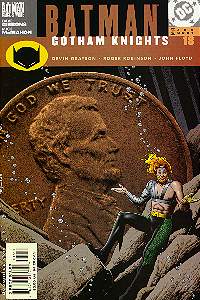 The Giant Penny
, as we have repeatedly discussed, is a remnant of the "Case of the Penny Plunderer" (
World's Finest 30, Aug/Sept 1947) starring
Joe Coyne. Note that
the year of penny is "correct", that is, the same as the year the story was published. I love Joe Coyne.
The Giant Penny is the centerpiece of a memorable Batman/Aquaman "team-up" in Gotham Knights 18 (Aug 2001). Batman is bored and lonely, so he calls Aquaman to come help him get the giant penny unstuck from where it fell during the NML earthquake. It's your typical overly personal Devin Greyson story, but it's a wonderful portrayal of what a nice and understanding guy Aquaman is when people aren't trying to turn him into Namor.
The Robot Dinosaur is a trophy from the story
"Dinosaur Island" (
Batman 35, Jun/Jul 1946; reprinted in
Batman 256); a millionaire entrepeneur ("Murray Wilson Hart") built a "Jurassic Park" style island (except the dinosaurs were all robots), which a criminal tried to use to kill Batman & Robin. He failed.

Unlike its two constant companions,
the Giant Joker Card does
not come as a trophy from an actual story. It was included in some early drawings of Batman's Hall of Trophies as a "generic" trophy that readers would automatically understand came from a clash with the Joker.
Originally, the three trophies were not housed in the functional part of the Batcave. The Batcave had a special locked room called the Hall of Trophies, where Batman & Robin kept souvenirs of their cases, usually in glass displays (introduced in
Batman 12, Jul/Aug 1942).

Even as a child, I knew that sunny window in the Hall of Trophies made no sense. Fabulous lighting effect, though.
The Card, the Dino, and the Penny were large, and therefore were often the main objects visible in any drawing of the Hall of Trophies. I'm not certain when, but at some point it seemed there was no longer of separate Hall of Trophies per se, but rather, trophies were now displayed throughout the Batcave. As I recall, during that period when Bruce shut down Wayne Manor and was living atop the Wayne Enterprises Building, his mini-Batcave under the building still had the Card, the Dino, and the Penny, despite the unlikelihood of Batman carting his three largest trophies into the city. Alfred; call
Niecy Nash.
In
Batman 657, Robin defends himself against the Bat-Brat by using another trophy, the bulletproof vest of Peter Rafferty, one of the three "Brothers in Crime", whose tragic tale was told in the same story that introduced the Hall of Trophies (
Batman 12, Jul/Aug 1942).

Note that Trophy 41 was acquired in June 1939; Trophy 1001 (as we are about to learn) was added in April 1950. That's 960 trophies acquired over 10 years & 10 months, which means Batman & Robin solve a case once every four days. That's better than even Adrian Monk.
Back to the fight scene in Batman 657! As for the giant dice you see in the background, we see those for the first time in the Batcave in that great "Hall of Trophies" story, "The 1001 Trophies of Batman" (
Tec 158, Apr 1950). Batman & Robin accidently smuggled a criminal into the Batcave in the trunk of the Batmobile (those were simpler times indeed). This fellow --named, I kid you not, "Dr. Doom"-- hid in their 1000th trophy, a sacrophagus. When he emerged, however, he found himself locked in the Hall of Trophies, so he rigged the trophies to kill Batman & Robin when they returned. He failed.
The giant dice were supposed to have rolled out and crushed Robin, but killing the Sensational Character Find of 1940 is harder than it looks (isn't that right, Dan?). In fact, one of the trophies killed Doom -- ironically, the very sarcophagus he was smuggled in. I love comic book irony.
I can't quite tell from the art in 657, but I think the trophy that Robin is lying next to on the last page is the very sarcophagus that killed Dr. Doom; if so, it's a nice touch. On his other side is, of course, the "Bat-Man" costume that Bruce's father once wore to a costume party (which clearly made an impression on young Bruce).


