Showing posts sorted by relevance for query joe coyne. Sort by date Show all posts

Wednesday, January 04, 2012

GIANT PENNY WEEK, #2: Meet Joe Coyne!


The Case of the Penny Plunderers begins with the origin of our antagonist, Joe Coyne.

"Penniless"? "Coyne"? "Business in pennies"? Hm; I think I'm sensing a theme here...


"A measly two cents? What can I buy with that?" In 1947? Probably a new suit. In fact, sell 2.75 more newspapers, Joe, and that'll be enough for you to buy an automatic washing machine, a year's supply of gasoline, carpeting for the living room, a vacuum instead of a plastic broom, not to mention a forty-inch television set.


Actually, according to the on-line inflation calculator, Joe cannot, in fact, buy much with 2 cents, since in 1947 it was only worth the equivalent of 19 cents currently. But Joe could still buy almost ten times as much we could, so no sympathy for him here; heck, we can't even buy a stamp for 19 cents.


Yes, Joe; other guys have 'big bills' and you have only pennies, as you stand there in the Gotham night under a streetlight. Of course, some other guys with big bills have to stand in the Gotham night under a streetlight and watch their parents lie there dead in pools of their own blood. Beware of envy, Joe. Well, perhaps, as you say, it will be different when you grow up.


Or maybe not. Writer Bill Finger, with astonishing efficiency, let's us know that Joe got his chance, and he blew it. It's not just that he got a good job and got fired. He wasted it on, well, penny-ante gambling. But the key is: Joe didn't stop when he got caught once. Because Joe is a weak fool.

See? I told you.


Joe is weak and turns to crime. And he's clearly a fool for not casing the joint better. Joe, you shoulda spent some of those pennies on some crime comics and you'd know that already. Oh, and speaking of weak fools... who's your tailor, Joe?

But the Gotham penitentiary has its usual salutatory effect and Joe sees the error of his ways.

Psych!
Stop whining, Joe; at least you got a nicer outfit out of the deal.


Um... Joe? Brooding's not healthy. You just said "I hate pennies", which is crazy talk, and you keep shouting "COPPERS!" and "PENNIES!", kind of like Mr Crocker from
Fairly Odd Parents. Now you're just making irrational, baseless connections in a paranoid attempt to displace your own failures and follies onto some sort of external conspiracy. Kind of like Umberto Eco. And you're doing that thing with your hands that people do right before they become comic book villains. Turn back, it's not too late, Joe, it's not too late!

This really needs in some museum somewhere. Or in every museum, everywhere.


Uh-oh; it
is too late. You're making absurdist vows, are talking about having a 'crime symbol', and have degenerated to the point where you can only portrayed by John Astin or Raul Julia. And since both of them are dead, that's ... a bad sign.

Yep, Joe's definitely turned what I call "the Mad Hatter's Corner", the point at which, after a series of questionable decisions of increasing dubious morality, a character gets that one final chance to suck it up and be a normal person but instead says, "What the heck, I'm a Gothamite, I'm just gonna choose to round that corner into Crazytown and set up shop there!" Vowing to avenge your parents' death by fighting crime doesn't seem quite so crazy when compared to vowing to base on your crimes on pennies.

So... Joe embarks on a life of crime based on... pennies. Which is sure to turn out so much better than his previous life of crime. You know... the one ruined by pennies.

Well... at least Joe's dressed for Crazytown.


Let's see: penny arcade machines (heck, ANY pinball machine), bank tellers with no plexiglass barriers, no coin counting machine. It's seeming less and less likely that Joe Coyne will be in the next
Batman film trilogy.

But how many opportunities for penny-related crimes can there be? I mean, even in Gotham?

Guys, guys; use bubble wrap!!!


Piggy banks. Of course Gotham has a millionaire with a "priceless collection" of something bizarre that relates to the villain's 'crime symbol' that he's willing to ransom back for a fortune. Because that's the kind of place Gotham is. At least piggy banks are more likely than Estruscan snoods.

Well, Joe should be okay; it's extremely unlikely that he's going to draw Batman and Robin's attention with these kinds of low-rent, low-risk heists. Unless Bruce and Dick are bored (since they have nothing to do other than fight all the crime in an enormous city, maintain the Batcave, and do all their millionaire philanthropist stuff) and are just sitting around trolling the newspaper for weird crap they can stick their noses into.


Oh, dear. This won't end well...

Saturday, January 07, 2012

GIANT PENNY WEEK, #5: Betrayed!

So, after Batman & Robin escape Joe Coyne's deathtrap by making a battery out of two pennies in saltwater and tapping out an S.O.S. into the phone wires, they search the joint and find a clue to the Penny Plunderers next target: a yacht party that had rented some of Joe's arcade machines.

Batman flies after their escape boat with the Batplane, towing Robin along on water skis. Which makes perfect sense in a world where people make batteries out of pennies and salt water. In fact, I'm not sure why Batman didn't just putting giant pennies in the water and friggin' electrocute the Penny Plunderers. Must have seemed more fun for the artist to draw Robin landing on the gang's faces with his water skis. Besides, it would be impossible for a flying craft like the Batplane to hang something like a Giant Penny out the window. Or so you'd think; more on that later.

So, since it's pretty easy to escape a man in a plane and a boy on water skis once you're on land, the Penny Plunderers go to ground at the docks. UNTIL Joe has a bright idea, as bright as a copper penny:


"No, let's not try to escape Batman; let's try to capture him. Just like I did two pages ago, when I failed to kill him because I chose to set up a death trap rather than shooting him in the head. Why? Because I'm not just an obsessive gangster; because I'm a VILLAIN, goddammit, and I'm gonna act like one! Furthermore, just to show how unafraid of Batman I am, I'm going to use MYSELF as bait. Then I'm going to assume that you two losers, who just had the snot beat out of you by a teenager on water skis, are going to be able to "bottle Batman and Robin up" by, I don't know, sneaking up behind him or something, rather than just getting your asses kicked again by a boy in swimming trunks. And in the process I'm going to lock myself, unarmed, in a room I can't get out of, and call it 'trapping Batman & Robin'; I AM A GENIUS!!!!"

Joe E. Coyne: Genius At Work.


Oh, but the room in which Joe decides to seal himself lies deep with the Warehouse of Irony, for it (highly improbably) has a payphone in it. Which of course Joe can't use, because....


The irony of this is not lost on Joe.

Face-melting irony, in fact.


Although the irony not might be lost on Joe, Joe is certainly lost on the irony.

"Betrayed"? MMmm, no, I'd say it's more like you chose something worthless and nearly useless as your "crime symbol", Joe. Appropriately enough. But nothing is ever YOUR fault, is it, Joe?


In case you might have missed it, the caption box underlines the fact that the cause of Joe's death is COMIC BOOK IRONY.

PLEASE tell me this kid grows up to become The Penny Plunderer II.

And Joe Coyne goes to the electric chair, which I really really prefer to imagine being hooked up to two giant pennies immersed in salt water. Joe's story ends here; but the Giant Penny's story goes on!!

Friday, January 06, 2012

GIANT PENNY WEEK, #4: Death Trap!


When last we left the Penny Plunderers, Joe Coyne had re-acquired one of his lost gang members, one who desperately hopes Joe doesn't realize that he ratted him out to Batman. But Joe does know. Penny for your thoughts, Joe!

Extra style points to Joe for taking the time and trouble to set up that damning fortune in the weight machine. Anyone can be evil; being a villain is about style, people!


I bet you probably don't find Joe Coyne very threatening. He has no superpowers or special weapons. He has no disturbing deformity or demented worldview. He's just a creative hood with an obsession for pennies and less fashion sense than Jimmy Olsen. But you know what? He's still a Golden Age villain:

Golden Age gangsters are happy to shoot you dead, in a darkly ironic way. We may laugh at Joe Coyne because he's no Lex Luthor or Joker, but he's a great example of the transition of villainy that occurs across the Golden Age and into the Silver Age.

Old school crime comics had a host of gangsters, who to us would seem mostly interchangeable. Usually they were not distinguished by their appearance or obsessions, but rather by their criminal rackets. They were The Guy Who Fixed Prizefights or The Guy Who Preyed on Trucking Companies; how exciting. But Batman changed all that.

As has been pointed out a zillion times, Batman was, in many ways, not particularly original. His various characteristics (detective, polymath, pugilist, acrobat, wealthy socialist, dark vigilante, etc.) had all been seen in other characters, even in combination. There were other heroes who could do all the things that Batman could do. The difference is that the focus shifted away from
what Batman could do-- because, as we know, Batman can do anything you need him to--and toward the way Batman did things. Batman was about STYLE, and that was the key to his popularity.

That, and his bottomless well of human sympathy.


His slate of foes, over time, naturally evolved in that direction as well. The emphasis shifted from scheme to theme. This was very liberating for the writers; once they had villains who were intrinsically engaging due to the style, they could focus on coming up with interesting, even outlandish, schemes for them to perpetrate. The combination was much more potent than the the old "Manny the Mafioso" gangster stories, and, to this day, colorful villains tend to squeeze out other, more mundane criminal threats.

[Oh, and for That Guy who's about to object that Dick Tracy and his villains Did It First: EHHNNKH! Sorry, wrong answer. If you'll check the debut dates of Tracy's villains, you'll notice that prior to Batman's debut in 1939, Tracy's foes are mooks like "the Smuggler", "the Squealer", "the Tramp", "the Stabber", and "Larceny Lou". With the possible exception of "The Blank", it wasn't until the 1940s that Tracy villains really went wacky.]

That's Batman's "sympathetic face", by the way.


Any way, Joe's basic tale is a classic gangster story of kid who makes the wrong choices. But his perception of a theme to his failure, his obsession with turning this theme to his advantage, the predictably his mania creates and the fact that his mania proves his ironic undoing: these are style markings of the supervillains to come. As is his use of thematic weapons to capture Batman and Robin when they show up:

Really. Supervillain or not, you have to respect someone who can beat the crap out of Batman and Robin with nothing but some pennies. In just two panels.


Then, in another moment of budding supervillainy, Joe, having knocked out Batman & Robin with nothing but a bunch of pennies, cobbles together a death trap with ordinarily household items.

One of those pennies should actually be colored GREY not ORANGE. It'll be important in a minute. Oh, and note the spices.


Batman, not to be outdone, spanks MacGyver's mama by getting out of trap using the two cents that Joe couldn't stop himself from tossing them in order to be an ironic asshole, some blotting paper, and salt water. Really, this is either the most awesomely absurd or absurdly awesome death-trap escape from anything, ever (you choose):

Thank goodness they store their condiments with the unused arcade machines. And that everyone in comic books knows Morse Code!


I tried to come with some reason while Batman would do this rather than just, say, pick the lock on the door. Only possibility: this means of escape was the optimum intersection of "awesome" and "ironic".

Monday, May 26, 2025

For your thoughts...

The Penny is dead.

Well, not DEAD.  U.S. currency is never sunset and can always be used as legal lender. But, finally, the U.S. has decided no longer to mint new pennies.

It's a logical decision I have long advocated myself.  Pennies, and the amount they represent, are a nuisance in modern-day commerce or, at best, superfluous.  They cost, I'm told, three times as much to make as their value.  And we already have gazillions of pennies in circulation, busy, well, not circulating, since their number far exceeds the supply needed nowadays.  

I rejoice for this sensible, realistic decision.  But, oh, how I weep for its implications for Joe Coyne, the Penny Plunderer! What would HE say?!

Something like that, I'm sure.

The Penny Plunderer is a favorite, not just on this blog, but across the comicsphere.  Although a one-off Batman foe, he was, ostensibly, saved from obscurity by the fact that the trophy from his adventure, The Giant Penny, is one of three most consistent and conspicuous of the Trinity of Trophies that identify the Batcave as not just any other hole in the ground.

It's why that penny is always drawn as a 1947 wheat-back penny; that is the year of its origin. 

I mean... it has its OWN Heroclix figure, for goodness sake.

I myself, however, think Joe Coyne's continued cultural currency goes deeper than that.  His fame comes not merely from his association with Batman's most prominent trophy, but from what he represents.  The Giant Penny itself represents all of Batman's Golden Age history. Palling around with Robin, the giant props era of Gotham City, and near-deadly confrontations with gangsters and thugs who are little more than barely amped up burglars.  It represents Batman's (comparatively) humble Golden Age roots, which anchor the character in a way no outer space adventure or world-saving omni-competence ever can.  Whatever else he is or becomes, Batman in STILL a guy you could knock off a giant postage stamp replica with a well-thrown roll of pennies, if you got lucky.

As opposed to SOME people, who would simply SWALLOW them.

Just as the Giant Penny represents Batman's Golden Age adventures and all their wacky glory, so does The Penny Plunderer represent an entire class of foe, the Thematic Criminal.

In the early days of comics, many crimefighters mostly just fought, well, criminals.  Guys in ties, armed with guns.  Golden and even Silver Age comics are FULL of them.

For example, the Martian Manhunter, even with his fantastic overage of powers, often just fought Guys In Ties.

Or, sure, some of them might have a "angle" or even a "gimmick".  But they themselves were completely unmemorable.  

And for some heroes that was challenge enough.

Supervillains, with their colorful origins, codenames, costumes, weaponry, and fixations, were very much the exception, rather than the rule.  But between the Guys In Ties and the Supervillains, both chronologically and conceptually, were the Thematic Criminals. Guys like Rocky Grimes, The Blaze, The Octopus.   

Like Ed Peale, a.k.a "The Gong".
He rebelled against bells; a severely disproportionate reaction to a common feature of society.

You can spot these guys a mile away. A prophetic real name; an over-reaction to some frustration for a backstory; a decision to adopt their fixation as their "crime symbol"; a thematic codename, outfit, weaponry, and, sometimes, choice of target. 

It's a sure-fire formula, still in use!

Such characters literally SHOW you, within the story itself, the transition of a Guy In Tie to a, well, if not a "supervillain", at least a "super-criminal".

They were ALWAYS called "super-criminals" on the Batman TV show. NEVER "supervillains" or even "villains".  

The "United Underworlders" up there are interesting examples. Each of them got "retrofitted" to be part of this pattern.  The Catwoman, originally just a thief and schemer, got a backstory where she was an airline stewardess who got amnesia in a plane crash, remembering only a vague affinity for cats from having grown up in a pet store.

Batman #62 (1950). Just to prove I didn't make something that stupid uo.

The Joker, originally a context-free cipher of an archetypal character of Evil Clown, was given a semi-tragic backstory to explain his schtick. 

Detective Comics #168 (1951). Just to prove I didn't make something that stupid up.

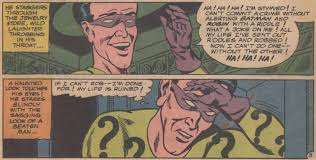
As a later-introduced character (1948), The Riddler largely fit the mold already. But even he has his story "deepened" to make his riddling an obsession rather than mere vanity, as it originally was.

Batman #179 (1966). Just to prove I didn't make something that stupid up.

Even the Penguin, who was always just a pompous murderous snot, eventually accreted a more humanizing backstory to account for his various eccentricities.

A process which actually began HERE, in the Batman newspaper strip (February 17, 1946). Just to prove I didn't make something that stupid up.

Batman's other Great Golden Age Villains, Two-Face and the Scarecrow, fit the pattern from the start. as previously discussed.  In fact, one of the reasons for the longevity and utility of Batman's golden villains is that while they CAN follow the pattern when the author wants, they can just as easily DEPART into some other venture (with a different theme or no theme at all). Since these characters predate their own thematic fixations, they seem just as valid without them.  The Penguin or the Catwoman can embark on a series of criminal endeavors that have nothing at all to do with cats or birds, and we don't think twice about it. 

This is not true of the Purely Thematic Criminals. The Gong is unappealing without bells, Rocky Grimes must travel a rocky road, and the Penny Plunderer would be short-changed without pennies.

It is not for nothing that Joe Coyne is the perfect and enduring symbol of thematic criminal obsession and is its prime representative on TVTropes.

But perhaps, ironically, society's dismissal of the penny is the most thematic outcome at all. After all it was the niggling and nugatory nature of pennies that set Joe off in the first place:


Joe felt that he, like the penny, was treated as valueless and tossed away, unloved, in a jar.  The fact that we can no longer be bothered to mint pennies is just the logical end of the story.

Just as Joe Coyne being undone by his obsession and the uselessness of pennies,

was the logical end of HIS story.


The Penny may be dead, but I say,

LONG LIVE THE PENNY PLUNDERER.

Figuratively, I mean.


Tuesday, August 11, 2026

JuJuBit Profile: The Penny Plunderer

Naturally, I had to make myself a special JuJuBit sculpt of Joe Coyne, the Penny Plunderer, who is the epitome of a one-shot Golden Age thematic villain and source of the Batcave's Giant Penny. Honestly, who DOESN'T love the Penny Plunderer?

Sigh. I really DO deserve to get a better digital camera.

The sculpt was created on JuJuBit using this pic:

As I've said before, it's a crying shame that John Astin played The Riddler on Batman'66, when Joe Coyne is so clearly the part he was born to play.

I already have a previous Joe Coyne custom Heroclix, so I needed a new dial for the new sculpt.  I wanted a dial that would be a useful support piece rather than a strong one that could successfully take on Batman as a team centerpiece.

Because taking on Batman didn't turn out very well for Joe.

I specifically wanted him to be a useful assistant for Two-Face, Batman's (MUCH) more prominent coin-related villain.  So I chose the one dial almost perfectly designed (unintentionally, I assume) as a complement to Two-Face: 


The Gambler has TWO "coin-flipping" mechanics handy, one of which lets Two-Face re-do a coin flip (and Two-Face figures almost always have some sort of mechanic that depends on a coin flip).  Giving Two-Face a second chance whenever he flips a coin to do something in the game can be a very useful ability, indeed!

Once I "rebrand" this dial, it looks like this:


He doesn't naturally have the "Batman Enemy Team Ability" but he does have the "Team Player" Team ability (that's the question mark in the circle) that allows him to copy the Team Abilities of other friendly figures.  That lets him "borrow" the Batman Enemy TA from another figure (such as Two-Face).  His regular powers, without going into detail about them are general about be fast-acting, sneaky, and LUCKY (or unlucky, as the case may be), which is not a bad match with the Penny Plunderer.

His 'coin-re-flipping' power might also come in handy if I play him with the actual Giant Penny.

I'm not sure the Giant Penny would really be helpful, but it sure would feel good thematically.!