Showing posts with label giant penny. Show all posts

Monday, May 26, 2025

For your thoughts...

The Penny is dead.

Well, not DEAD.  U.S. currency is never sunset and can always be used as legal lender. But, finally, the U.S. has decided no longer to mint new pennies.

It's a logical decision I have long advocated myself.  Pennies, and the amount they represent, are a nuisance in modern-day commerce or, at best, superfluous.  They cost, I'm told, three times as much to make as their value.  And we already have gazillions of pennies in circulation, busy, well, not circulating, since their number far exceeds the supply needed nowadays.  

I rejoice for this sensible, realistic decision.  But, oh, how I weep for its implications for Joe Coyne, the Penny Plunderer! What would HE say?!

Something like that, I'm sure.

The Penny Plunderer is a favorite, not just on this blog, but across the comicsphere.  Although a one-off Batman foe, he was, ostensibly, saved from obscurity by the fact that the trophy from his adventure, The Giant Penny, is one of three most consistent and conspicuous of the Trinity of Trophies that identify the Batcave as not just any other hole in the ground.

It's why that penny is always drawn as a 1947 wheat-back penny; that is the year of its origin. 

I mean... it has its OWN Heroclix figure, for goodness sake.

I myself, however, think Joe Coyne's continued cultural currency goes deeper than that.  His fame comes not merely from his association with Batman's most prominent trophy, but from what he represents.  The Giant Penny itself represents all of Batman's Golden Age history. Palling around with Robin, the giant props era of Gotham City, and near-deadly confrontations with gangsters and thugs who are little more than barely amped up burglars.  It represents Batman's (comparatively) humble Golden Age roots, which anchor the character in a way no outer space adventure or world-saving omni-competence ever can.  Whatever else he is or becomes, Batman in STILL a guy you could knock off a giant postage stamp replica with a well-thrown roll of pennies, if you got lucky.

As opposed to SOME people, who would simply SWALLOW them.

Just as the Giant Penny represents Batman's Golden Age adventures and all their wacky glory, so does The Penny Plunderer represent an entire class of foe, the Thematic Criminal.

In the early days of comics, many crimefighters mostly just fought, well, criminals.  Guys in ties, armed with guns.  Golden and even Silver Age comics are FULL of them.

For example, the Martian Manhunter, even with his fantastic overage of powers, often just fought Guys In Ties.

Or, sure, some of them might have a "angle" or even a "gimmick".  But they themselves were completely unmemorable.  

And for some heroes that was challenge enough.

Supervillains, with their colorful origins, codenames, costumes, weaponry, and fixations, were very much the exception, rather than the rule.  But between the Guys In Ties and the Supervillains, both chronologically and conceptually, were the Thematic Criminals. Guys like Rocky Grimes, The Blaze, The Octopus.   

Like Ed Peale, a.k.a "The Gong".
He rebelled against bells; a severely disproportionate reaction to a common feature of society.

You can spot these guys a mile away. A prophetic real name; an over-reaction to some frustration for a backstory; a decision to adopt their fixation as their "crime symbol"; a thematic codename, outfit, weaponry, and, sometimes, choice of target. 

It's a sure-fire formula, still in use!

Such characters literally SHOW you, within the story itself, the transition of a Guy In Tie to a, well, if not a "supervillain", at least a "super-criminal".

They were ALWAYS called "super-criminals" on the Batman TV show. NEVER "supervillains" or even "villains".  

The "United Underworlders" up there are interesting examples. Each of them got "retrofitted" to be part of this pattern.  The Catwoman, originally just a thief and schemer, got a backstory where she was an airline stewardess who got amnesia in a plane crash, remembering only a vague affinity for cats from having grown up in a pet store.

Batman #62 (1950). Just to prove I didn't make something that stupid uo.

The Joker, originally a context-free cipher of an archetypal character of Evil Clown, was given a semi-tragic backstory to explain his schtick. 

Detective Comics #168 (1951). Just to prove I didn't make something that stupid up.

As a later-introduced character (1948), The Riddler largely fit the mold already. But even he has his story "deepened" to make his riddling an obsession rather than mere vanity, as it originally was.
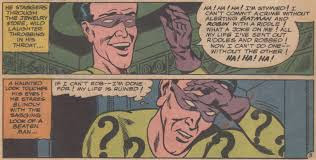
Batman #179 (1966). Just to prove I didn't make something that stupid up.

Even the Penguin, who was always just a pompous murderous snot, eventually accreted a more humanizing backstory to account for his various eccentricities.

A process which actually began HERE, in the Batman newspaper strip (February 17, 1946). Just to prove I didn't make something that stupid up.

Batman's other Great Golden Age Villains, Two-Face and the Scarecrow, fit the pattern from the start. as previously discussed.  In fact, one of the reasons for the longevity and utility of Batman's golden villains is that while they CAN follow the pattern when the author wants, they can just as easily DEPART into some other venture (with a different theme or no theme at all). Since these characters predate their own thematic fixations, they seem just as valid without them.  The Penguin or the Catwoman can embark on a series of criminal endeavors that have nothing at all to do with cats or birds, and we don't think twice about it. 

This is not true of the Purely Thematic Criminals. The Gong is unappealing without bells, Rocky Grimes must travel a rocky road, and the Penny Plunderer would be short-changed without pennies.

It is not for nothing that Joe Coyne is the perfect and enduring symbol of thematic criminal obsession and is its prime representative on TVTropes.

But perhaps, ironically, society's dismissal of the penny is the most thematic outcome at all. After all it was the niggling and nugatory nature of pennies that set Joe off in the first place:


Joe felt that he, like the penny, was treated as valueless and tossed away, unloved, in a jar.  The fact that we can no longer be bothered to mint pennies is just the logical end of the story.

Just as Joe Coyne being undone by his obsession and the uselessness of pennies,

was the logical end of HIS story.


The Penny may be dead, but I say,

LONG LIVE THE PENNY PLUNDERER.

Figuratively, I mean.


Tuesday, January 10, 2012

GIANT PENNY WEEK, #8: Haikuesday with the Giant Penny

We have already noted two comic book haikus in the Giant Penny's original story, "The Penny Plunderers":

I call this one "Skinny's Epitaph":

Tough! But that's always
the risk a fellow takes when
he turns criminal.


I call this one "Joe's Two Cents" (a.k.a., "If Joe Coyne weren't a Sarcastic Wise-Ass, He'd be Alive and Batman & Robin would be Dead"):

So long! Here's two cents--
that's all your lives will be worth
in a little while.


But today we round out Giant Penny Week with ONE MORE. It's in Joe's famous meltdown scene, and I call it

NO GOOD AT ALL!


It's a pay phone ! I
need a single nickel to
be able to dial!

And that's the end of GIANT PENNY WEEK! Except for tomorrow's epilog, which is about the Giant Penny's home: the Batcave!

Monday, January 09, 2012

GIANT PENNY WEEK, #7: Adventures of the Giant Penny!

As seen at "Comics Make No Sense", there's actual more than one giant penny rolling around Gotham:
"Gosh, Batman; the nobility of the almost-human giant penny!"

As pointed out yesterday, the Giant Penny weighs in the neighborhood of 49,000 pounds, which should mean that every one of the Penny Plunderers in this panel are DEAD (and that Batman is hella strong): And then there was the time that Bruce and Dick moved the 49,000 lb Giant Penny... BY HAND.
Gene Colan was a great guy; but getting the year on the Giant Penny wrong?
ONLY a Marvel person would make that mistake.
Speaking of the Marvel universe, apparently it's where the Giant Penny vacations:
The Giant Penny likes to lord it over pointless Kirbyesque whatnots: "So, what exactly are YOU supposed to be?"
Then (as previously covered the Comic Treadmill's exhaustive examination of ALL giant props) there was the time the Giant Penny decided to go bungee jumping from a helicopter.
Forty. Nine. THOUSAND. Pounds.
Or, one of my favorites: the time it finally had it out with the Robot Dinosaur.
  • "I'm the coolest trophy! Robots are cool; dinosaurs are cool; I am a ROBOT DINOSAUR."
  • "Yes, Rex, you've pointed that out before..."
  • "I'm also the largest trophy! And the most popular! Kids look at the Batcave and say, 'ooo, how cool it would be to have a Robot Dinosaur!' No kids says 'ooo, I want a Giant Penny!' "
  • "Rex, I'm warning you...."
  • "I bet they don't even know your NAME..."
  • "THAT DOES IT---!!!!!"
Little known fact: instead of "rock - paper -scissors" kids in the DCU play "Giant Penny - Joker Card - Robot Dinosaur".

Sunday, January 08, 2012

GIANT PENNY WEEK, #6: Thoughts for Your Penny

So, have you ever stopped to consider... how much the Giant Penny actually WEIGHS?

My estimate; oh, about .... 49,000 pounds.

Happy to show my work, by the way. The Giant Penny is depicted at various sizes, from between about 12 feet high (about twice as tall as Batman & Robin) or up to, oh, I'd say 16 feet high, tops.

Assuming the Penny is 12 feet high (that's usually how it's drawn) it would be about 9.6 inches thick (since it's proportionate with the dimensions of an actual penny, .75 inches in diameter by .05 inches thick).

Since the volume of a penny (even a giant one) would be (pi * radius * radius * height) that gives a volume of between 90 and 91 cubic feet. It's 90.7 if you assume it's a perfect cylinder; it's not, of course, since the heads and tails have raised and lowered areas to form the design. But it's close enough for comic books.

Assume the penny is made of the same stuff as a regular penny (which you KNOW it is, because Gotham City's Giant Props are NEVER just hollow mock-ups; they are always actual working giant versions of whatever they model).

Apparently, I'm not Joe Coyne's biggest fan after all.


In 1947 (that's the year on the Giant Penny, in case you never noticed, and the year the "Case of the Penny Plunderer" was published), pennies were about 95% copper (which weights 542 lbs per cubic foot) and 5% tin (which weights 456 lbs per cubic foot). So, since the Giant Penny is about 86.165 cubic feet of cooper plus about 9.535 cubic feet of tin...

the Giant Penny would weigh an estimated 48,769 lbs. A little less if they used zinc instead of tin.

Which makes some of things the Giant Penny does in tomorrow's post even MORE surprising...


Saturday, January 07, 2012

GIANT PENNY WEEK, #5: Betrayed!

So, after Batman & Robin escape Joe Coyne's deathtrap by making a battery out of two pennies in saltwater and tapping out an S.O.S. into the phone wires, they search the joint and find a clue to the Penny Plunderers next target: a yacht party that had rented some of Joe's arcade machines.

Batman flies after their escape boat with the Batplane, towing Robin along on water skis. Which makes perfect sense in a world where people make batteries out of pennies and salt water. In fact, I'm not sure why Batman didn't just putting giant pennies in the water and friggin' electrocute the Penny Plunderers. Must have seemed more fun for the artist to draw Robin landing on the gang's faces with his water skis. Besides, it would be impossible for a flying craft like the Batplane to hang something like a Giant Penny out the window. Or so you'd think; more on that later.

So, since it's pretty easy to escape a man in a plane and a boy on water skis once you're on land, the Penny Plunderers go to ground at the docks. UNTIL Joe has a bright idea, as bright as a copper penny:


"No, let's not try to escape Batman; let's try to capture him. Just like I did two pages ago, when I failed to kill him because I chose to set up a death trap rather than shooting him in the head. Why? Because I'm not just an obsessive gangster; because I'm a VILLAIN, goddammit, and I'm gonna act like one! Furthermore, just to show how unafraid of Batman I am, I'm going to use MYSELF as bait. Then I'm going to assume that you two losers, who just had the snot beat out of you by a teenager on water skis, are going to be able to "bottle Batman and Robin up" by, I don't know, sneaking up behind him or something, rather than just getting your asses kicked again by a boy in swimming trunks. And in the process I'm going to lock myself, unarmed, in a room I can't get out of, and call it 'trapping Batman & Robin'; I AM A GENIUS!!!!"

Joe E. Coyne: Genius At Work.


Oh, but the room in which Joe decides to seal himself lies deep with the Warehouse of Irony, for it (highly improbably) has a payphone in it. Which of course Joe can't use, because....


The irony of this is not lost on Joe.

Face-melting irony, in fact.


Although the irony not might be lost on Joe, Joe is certainly lost on the irony.

"Betrayed"? MMmm, no, I'd say it's more like you chose something worthless and nearly useless as your "crime symbol", Joe. Appropriately enough. But nothing is ever YOUR fault, is it, Joe?


In case you might have missed it, the caption box underlines the fact that the cause of Joe's death is COMIC BOOK IRONY.

PLEASE tell me this kid grows up to become The Penny Plunderer II.

And Joe Coyne goes to the electric chair, which I really really prefer to imagine being hooked up to two giant pennies immersed in salt water. Joe's story ends here; but the Giant Penny's story goes on!!

Friday, January 06, 2012

GIANT PENNY WEEK, #4: Death Trap!


When last we left the Penny Plunderers, Joe Coyne had re-acquired one of his lost gang members, one who desperately hopes Joe doesn't realize that he ratted him out to Batman. But Joe does know. Penny for your thoughts, Joe!

Extra style points to Joe for taking the time and trouble to set up that damning fortune in the weight machine. Anyone can be evil; being a villain is about style, people!


I bet you probably don't find Joe Coyne very threatening. He has no superpowers or special weapons. He has no disturbing deformity or demented worldview. He's just a creative hood with an obsession for pennies and less fashion sense than Jimmy Olsen. But you know what? He's still a Golden Age villain:

Golden Age gangsters are happy to shoot you dead, in a darkly ironic way. We may laugh at Joe Coyne because he's no Lex Luthor or Joker, but he's a great example of the transition of villainy that occurs across the Golden Age and into the Silver Age.

Old school crime comics had a host of gangsters, who to us would seem mostly interchangeable. Usually they were not distinguished by their appearance or obsessions, but rather by their criminal rackets. They were The Guy Who Fixed Prizefights or The Guy Who Preyed on Trucking Companies; how exciting. But Batman changed all that.

As has been pointed out a zillion times, Batman was, in many ways, not particularly original. His various characteristics (detective, polymath, pugilist, acrobat, wealthy socialist, dark vigilante, etc.) had all been seen in other characters, even in combination. There were other heroes who could do all the things that Batman could do. The difference is that the focus shifted away from
what Batman could do-- because, as we know, Batman can do anything you need him to--and toward the way Batman did things. Batman was about STYLE, and that was the key to his popularity.

That, and his bottomless well of human sympathy.


His slate of foes, over time, naturally evolved in that direction as well. The emphasis shifted from scheme to theme. This was very liberating for the writers; once they had villains who were intrinsically engaging due to the style, they could focus on coming up with interesting, even outlandish, schemes for them to perpetrate. The combination was much more potent than the the old "Manny the Mafioso" gangster stories, and, to this day, colorful villains tend to squeeze out other, more mundane criminal threats.

[Oh, and for That Guy who's about to object that Dick Tracy and his villains Did It First: EHHNNKH! Sorry, wrong answer. If you'll check the debut dates of Tracy's villains, you'll notice that prior to Batman's debut in 1939, Tracy's foes are mooks like "the Smuggler", "the Squealer", "the Tramp", "the Stabber", and "Larceny Lou". With the possible exception of "The Blank", it wasn't until the 1940s that Tracy villains really went wacky.]

That's Batman's "sympathetic face", by the way.


Any way, Joe's basic tale is a classic gangster story of kid who makes the wrong choices. But his perception of a theme to his failure, his obsession with turning this theme to his advantage, the predictably his mania creates and the fact that his mania proves his ironic undoing: these are style markings of the supervillains to come. As is his use of thematic weapons to capture Batman and Robin when they show up:

Really. Supervillain or not, you have to respect someone who can beat the crap out of Batman and Robin with nothing but some pennies. In just two panels.


Then, in another moment of budding supervillainy, Joe, having knocked out Batman & Robin with nothing but a bunch of pennies, cobbles together a death trap with ordinarily household items.

One of those pennies should actually be colored GREY not ORANGE. It'll be important in a minute. Oh, and note the spices.


Batman, not to be outdone, spanks MacGyver's mama by getting out of trap using the two cents that Joe couldn't stop himself from tossing them in order to be an ironic asshole, some blotting paper, and salt water. Really, this is either the most awesomely absurd or absurdly awesome death-trap escape from anything, ever (you choose):

Thank goodness they store their condiments with the unused arcade machines. And that everyone in comic books knows Morse Code!


I tried to come with some reason while Batman would do this rather than just, say, pick the lock on the door. Only possibility: this means of escape was the optimum intersection of "awesome" and "ironic".

Thursday, January 05, 2012

GIANT PENNY WEEK, #3: Attack of the Giant Penny!


When last we left "the Case of the Penny Plunderers", Joe Coyne had pretensions of remaking himself as a "villain" rather than a mere crook by hewing to a lunatic "crime symbol". Using the power of free association that allows them to divine the schemes of the madmen they fight, Batman and Robin have not only figured out, just by reading the paper, that there
is a "Penny Plunderer", but they've divined his next target.


The One-Penny Black, by the way, is a real thing. Golden Age writers like Bill Finger used to hang out in illicit trivia dens in Chinatown, lying on divans, soaking in all sorts of bizarre useless data that they might later incorporate into some plot point. You kids, with your internet, you know nothing of sacrifice.

The first appearance of the Giant Penny. And the much less famous Giant Stamp Tongs.


Rather than alert the police (because, you know, where's the fun in that?), they just lurk around in the shadows, until Coyne and his gang show up, whereupon there's lot of Patented Punning & Punching. And Batman showboating by means of functional giant props.

Just once I'd like to see one of those props turn out to be paper mache, so I could see Batman go crashing through it to a faceplant on the hard, cold floor, while the photographers from Picture News go to town. But I'm sure that's against the Gotham City Civil Code on Giant Props.


But sometimes the gods punish hubris immediately and Batman pays for his showboating with...

a roll of pennies to the forehead.

Hm. What's the word I'm looking for? Oh, yes:

BWAHAHAHAHAHAHAHAHAHAHA!


Batman's humiliation is deliciously augmented by the fact that Robin--and a roomful of Gothamites--are watching as Batman gets pwned by a Grade Z hoodlum with some pennies and falls off a giant stamp to the hard, cold floor. Where's Vicki Vale when you need her?

Before there were blogs, there were the Gotham tabloids.


The bad guys do the logical thing, which in Gotham means "escape via the rooftops after climbing up the giant postage stamp and out the skylight." Because, you know, the rooftops are the perfect way to flee from Batman. But one of them doesn't make it, and Batman, tries desperately to salvage his self-image by intimidating a skinny gunsel. Boy, I sure hope a member of Coyne's gang isn't eavesdropping from the skylight and kidnaps the squealer....!

Uh-oh. This won't end well...

P.S. Oh, I almost forgot....!

This is what the Giant Penny does:

Small wonder that the Giant Penny is the standard by which all other Giant Props are measured. But what's it feel like to get hit by a Giant Penny? Well, we'll be discussing that later.


Batman actually uses the Giant Penny against Coyne's gang, NOT vice versa. Then it's not seen again until it shows up three years later in the original Hall of Trophies story ("The Thousand and One Trophies of Batman", Detective #158, Apr 1950).

How did Batman get his gloves on the Giant Penny? Most readers think grateful citizens just up and give Batman trophies after he saves their asses (or gets them publicity by getting pwned on the front page of Picture News). Or they think that Batman pockets trophies from crime scenes when the police aren't looking. But that's silly. Clearly, Alfred spends most of his day on Ebay on Bruce's behalf, buying up relevant giant props from previous cases. And thanks to the Gotham City Civil Code on Giant Props, the expense is actually tax-deductible.