Showing posts sorted by relevance for query hunch. Sort by date Show all posts

Friday, August 14, 2026

Speed Saunders and the Hilton Diamond 2: Getting the 411!


When last we left Speed (and his new tagalong, "Jim", Son of Corpse), he was following up on a hunch (as he often does).

"Later"?  Is this the Hunch Following or AFTER the Hunch Following?  Even a veteran of Speed Saunders stories such as I has trouble holding on as the plot roars along at breakneck Speed.

Pause for a moment to appreciate the worldliness of Speed Saunders, who recognizes by sight the Biggest Diamond Merchant in Europe, Elias Brent.  As well as the natural Ace Investigator skills his sidekick is quickly acquiring. 

"HAVE HIS STOMACH PUMPED!"  

"Let's not rush things, Jim..."


I guess it helps that Brent is DRESSED European; the bowler, the wing collar, the cravate, the carnation, the dress gloves.  If he had a mustache I'd assume he was Nikola Tesla, just coming back to his hotel from feeding the pigeons.


Also, Nik didn't have a scar (thanks to those big rubber shoes he worn in the lab).


You know what used to be VERY easy back in the day, before credit cards? Lodging under an assumed name. It happens all the time in old movies.

A diagonal scar? I thought he just had well-defined cheekbones. Well, such is Golden Age art.

Turns out Mr. Brent is posing as... MR. BRANDON. Whatever that means.


Note this part of the panel very well:

You see, Room 411 is located directly BELOW Room 511; it's a plot point and this panel foreshadows that.  Such is Golden Age art!

Next we get one of my favorite Speed Saunders quotes, one that I use myself all the time:

"I'm from Headquarters."

Headquarters? Headquarters of what? It doesn't matter; of EVERYTHING.  Whatever the relevant authority is, Speed is from its Headquarters.  

Speed and Jim go to 411 for some information.

For those who keep track of such things; this bellhop may be the only black person in a Speed Saunders story.  

Where Speed discovers the most non-descript generic coffee cups imaginable.

Which Jim somehow manages to immediately and unquestionably identify as belonging to his father.  Maybe that's his dad's lipstick? 

I think "generic" undersells it; these are the very instantiations of the Platonic Ideal of Coffee Cup.

This story, by the way, is in the exact period when melamine cups and dishes were being popularized among American consumers.  Jim's dad was HIP.

Before we, the readers, can even think of asking, "Who on earth TRAVELS with their own coffee cups?!", Speed focuses on some... napkins? Wax paper? Receipts?  Proto-postit notes?  Lipstick blotters? Who can tell?

WHAT ARE THEY GOOD FOR, SPEED, TELL US QUICKLY BEFORE--

SUDDENLY A SHOT RINGS OUT!

Okay, fine; NOW I can tell it's a scar.

Thus did the Biggest Diamond Merchant in Europe, Elias Brent (whom we are apparently now calling by his pseudonym, "Brandon") shoot both Speed and Jim to death, may they rest in peace.  Don't mess with the Antwerp mafia!

Tomorrow: We pay our final respects to Speed Saunders (and his sidekick, Jim).


Thursday, August 13, 2026

Speed Saunders and the Hilton Diamond, 1: A Locked Room Mystery

 Meanwhile, in Detective #18, we find:


We join this episode of Speed Saunders, already in progress!

Yes, this is the first panel.  Speed has work to do and can't wait around for you to catch up.

Who is the corpse? Who's the non-chalant blond kid?  Does getting a chemical report involve stomach-pumping?  Who knows! It's Speed Saunders, just run with it...

So, the blond kid nonchalantly staring at the corpse is the corpse's son.  But, because English has no clear way to distinguish between an appositive and a vocative, it's perfectly ambiguous whether Jim is name of the corpse or of the corpse's son. Or both.

Something big and dangerous, Speed? Like.... a bear? Do you think the diamond merchant was shot by a bear?  Or maybe a talking gorilla, like the one you fought before?  Curious to see where this hunch takes you!

Turns out, this is a "locked room" mystery.

"He entertained someone?"
"Sorry to have to break it to you, kid, but... 
your father was a veritable strumpet."

"Your father was not ready for bed." He looks pretty ready to me, Speed. He's wearing a robe and lying in bed.  But if he did commit suicide, would he really "get ready for bed" first?  Pretty sure that's not a thing suicides do. "Must remember to set the alarm before I shoot myself; wouldn't want to oversleep!"

Speed, however, is not some methodical fanciful fop like Hercule Poirot; Speed is an active action-oriented fop.  As such, Speed does not have time or patience for "locked room" mysteries and so dismisses THAT part IMMEDIATELY.

There was a time when you needed a key to lock a door from the inside, as weird as that now seems.  That's the time Speed lives in.

Jim -- or is it Jim Junior? -- is disconsolate.  Having lost his father, in his despair he naturally chooses Speed as a role model and immediately starts to look like him.


In mere moments, Jim Junior's transformation into Speed Junior is nearly complete.

Speed Junior would later become a founding member of the Teen Ace Investigators, along with Slap Bradley, Denise Colt, and Coco, Maid of Disguise.

Speed has a hunch!  Let's see how THAT turns out...


Saturday, June 17, 2006

Professor Radium

For those of you enjoying the total insanity that is "Battle for Bludhaven", I need to draw your attention to Professor Radium. You know, the guy who looks like a green Hugo Strange.

The rest of the characters being reintroduced in the BFB are crazy Silver and Bronze Age commentaries on the post-WWII nuclear era. Prof. Radium is not.


I'm guessing Prof. Radium was a Joker fan, because he does that whole "look in the mirror with horror" scene, then goes bonkers and does the Joker's patented "YMCA dance while surfing" maneuver. Gotta love Gotham.


BFB is Prof. Radium's first appearance since his original one in 1941. I love stuff like that. If you don't, well, then you're missing a big chunk of the fun of DC.

His real name is Henry Ross, and his hobby was inventing radium-based serums that can bring the dead back to life. If only Gotham had had Heroclix; think how much needless waste of life could have been avoided if wackos like Henry spent their evenings trying to understand how to apply the Pummel Feat Card to figures with CCE instead of performing ill-advised scientific experiments.

Anyway, Henry figured out how to bring dogs back from the dead.

Look at those first two panels; that's art, people.
Golden Age artists may not have been as technically adept as modern ones, but they had a compensatory sense of style and composition that was nearly overwhelming. Are there any panels in any of the comics you bought this week that will impress or even haunt you like that second panel above? I don't think so.


You go, Henry. As a dog lover, I salute you, and note that here on Earth Prime we are just beginning to figure how to do what Henry did over 60 years ago. Now, go re-read the first pic in this post, the one from BFB; clearly, Henry lost a dog or two tragically as a child and that left a lasting impression. Dude loves dogs, and his first thought for any science or technology is, "How can this ease the lives of dog-owners?" Henry's A-okay in my book.

Sadly, his bosses don't believe in Henry's reanimated zombie dogs because he performed his experiments in the dead of night when no one was watching and might have substituted lookalike live dogs for the dead ones. In fact, they fire him for stealing thousands of dollars worth of radium for his unauthorized experiments. Fools! The utter fools!

Naturally, Henry's next step was:

(A) Repeat the experiment with credentialed witnesses.
(B) Publish a paper on his research and call for external verification.
(C) Prove that the zombie dogs were the original ones through DNA comparison.
(D) Post an mpeg of his reanimation experiment on YouTube.


Since this is the DCU, the answer is obviously (E):Later, Henry blames the radium for driving him crazy.
Personally, I'd say that began when he thought it was a good idea to drink a bottle of something green, labelled "poison" with three Xs on it. Where was Mr. Yuk when Henry needed him?


See, this is why I never became a full-fledged scientist; I just don't have the right mindset. That idea would never have occurred to me.

So Henry kills himself and leaves a note for a colleague on the bottle labelled POISON XXX saying, "Shoot me up with this gunk after I'm dead." This being a comic book, the colleague immediately does so, instead of, say, calling the police or shrieking like a little girl. Yet more evidence I don't have what it takes to be a scientist.

Which may, in fact, be fortunate for me, since soon after Henry reanimates, he begins to glow with radiation and accidently irradiates to death the very colleague who brought him back to life. Oops; one less card to send at Christmastime, though.

But Henry "Professor Radium" Ross is equal to the emergency and develops a wonder cure for himself based on the non-existent chemical Volitell, which you can tell from its very name is an expensive drug found only at hospitals that Henry is going to have to start stealing to control his condition.

But first, a quick stop off to kill his girlfriend!


Stories used to be so much more gosh-darned efficient .
We've not seen this women before, the only way we know she's his girlfriend is through context, and she is not mentioned again. Yet she exactly serves her literary purpose of heightening the villain's personal Greek tragedy. I think modern writers are afraid that if they write scenes this efficiently, readers will have heart attacks because the plot's advancing too quickly.


You know, every time I hear someone whining about the "women in refrigerators" thing or the Rolling Head of Pantha "problem" with modern "bloodthirsty" writers, I feel like sending them every Golden Age panel where people die unceremoniously in the most horrible ways with barely a second mention. Because in a Golden Age story, there's an average of one per page. Men, women, dogs, children; I tell you, they used to drop like flies.

Fortunately, the Golden Age Batman gets one of his ridiculous hunches, something he does, oh, about once a story. These hunches are invariably correct; the GA Batman was a precog on a level with Agatha in Minority Report. If Batman says, "I have a hunch, Robin, that tonight an embittered ex-Nazi scientist may release a plague of robotic cicadas that will devastate the South American cocoa crops," then you dang well better stock up on Hersey bars, pronto, buster. No wonder Bruce Wayne does so well in the stock market.

Read enough stories and you'll notice that inspiration often comes to Bruce when he's undressing in front of his youthful ward. Who can fathom the mysteries of precognition? By the way, rumor has it the descendants of Batman are the first colonists on Naltor; it's all a plot by Evil Skeets, I'm told.

Sure enough, Batman's hunch is correct and out pops Henry in a startlingly unattractive containment suit. Henry, cornered by B&R, does what anyone with the deadly power of radioactivity literally at his fingertips would do:

Ouch. So much for the "descendants of Batman" theory.

...shoves a table into Batman's crotch..

Surprisingly lithe in his bulky containment suit, Henry shimmies down the drainpipe, which he destroys with his radioactivitiosity to prevent the Caped Clods from following. Remember, this is not the modern Batman, who's 102 rippling rockhard points of Leap/Climbing, Outwittish Willpower; this is the Golden Age Batman, who's more like the 47 point Icons starter set Batman, and faints if you throw the Gumball Machine token at him.

At this point, Batman does some fancy lab work to figure out that Prof. Radium is, in fact... Henry Ross! Thank gods Gotham City keeps on file the fingerprints of all civil service workers; no really, that's what Commissioner Gordon says. Yikes.

CSI: Gotham City. You see, Batman used to be a detective. Crazy idea, huh?
Poor Robin always used to nod off during these parts and had to hold his head up to stay awake.

Why didn't Batman or the police just read the article in the paper that said, "Wild-Eyed Civil Servant Fired for Stealing Massive Amounts of Radium"? Probably because it got bumped by one of Batman's silly "Trap Notices", I'll wager.

You see, Batman & Robin naturally did what they ALWAYS do: put a fake notice in the newpapers to lure the villain into a trap. In the Golden Age, the Gotham papers would reserve at least two or three columns per issue, just for Batman's little fake stories. I can just hear the Editor going over them: "Jeez, this one's got Mrs. Van Landorpf planning to wear her emeralds with tweed, ferchrissake; yeah, like the Penguin's gonna fall for that. I think he's letting Robin write these things!"

Just as naturally, Henry falls for it. They always fall for it. Except for the Penguin, who's too smart for that crap.

Anyway, Batman & Robin, now wearing insulating rubberized versions of their costumes for protection, face off against Prof. Radium at the shipyards because it (A) looks dramatic (B) provides plenty of props to fight with (C) offers lots of opportunity to fall. Which is, of course, exactly what Henry does, right into the (C), which further proves that he's a Joker fan, 'cuz that's just what the Joker'd do.

Of course, there's just one little loose end... the zombie dog.

What happened to Henry must have happened to the dog he reanimated. So where's Rusty the Radiumhound? And why...

is he not kicking this "dog" 's little canoid kiester?!

Thursday, August 19, 2021

The Death Sled, Part 2: The True Murder Weapon

Speed, being an Ace Investigator, has the brilliant idea of following the tracks that led to and from the body.

AGAIN, he could have been a cutter. Was Ellie Nash's suffering entirely in vain?!

I
t turns out (despite having left clear tracks to and from the body, making it obvious it wasn't a suicide) the criminal was a mastermind! The murder cleverly walked ON THE ROAD.


When your transportation consists almost entirely of tesseracts, silhouettes, and the Speedmobile, the idea of walking on a road seems pretty innovative.


Speed follows his hunch and heads for the garage, not only because Speed's hunches are invariably correct, but because it's cold out.

Because it's cold out.

Speed searches the garage for vital clues, and, naturally, finds some, because whatever Speed wants to happen, the universe will make happen, if the universe knows what's good for it.

Nothing you see in this panel is a vital clue.


I think Speed finds the wires that were used to bind Tommy Dell to his sled, but it's a bit hard to tell from the art. Not as hard to tell as Ming Toy's blood arrow from the Chinatown murder, mind you, but still a bit hard.

That's "skin" for us laymen.


After manhandling with his bare hands the evidence that he hopes carries traces of the victim's skin, Speed strides out into the universe, confidence that it will continue to obediently provide him with clues. Which it does.

"I may find some interesting goldfish frozen in there. They're something of a hobby of mine, you know."


Without a city's worth of authority figures to boss around, all of Speed's ridiculous and imperious demands fall into the muffled mitts of Miss Evarts (and, through her, Constable Safetybelt).

"Also, a yo-yo, a live chicken, and a volume of Oriental lore. I'll wait here, thinking up more absurd demands."


That's not really a "grappling net" it's a fishing net, but Speed kind of lives in his own idiomatic linguaverse.  Speed has the constable do the grunt work because, I mean, really now, have you seen what Speed's wearing?  He's not going to risk get pond scum on his winter-white fedora.

The constable, like all authority, bows down before Speed Saunders.


Naturally, Speed finds exactly what he wants, even though he has no idea what he's looking for.

"But... what is it?"
"I HAVE NO TIME FOR DETAILS!"

Ah-ha; the murder weapon! It's a hammer. 

Somehow, Speed thinks it's "very clever" to: whack a boy on the head with a hammer, ditch the weapon in an obvious hole in the nearby pond, tie the body to a sled with wires that leave marks on the body, push the sled down a hill till it (you hope) hits a tree, go down afterwards and (HOPING that no one has yet reached the body, having heard the thudding sickening thump) tromp through the snow to snip off the wire, which you then don't bother to dispose of properly but just let lie around in the garage.

Why not just hang the hammer back up wherever you got it? Why not wedge the boy's clothes into the sled to keep the body on it?  Why not lose the wires in the pond?  So many questions.

A pause to un-ironically appreciate Speed's lack of sexism.


At this point, I'll note that for a store titled "The Death Sled", it's kind of odd that pretty much the very first thing we learn is that... the sled didn't kill anybody. But it is a much more interesting title than "The Death Hammer".

As long as we are paused, let's give you a chance to guess Speed's next move. He's knows there's been a murder and a cover-up.  He's found the body and method and the weapon and has all authority at his disposal.  WHAT DOES HE DO?

... pencils down!

POINTS for everyone who guess "ordered a stomach pumped".


YES; Speed orders the corpse's stomach to be pumped.  Which is a little odd, since you can just cut a corpse's stomach open; the reason you have people's stomachs pumped is because when they are ALIVE it's the only way to get stuff out of their stomach (short of surgery).  It also odd because THE VICTIM'S HEAD WAS BASHED IN. But, hey... Speeds loves to order stomach pumps.

Miss Evarts has an apostrophe problem. Or perhaps it's Dr. Jone's problem.

Speeds gets to boss around another authority figure, Dr. Jones.

"You want me to pump a corpse's stomach? Oh, you must be Speed Saunders!"

Speed doesn't just stand around, because that would waste time, so he conducts fingerprint tests on the murder weapon--the one that's been sitting at the bottom of a frozen lake--but, in vain.

I assume that a good chunk of that hour was just Speed trying to STARE the hammer into confessing.


Amazingly, it turns out that... Speed was RIGHT! For no reason whatsoever, in a scene we never saw, Speed had guessed that Tommy had actually been POISONED BY DIGITALIS.

"Yes, doctor, I insist that digitalis be the poison used in ALL my stories; it saves time."


"The Death Digitalis" is an even worse title than "The Death Hammer".  Anyway, sensing how many pages have already been used up, Speed dashes off to start bossing around every druggist he can find.

"What do you mean MORE than one druggist in town?! I don't have time for that, it damned well better be the first druggist I visit, if he knows what's good for him!"

Monday, December 12, 2022

A Shade of Doubt

Having watched the final episode of Stargirl, I was left with few questions, since great effort was made to wrap up all the plot threads (including ones not even introduced yet, thanks to its non-renewal for an anticipated fourth season). Even Mike (whom they quickly had to GIVE an unresolved plot thread, just so they could resolve it and give him An Emotional Arc) and Jakeem (if "finally realizing he should stop letting himself be bossed around by his objectively stupider friend, the one who was too bad at using the Thunderbolt to keep it in the first place" counts as an emotional arc).  

The dei were FLYING ex their machinis (except for that falling car, which was, I suppose more machina de deo than deus ex machina) to wrap up loose ends I didn't even know we had.
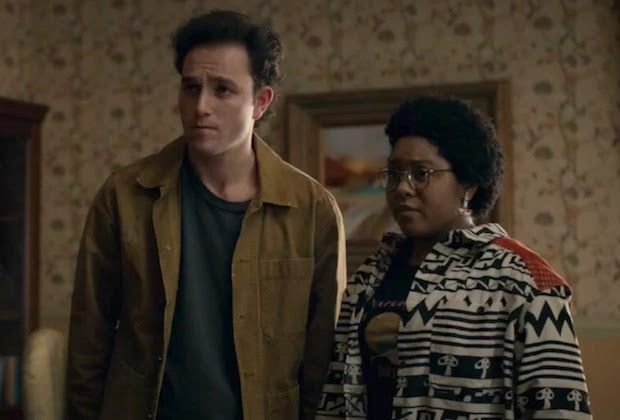
I certainly didn't see THAT coming. I assumed that part of next season's journey would be Rick and Cameron finally, ya know, working out The Big Thing Between Them.
And I don't mean Grundy.

I had completely forgotten about The Search for Becky, but Courtney didn't because she's a better than I am (and, you know, than just everybody).  Courtney didn't get told "you shit marble" by anybody and finally was able to say "Hey, I shit marble!" herself, which I suppose was her character arc.  The arcs were full of pairs during the finale as Everyone Got to Face Off with whoever they needed to, and I was most satisfied by Beth and Sofus simply going, "Can we just NOT fight? Great."

As for me, well, I got to see Joel McHale strapped down half-naked to a table with Neil Jackson whispering in his ear.


Dreams CAN come true.

Even Sir Justin, the janitor from Season 1, was not forgotten, since the "recap of the future" let's us know that the JSA eventually rescued the missing Soldiers of Victory from the Nebula Man.  

Imagine Stephen Amell and Colton Haynes in even ONE SCENE
 dressed up as the Golden Age shelf-elves. 


But the final scene, between Jay "The Flash" Garrick and The Shade, was the real mystery.

John Wesley Shipp played a superhero when that was the hardest thing to do on screen and deserves every resultant perq in perpetuity.

I don't mean Jay's reference to "some adventure we all need to do!"  I mean Jay semi-ironically calling the Shade "old friend".  Because that's when it hit me: the idea that the Shade was a recurring Flash villain in the Golden Age had been repeated again and again and again in continuity since 1961.  And I knew immediately that, therefore, it must be completely false. Why else would it be so often repeated but the stories never re-printed or any of their conflicts used a seed for a modern plot?

Do ever get the feeling that you're slowly but surely turning into...
Speed Saunders?

This idea is (of course) regurgitated endlessly on the internet.  Whoever those people who write the internet are, they will believe ANYTHING they read in a comic book (or elsewhere on the internet).  So, just like with Hippasus of Metaponum, I decided to check, this time with help from the DCU Guide's Chronology of all the Shade's appearances (which must be correct, since it's on the internet).

Naturally, just like a Golden Age Hero, my hunch was correct. The Shade appears in exactly ONE story in the Golden Age, which I then read at Speed Saunders' library after donning some appropriate bracelets.
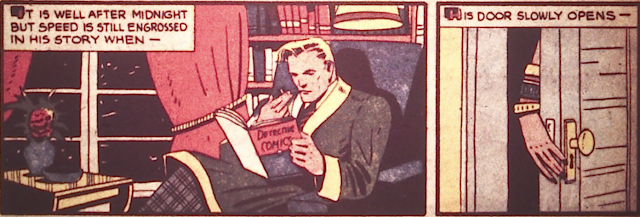

I mean, how many people own ALL the issues of Detective Comics before Batman debuted?


The Golden Age Shade is different from his later versions, and his story is just as terrible as most Jay Garrick stories.  I don't have the patience to 'read' it with you (nor do you deserve such punishment). But I will share some of what I learned from "The Man Who Commanded the Night!"

The Shade wears normal, if old-fashioned, black clothing. As opposed to his hilarious "beano with top hat" outfit from the Silver Age.
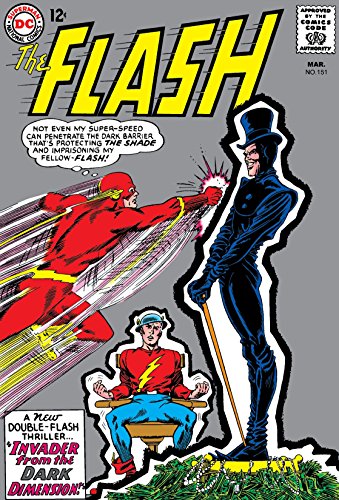
How many years was it before The Shade finally said,
"Look, I'm just going to wear my pajamas from now on. It's not as if anyone SEES me."

The Shade is pure (comic book) science; he brings darkness to the city with a machine (more on that later). That darkness has a scientific antidote: cosmic ray–based flashlights called "cosmoray guns".  
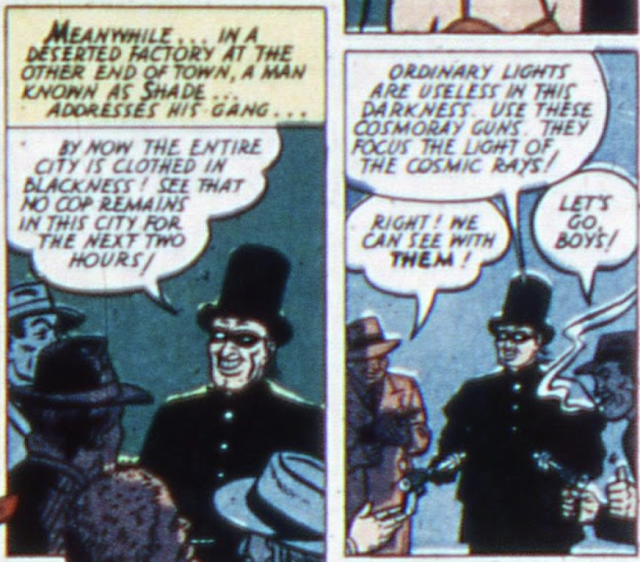
Cosmo Raygun? "Cosmo Reagan" would be a great pseudonym. Anyway, it's the Starman Era and "cosmic rays" were still pretty mysterious, so comics writers enjoyed the opportunity to use them as plot devices.

But the Shade is not up against Starman (who would clearly kick his hinder and give him a lecture about the responsible use of cosmic rays and ridiculous headgear); he's up against Jay "The Flash" Garrick. Who's a lunatic.

Allow me to clarify.  MOST of your impressions of Jay Garrick from post-Golden Age comics are pretty consistent with his actual portrayals in the Golden Age.  Friendly guy, science-smart, DILF-y vibe, unflappable and light-hearted in his heroics, happy with his knowing bombshell girlfriend.  What you DON'T know without reading original Jay Garrick stories is:

Jay Garrick was not only 10 times more light-hearted than Barry Allen but 100 times more savage.
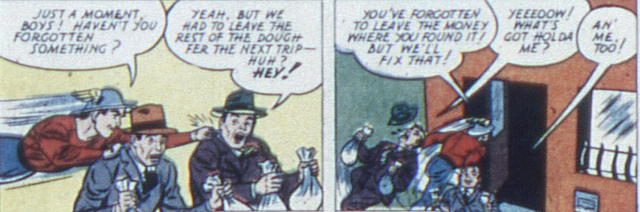

10 times more light-hearted.


100 times more savage.

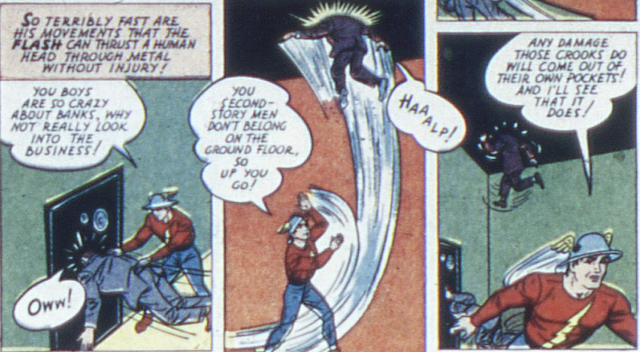
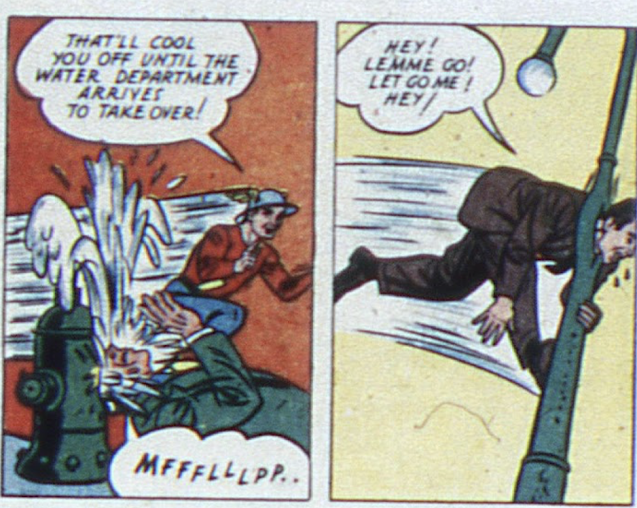
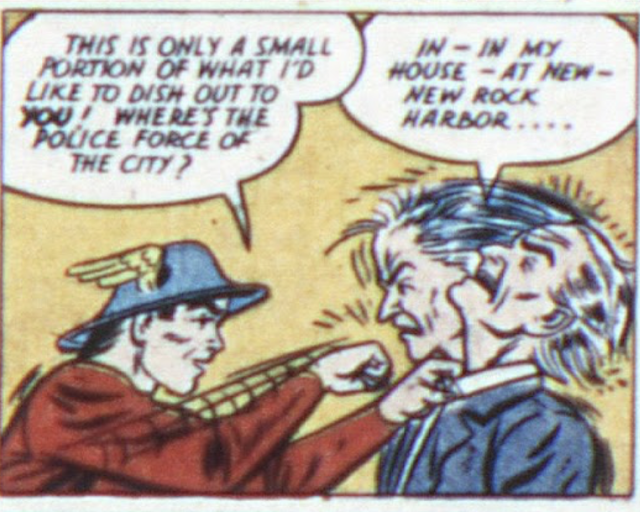
Yes. Read it again.  Jay could – and did – uses his vibrational powers (which the writers didn't know how to name) to embed those men's bodies into solid objects. And then make them PAY for it. Jay may not sweat when he runs, but he exudes nightmare fuel.
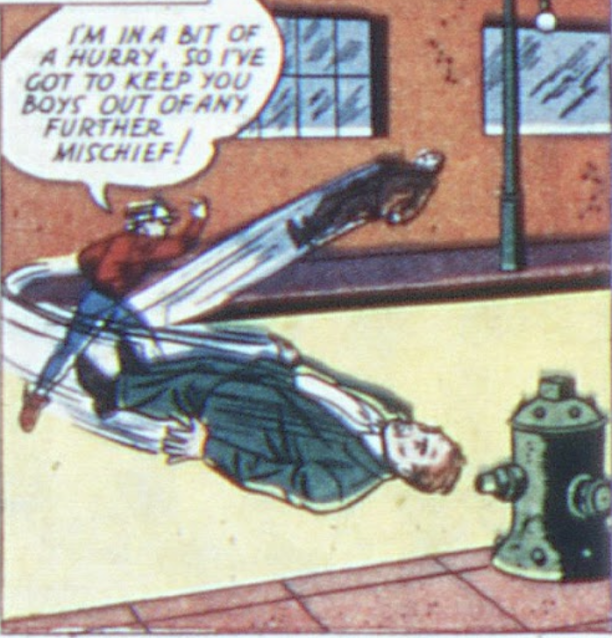
I think Geoff Johns is wrong...

if there is hero who clearly should NOT have had kids, it was Jay Garrick.


Imagine having your head embedded in a spouting fire hydrant. But Jay always played such horrors for laughs. Jay spent a lot of energy using his powers to humiliate his (criminal) victims, because, as we have discussed, humiliation was a highly favored tactic in Golden Age crime-fighing. And the Flash was a light-hearted (Golden Age style) series, so light-hearted it's CRUSHED under the weight of frequent comedy-relief characters and passages. The Shade gets less screen time in his own story than the Happy Drunk who winds up being Jay's unintentional partner in Shade's defeat.
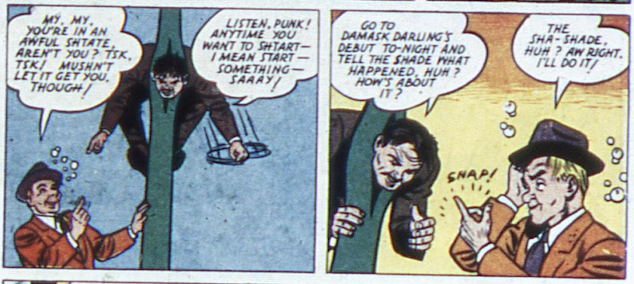
Guy never gets a name.  I bet it's "Cosmo Reagan", because comic book irony.


Jay, being a scientist, deduces that The Shade is generating darkness by... removing dust.

Apparently, Golden Age writers didn't understand how LIGHT worked, let alone cosmic rays.


Dust; remove it and all is in darkness. Well, as hilariously, insanely wrong as that is, it is The Premise of the story. So how is The Shade–
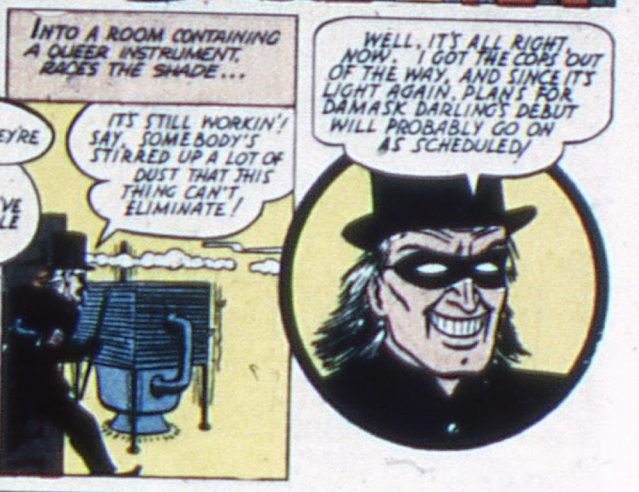
a super-dust-filter machine, of course.

Hard to imagine, but Shade's original gimmick is way less believable than "a magic cane". 

It actually WASN'T a "magic" cane in the Silver Age, because, just as for Shade's first story, Gardner Fox was STILL the writer.  He didn't do "magic", just vague "science" that might as well be magic.  Only later writers finally gave up and retconned it:
"Yeah, this damned thing is obviously just MAGIC."

 
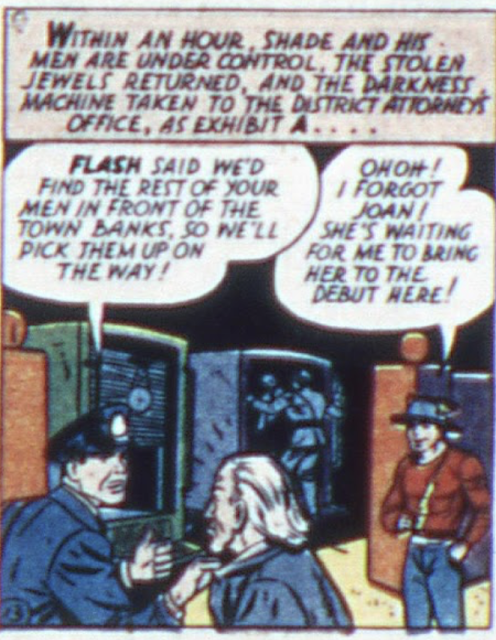
Well, the science Premise may be stupid, but the criminal Scheme is ingenious: instead of running out to loot the city during the blackout, Shade has his gang CAPTURE THE ENTIRE CITY'S POLICE FORCE, station by station.  Only afterwards do they loot.  
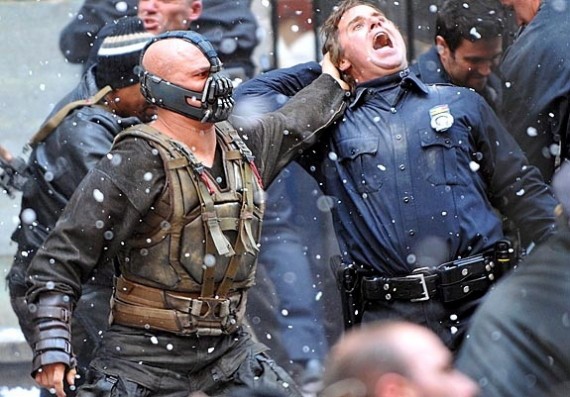
Bane steals all his plans from Golden Age Flash comics, because he knows no one reads them.


When Jay does eventually confront Shade & Gang, he continues his reign of speed terror/humiliation in a way that poor dull Barry Allen would never imagine.
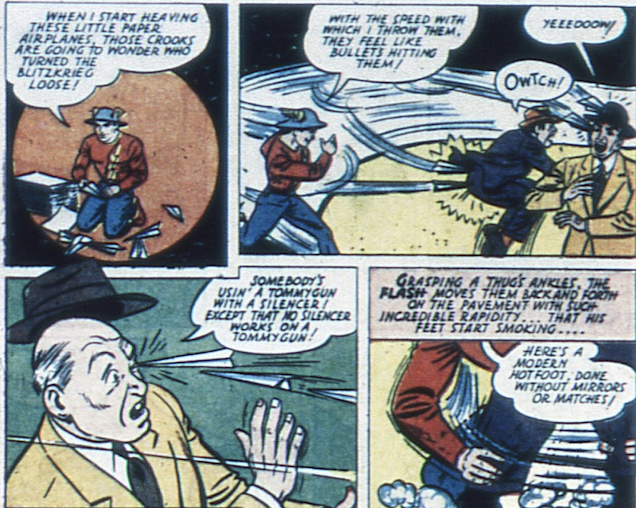
With paper airplanes


Paper airplanes thrown so fast as become like bullets; that's both playfully humiliating and pants-wettingly terrifying.  Jay may not have regularly consorted with talking dinosaurs or been turned into a puppet, but the imagination he brought to the mundane task of fighting Guys-In-Ties was manic. The man was a lunatic performance artist and every storylines has "power-using passages" that seem lifted from the Emperor Joker storyline.

Fact is, seeing Jay use his powers simply and efficiently would be painfully boring, especially for kids, so the writers had Jay use his powers in ways that KIDS would use them, or at least would be entertained by.  But with the ten zillion speedsters, good and evil, that Flash writers have insisted on generating over the decades, not ONE of them uses their powers the way Jay did. 

ASIDE: THAT's what I would do to distinguish a speedster (maybe even Wally/Wallace).  Imagine a Flash (or another speedster) who stopped focusing on RUNNING.  

Can you imagine how terrifying the Flash would be if he just learned to use a bow and arrow?

SHOOT, BARRY, SHOOT!

It's been done on occasion. Remember Lieutenant Boomerang? Or the version of Zoom who'd learned to weaponize HIS FINGER-SNAPPING?  

A trick he taught the Reverse-Flash.


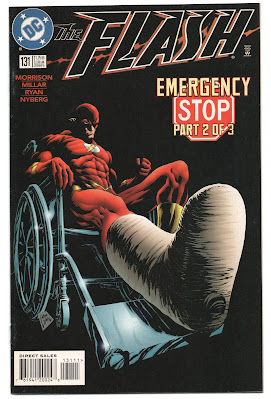
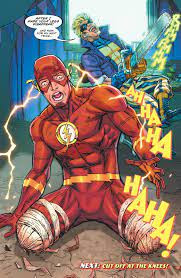
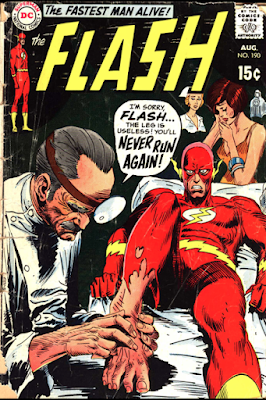
Imagine a speedster confined to a wheelchair!
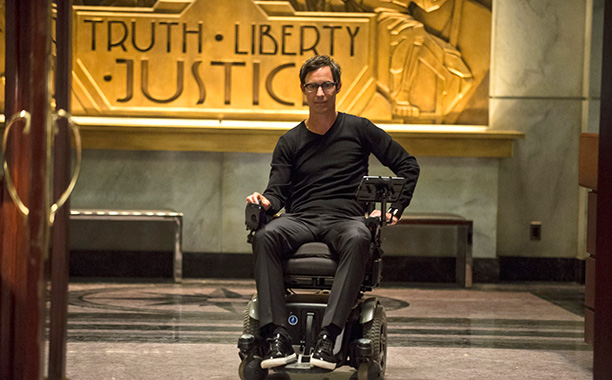
Nah, that would never seem threatening.


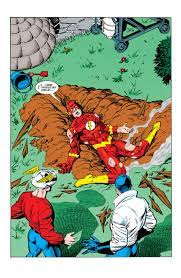
None of these stories 

ever confronts the actual issue

of what Flash or another speedster could / would do

if the condition were actually permanent.

ASIDE OFF

Jay Garrick appears in only three panels with Shade, depicting the traditional three-stage final face-off between a Golden Age hero and villain: 
    1. the Intro ("I've come to punch your face repeatedly"), 
    2. the Fight ("Here's a joke about punching your face repeatedly"), and
    3. the Remanding ("Now that his face has been punched repeatedly, take him away, officer.").
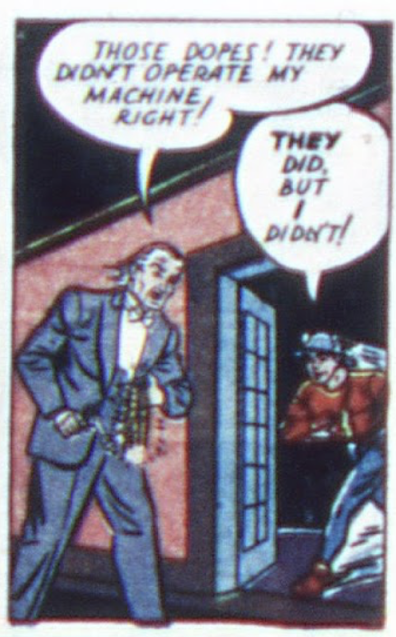
I'VE COME TO PUNCH YOUR FACE REPEATEDLY.


I'M PUNCHING YOUR FACE REPEATEDLY.

HERE YOU GO, OFFICER

Congratulations; with those three panels you have now experienced the totality of Jay Garrick and the Shade's ACTUAL INTERACTION in the pre-Silver Age comics. Realize that everything else is just modern retcon to make the character usable or interesting.

I learned some other things from the rest of Flash Comics #33, but I'll save those for another day. Now that this matter has prompted me to (finally) learn to edit Wikipedia, I have to make sure there's no wrong information on the internet. Plus, thanks to Wikipedia's automatic suggestions, I don't have to patrol Wiki City; Commissioner Crowdsource just asks for my help with a Scipio-signal and is telling me a hero needs my help!

I mean, how hard could it be?