Thursday, July 11, 2024

Doll Man versus the Runaway Formula, Part 2: The Well-Known Powder

When last we left Darrel ("Doll Man") Dane he was cruising a train to find a man.

How could he NOT see you, with that idiosyncratic perspective making you seem 8 feet tall?

This means that Dane anticipates recognizing the thief, and vice vera. Which means that... he and Dr. Rogers SAW the guy steal the formula?  How on earth did THAT happen? Did they just... jump in a car and chase him?  If so, how did they not reach him before he had time to board a train?  Did they not think to call the authorities?

None of this matters. It's a Doll Man story.  Things happen as they need to in order to facilitate Dollmanning, end of subject.  

"I think I hear... the characteristic overconfidence of lunatic chemist Darrel Dane! Cheese it!"

Guiltily, the Joe Spinell of espionage grabs his yellow trilby and briefcase and leaps from the train (which, fortunately for him, Dane has already stopped).


I really can't blame Dane for hesitating before jumping out into whatever post-apocalyptic irradiated atomic wasteland is being depicted in that third panel. He may be crazy but he's not stupid.

Joe Spinell unaccountably and improbably simply disappears in the meager scrub brush clinging to the scorched earth, because, well, because the plot requires him to escape.  But while Dane doesn't find Spinell, he DOES find Dr. Rogers, his badass senior colleague, who apparently continued to drive a convertible at over 80mph from the passenger side without even losing his hat until he caught up with the stalled locomotive.

"Too bad. I suppose foreign agents will use my work to kill thousands, then. Ah, well. At least it was a fine day for a bracing drive through the post-apocalyptic hellscape."

Since they are eminent chemists Dr. Roberts and Darrell Dane need face no reprisal for halting an express passenger train in the middle of a post-apocalyptic wasteland; rather, they pause in Lincolnesque fashion to bid the train a fond and affectionate farewell.

And to appreciate some PERSPECTIVE PORN.
I declare it's a thing.

But, what's THIS?!

Joe Spinell escaped WITHOUT his briefcase, which has lodged in the scarred crags carved by atomic explosions into the post-apocalyptic cliff-side. 

What absurd luck! Now all they have to do is retrieve the briefcase, which contains Dr. Roberts' stolen formula!

Or not.


So ...

the formula they were looking for isn't in Spy Joe Spinell's briefcase.  Which... 

makes zero sense.  

Did Spinell REMOVE the formula the briefcase before jumping from the train? He had no time to do that. 

Did he have the formula on his person and not in the briefcase? No, that makes no sense, since why else would be carrying a briefcase than to carry papers in? 

The answer, of course, is...

because the plot requires it in order to facilitate Dollmanning. End of subject.

And facilitate Dollmanning it does, because, as the dialog indicates, Dane is CERTAIN the spies will come back for the briefcase (even though we have no reason to believe it has anything of value in it, since the formula's not there) and therefore hides inside it.  

Dang, Dane works that outfit like a go-go boy at a Pride Parade.


After all, what could possibly go wrong?  Other than the briefcase being carried off but a mangy mutated fox or invaded by irradiated fire ants?

"Phew.  Now I don't have to worry about my daughter marrying this lunatic."

Dr. Roberts leaves Dane to his fate.  I like to imagine that Dr. Roberts doesn't even get into the driver's seat of his convertible, but sits back in the passenger seat, puts a rock on the accelerator and motors home at 80mph while steering with his left hand, because that's the kind of badass Dr. Roberts is.

PERSPECTIVE PORN, I SAY.

Naturally, Dane hasn't gotten long to wait because this is the Golden Age and the plot can't plod.

Speaking of badass, this guy doesn't even SLOW DOWN to pick up the briefcase. Golden Agers were made of sterner stuff, I tell you.

Any ordinary person would be wildly buffeted about and injured by this treatment, but this is DOLL MAN we're talking about here.

Who ALSO gets wildly buffeted about and injured,
which I find hilarious.

Well, as least the rough part is over.  Now that he's been picked up by the espionage courier, Dane can sit back and relax until he's delivered to the spy headquarters.

Oh. Oh, NO....

Or this could happen, instead:

BWAHAHAHAHA

I'm sure that Doll Man's okay. I mean, he's a Golden Age hero, after all, and they are made of sterner stuff.


The little airplanes are a VERY nice touch.

Hahahahaha, Doll Man is totally going to leave teeny, tiny vomit in that briefcase. Or WORSE.


"What the @#$& is that SMELL?!"

The flight deck crew is non-plussed by the briefcase's contents.

Golly.

So, Doll Man, being insane, decides that the logical thing to do is

climb out on the wing.

I'm in aviation. In my professional opinion, there are no "safe places" on the wing of an airplane. Even for people under six inches tall.

The flight deck crew, meanwhile, inspire one of Williams Shatner's best loved performances.

"THERE'S A MAN OUT THERE."

Phew. 

Well, now Doll Man is "safe", perched on the landing gear of a WWII-era aircraft, where he just has to endure winds of, oh, 200, 300mph until they land at spy headquarters.

Whatever follows will obviously be a piece of cake by comparison!


Wednesday, July 10, 2024

Doll Man Versus The Runaway Formula, Part 1: Coal Porter

You remember Doll Man? The lunatic chemist-crimefighter whose size-changing chemical affects his brain and lives in Escher City, with its idiosyncratic perspective and avant-garde decorating style?  Who we've seen fight a diamond-thirsty hunchback, a box of chocolates, and the U.S. military?  

It's easy to blame Escher City, but in fact, as that train shows, the idiosyncratic overly dramatic perspective is just something that follows Doll Man around. No doubt it is visually evocative of his perspective as a tiny person (or as a lunatic). 


Today we join chemist Darrell ("Doll Man") Dane in medias res, as he motors at full speed with his colleague (and father of his Gal Pal Martha) Dr. Roberts to recover a dangerous formula stolen from Roberts by foreign agents who are now on an escaping locomotive, in hopes of neutralizing the formula into becoming a valuable antitoxin using the fictional chemical "hypersulmide", 

Got all that?

If not, here it all is again.

Boy, I love the Golden Age, but sometimes trying to take in the ultra-condensed exposition and plotting is like chugging a thermos of double espresso.

Dane casually turns over the wheel of this car, doing 80, to an elderly man in the passenger's seat, while jumping for a moving locomotive.

Because Doll Man is insane.

How does Dane turn into Doll Man, you wonder? Originally, it was a gas.  Then it was a pill. By this point, for narrative convenience and through power internalization, it is apparently through sheer force of will.

Even The Atom uses a size-changing belt (controlled through his gloves).  Doll Man does not have the time or patience (or sanity) for such things.

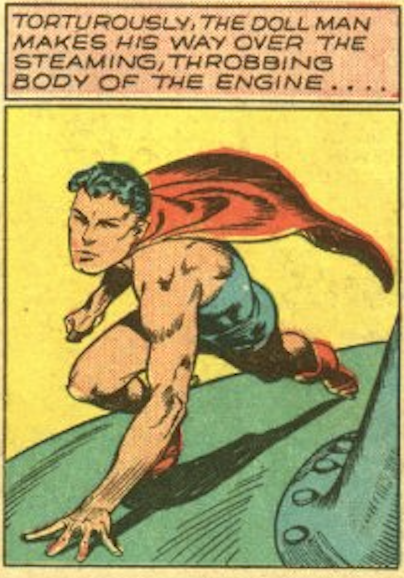
Some credit here; the shift into Doll Man mode, through inexplicable, is not gratuitous. A locomotive offers too little purchase for an ordinary man trying to climb aboard, but there's plenty of room for Doll Man.

Doll Man tries to handle the hot rod of the rainbow train.

I bet he says that to all the trains.

I apologize.  It's tacky of me to impose gay interpretations on innocent Golden Age panels!

But these panels don't count, 'cuz that's just SMUT talk there.

Phew! Glad that bit of homoeroticism is over!

For us, if not the engineer.

Doll Man brakes the train:

Hot: the little guy calling the big guy "boss".

For some stupid reason, he crawls through the coal car.


Oh. Here's the stupid reason:

For a blackface joke.
Stay classy, Doll Man.

Sigh.  I'll forgive a lot of a guy whose hands are as big as his face, but a line must be drawn somewhere.

Fortunately, Doll Man's Al Jolson phase lasts only one panel.

Where does that suit come from? The Dane-osphere, I suppose.

Can Darrell recover from this embarrassing incident enough to regain the stolen formula?  Tune in tomorrow (unless you choose to boycott Doll Man, of course).


Monday, July 08, 2024

Seven Things About The Map of Metropolis

I do so love maps.  What can we learn from the map of Metropolis, newly visible in set pics from the forthcoming Superman film?


1. Metropolis is in Delaware, as indicated by the Delaware Bay.

Locating Metropolis in Delaware is pretty traditional and has always made sense.  Metropolis is pretty clearly intended as an East Coast city and Delaware is a "gap" among existing large cities which allows you to locate Metropolis there without moving or eliminating any significant places or landmarks.

Although I am sure Jack Lingo would disagree.

Architecture fans like to imagine Chicago as Metropolis because of the presence of Art Deco and elevated trains.  And fans of Smallville, KS, often picture it as being closer to the heartland.  But those aren't as consistent with the history of Metropolis is portrayed in the comic books.


2. "It is a crag! ... a peak! ... a promontory! ... A promontory, did I say? ... It is a peninsula!"  Or, at least, so it appears. One cannot see what's beyond the western edge but it doesn't feel like it tapers off again into an island.

3.  It has many streets. Almost of which have been named after Superman-related comics creators.  In fact, there are TWO Robinson Streets, even though that almost certain would not happen in real life.

4. It has many smaller parks rather than one large one.  This is very consistent with what we have always been shown of Metropolis. There always seems to be a small park in walking distance of, well, anything.  The park that Superman winds up fighting someone above.  

5.  It has no marked neighborhoods. A little odd for a tourist map, where most people will be looking for general neighborhoods rather than every little specific street.  

Pity. I was REALLY hoping to find out just where Little Africa was.

This saddens me, as neighborhoods are the real handles by which we can pick up and drink lore from a huge cup like Metropolis. Metropolis does have neighborhoods that have been defined (or mentioned) in the past, even if not so aggressively as Gotham City.

One of many ways in which Gotham City is more aggressive than Metropolis.

I did see in other material from the film that the neighborhood of New Troy is being used, so there is hope for more neighborhood being mentioned, too.

6.  The city has a more historic "lower end", which gives way to more strictly planned later development.  This is the Manhattan model and, although Metropolis is not Manhattan, it is very logical layout.  The tip of the peninsula would have been developed first by settlers, using a more organic street layout, followed in later decades by more standardized city street planning in the American way.

Which is one of the things Superman protects.

7. It's a shipping/port town, as indicated by all the wharfage.  This might seem so obvious as to not need mentioning. But it is important to note since Metropolis is somewhere along Delaware's coast, better known for beachfront property than shipping.


The Metropolis map has Delaware Bay mapped clearly.  This locates it somewhere NORTH of Rehoboth Beach, since anything south would be labelled "Atlantic Ocean" rather than "Delaware Bay".

Wednesday, July 03, 2024

In which I complain about nostalgic remakes of a character from 1939

 In fact, no...

Pictured: creature of the night posing on a giant neon sign.

I am NOT looking forward to the new Batman: Caped Crusader animated series.

Oh, I will watch it (particularly since I already have Prime); I will probably enjoy it.  But I'm not sure this "Mazzuchelli and Timm have a baby delivered by Batman: Brave and the Bold" approach is the best idea.

I am, frankly, weary of Bruce Timm telling us that BTAS (Batman: The Animated Series) -- which was almost absurdly influential on a generation of Batman fans-- wasn't His Perfect Vision and he wants a do-over.  It's 30 years later, people. I think we all deserve to move on from the crude drawing style that disappointed me in 1992 certainly interests me even less in 2024. 

There are definitely elements in the trailer that do interest me.  There finally seems to be an innovative take on Two-Face, Catwoman in her original costume is always a plus for me, a non-annoying Harley Quin would be a deep breath of fresh air, fat Alfred is a bold Golden Age touch, and the like.  

But, really... "THIS time it's Batman EARLY in his career!" as if that's something we haven't seen a hundred times before (including Batman's ACTUAL original adventures, which are more accessible today as any current comic book, if not more).  I actually heard a YouTube reviewer say, "This is a new take on an Alfred we've never seen before, one who's not Bruce's surrogate father, but an active partner in his war against crime!"  Yes, "we" have never seen that before if "we" have never read a pre-Crisis Batman story or seen an episode of Batman '66; such is the depth of knowledge of YouTube reviewers.

Batman is a character created in 1939, who continues to have a very large following, both deep and broad, some 85 years later.  In that sense, complaining about "nostalgia" in treatments of the character can sound a bit hollow, perhaps even hypocritical.  The character is INTRINSICALLY nostalgic.  

However, my concern here isn't nostalgia for the character, but for one particle interpretation of the character: Bruce Timm's BTAS (and all the '90s/'00s related projects).  I don't wish to be harsh, but it was a highly un-even series, viewed with rose-colored glasses by people who watched it when they weren't yet adults.  I still remember CRINGING the first time Batman's "I am vengeance" speech aired; I still do every time it's mentioned. 

And I'm not easily embarrassed by Batman Stuff.

All that said, it's not like this is the ONLY version of Batman currently going on. The days when a comic book character (at least as one as popular as Batman) would only be allowed to appear in one version at time are gone.  And, as Bat-Mite pointed out in Batman: Brave & The Bold, a mythic concept like Batman is strengthened, not weakened, by the fact that it is open to multiple interpretations.

But I just feel like I've already seen this one. Over thirty years ago.


Tuesday, July 02, 2024

To Be or Not To Be

 Sigh.

I do appreciate the effort.

But.

If you are going to do this thing, please do it correctly.  The internet should make this easy.


εἶναι is the infinite of the Ancient Greek word for "to be".  Somebody just looked up "to be" in some dictionary, saw "εἶναι" and plopped it right in the sentence, with no thought as to conjugation.  I realize that English has fewer ending changes than Greek, but it is not Chinese; English does have conjugations, so this is quite naive and sloppy.

It is especially egregious in that the sentence correctly uses the genitive plural of "the monsters", which is the kind of thing comics always mess up.  How did they get that right and mess up the more obviously infinitive?

The correct form of the verb should be εἰσί; actually, since it is followed by a vowel, it should take a euphonious nu:  Îµá¼°ÏƒÎ¯Î½.

Not that anyone will read this, let alone take me up on it: I offer my consultation on Latin and Greek to any DC writers who want to use them in their stories.

Hm.

Except Tom King. Futuite istum.

Saturday, June 08, 2024

Bachmotifs for Batvillains


Shirley Walker, the composer who did the music for Batman: The Animated Series, was a skilled crafter of leitmotifs (musical themes to used as the signature music for particular characters).  Sometimes she missed the mark a bit (what possessed her to give Two-Face a theme that's in THREE, I cannot imagine).  But the fact that themes for the Penguin, Two-Face, and (especially) the Joker are all based on Elfman's Batman theme is simply genius.  

In this episode ("The Strange Secret of Bruce Wayne", Oct. 29, 1992), the three themes are all played in immediate succession as they get off the plane to visit Hugo Strange.

But what if Walker had not been available and we had to rely on an earlier musical talent? Say...

J.S. Bach.

Batman may merit a more serious composer.
But I have still chosen Bach.


That is to say, what pieces of J.S. Bach would one use as leitmotifs for Batman's most iconic villains? Here are my choices.


The Joker 

Die Kunst der Fuge, Contrapunctus IX, BWV1080

Bach wasn't exactly a free spirit.  A obsessively hard working perfectionist with anger issues, who still had a tender side.

Reminds me of someone else, seen here firing Alfred's predecessor. 

Bach was pretty strait-laced. But if there is any Bach piece that can be said to sound unhinged, it is Contrapunctus IX.  Boldly themed, it leaps out of the gate with an octave jump and pell-mell scalar run that always remind me of a madman's laugh, its theme punching through frequently, almost mockingly, above the melee of the voices. 

The exemplifying performance I offer you is by the modern madman of the keyboard, Glenn Gould.  I find it easy to imagine this version playing as the accompaniment to scenes of chaos perpetrated by the Joker as he is chased by Batman.  In fact, when I listen to it, I find it hard to picture anything else.


The Penguin

English Suite #5, Prelude (BWV 810: I)


This piece, like the Penguin, has a peculiar rolling gait. Bach's having a bit of fun with the "English" style; it's a bit precious and seems almost to take itself too seriously. It's trying to be dignified with its pompous theme, but can't help coming across as risible.  


However, the repeated reassertions of the theme give it a diehard dignity with a dark undercurrent. This is still Bach, after all, and despite his rolly-polly appearance, his ability is not to be underestimated. And genius disguised as gentility is the hallmark of the Penguin.

This harpsichord version by the impish Chiara Massini captures this feel.  The Prelude is the opening part, but you might enjoy the rest of the suite as well.


Two-Face  

Now, some people would have gone right to Bach's Two-Part Inventions, which are all about the interplay between two voices with related themes.  But I am not among those people, because I think Two-Face is a much more complex character than that.

I mean, c'mon; it's music for KIDS.

Instead, I have thematically chosen not one, but TWO pieces that could serve as leitmotifs for Two-Face.; one is for keyboard, the other is choral.

Canon 1 à 2 from J. S. Bach's Musical Offering (BWV 1079).

You don't see the Soprano Clef often.
Let alone a REVERSE Soprano Clef.

This deceptively simple-looking piece is more commonly known as Bach's Crab Canon.  A crab canon is a piece that can be played forwards or backwards, and --

here's the tricky part--

forwards and backwards SIMULTANEOUSLY.  Let that sink in a bit.

If you are old enough to, like me,  have suffered through the painfully baroque Goedel, Escher, Bach, you will already be familiar with this piece, or at least its structure.

The forward and backwards versions of the canon are like the obverse and reverse of a continually flipping coin. They are two opposite melodies that nevertheless fit perfectly together, both balanced and inextricably intertwined. Neither can "triumph" over the other, since they are the same thing. As such I think they well represent the "good" and "evil" sides of Two-Face and how he views those as merely two sides of the same coin, each implying the other.

It also sounds pretty creepy, and I have chosen Jos Leys' version for your listening AND watching enjoyment because it illustrates its unique nature well.

That is my cerebral, "amoral" choice of theme. My other (also creepy) choice is a more emotional and morally charged choral piece: the opening motet-style chorus from the cantata Siehe zu, daß deine Gottesfurcht nicht Heuchelei sei (BWV 179).

Mein Gott, what a terrible translation.


Boy, this baby had them squirming in their pews in Leipzig on August 8, 1723! "Mind that your fear of God isn't hypocrisy" is a rather scoldy title, even for a hard-ass JSB church cantata.  But he wasn't kidding around here; the work is considered his musical condemnation of, well, people who were two-faced.  Being Bach, he built that into the musical structure. Each time the theme enters, it is answered (in stretto!) by an inversion of the theme as a counter-subject, with some chromatic spin, which is Bach's nifty (and salty) way of demonstrating (and condemning) two-facedness.  

It can be hard to pick out by ear if you aren't looking at the score and lyrics can be distracting, so I offer you a malinowskigram of the piece that may make it easier to perceive and, if you really want to get into it, here's a detailed analysis of the chorus.


The Riddler 

The Fugue in A minor (BWV543, No. 2)

What were you expecting: Schubert's Ave Maria?


This one was easy.

It's a fugue, because only a fugue could convey the complexity of the Riddler's schemes. It's in A minor, because the Riddler is weird and creepy.  It's relentlessly driven yet still capering, like the Riddler; its hiccuppy melody evokes Frank Gorshin's manic giggle; its frequent suspensions mimic the tension of confusion that the Riddler causes in those he challenges.

For decency, I must present you with music-stud Matthias Havinga's definitive organ interp, for atmosphere, I offer you Michele Bianco's plangent accordion version; and for clarity, a version that follows the score AND an especially helpful malinowskigram.

And, no, don't be silly: I didn't consider any of his "riddle" canons. Those are "riddles" only in historical context and nothing in their musical nature is appropriate to the Riddler.


The Catwoman

Ricercar à 6 from Musical Offering


Like the Crab Canon, this six-voice fugue is from Bach's Musical Offering (BWV 1079), which has a bunch of separate but related pieces.  It's a little sad, a little slinky, with an oddly jumpy melody that's a bit like a cat walking on a keyboard.   Being a ricercar, it's not strict and formal like Baroque fugue, so it's got a meandering quality, as if it simply can't be bothered to follow the rules.  And that reminds me of Catwoman.  Like Catwoman, the piece is actually more complicated than it might seem. 

Ordinarily, I don't approve of Bach played on a piano, but this version captures the Catwoman feel I get from the piece. Stretch out and relax to listen; it takes its time.

Thursday, June 06, 2024

Superman's Costume


Okay, I'm going to address this issue (the teaser pic from the upcoming Superman film) to get it out of my system. I am possibly the only DC comics fan who has NOT read any of the debate about this. But I have seen the HEADLINES of those articles enough to keep me aware of the issue.

Before I address the photo, I have to remind us of something about Superman's outfit:

It's a costume.

That may seem like a dumb statement of the obvious, but let me explain.  My point is that it is not a "combat suit" (such as Batman and other non-super characters favor, out of necessity). 

Some combat outfits are tactical.
Other are mostly ... strategic.

The man's invulnerable; the idea of a suit that "aids" him in combat is absurd. The only outfit that could possibly "aid" him in combat would be his birthday suit, since the fewer clothes he has on the faster he should be able to soak up solar energy.

That's what the Metropolis Prurient Scientific Society would prefer.

It's not a "disguise" (as are superhero outfits with masks).  Superman does want to keep his private identity secret, but he doesn't really rely on his heroing outfit to do that.  He relies on his super-thespianism and the idea that no one really has any reason to suspect that Superman even HAS a civilian identity.  

Now THAT is a disguise.


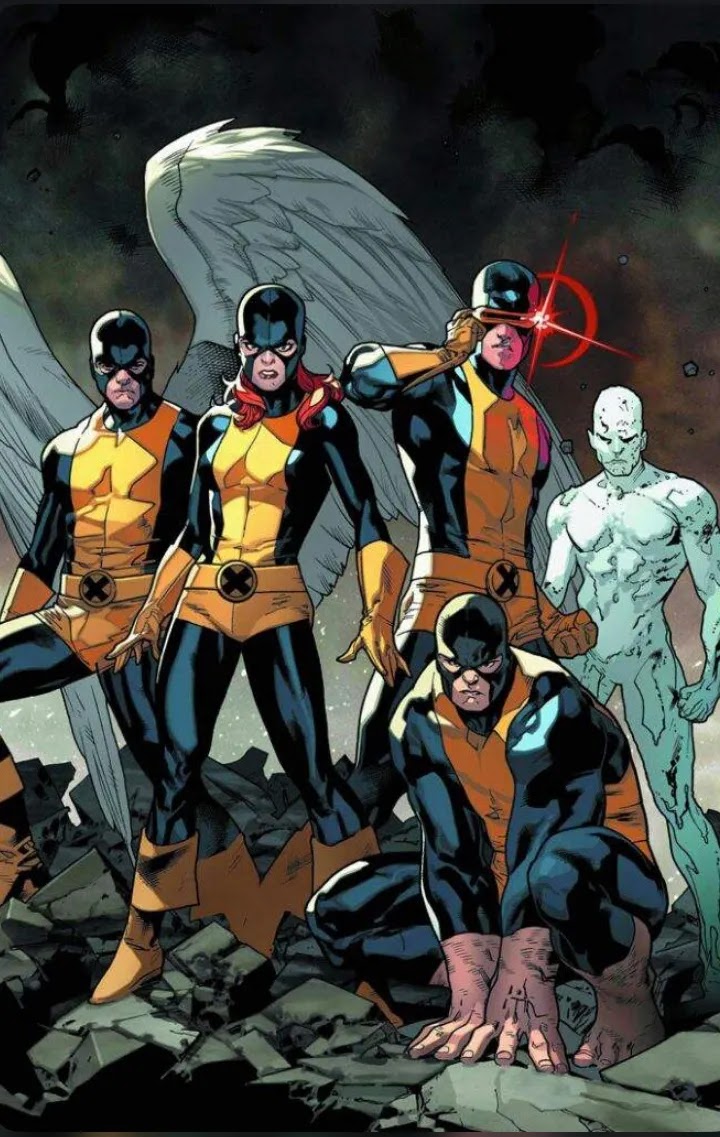
It's not a "uniform", such as the original X-Men wore to designate their status a members of a team,

Except for the guy running around apparently (mostly?) naked like he's a gay porn star.  
Must be an influencer.

or like those coordinated but individualized uniforms the Athramites designed for the Legion.

I love the Athramites.
If you do not know the Athramites, you have been deprived.

Uniforms, after all, are for characters who are known principally as members of a team, not merely incidentally.

The dumbest part about the New 52 Justice League was giving three of them the SAME COLLAR to give them more of a team look.  As if Hal, Arthur, and Clark go SHOPPING together.

No, it is costume, which he puts on for his "performances" as Superman (because, as previously discussed, Superman is essentially a circus performer).  

With all that in mind, let's examine the missteps in the photo of the film costume.

The costume does not seem well designed for the costume's purpose.  In contrast to, say, Batman's outfit, the purpose of Superman's costume is to make him very visible: a circus performer must be SEEN.  And clearly visible from a distance.

This iconic sequence of utterances conveys this need perfectly.

Superman needs to be as visible as possible so that people can be inspired by his presence and comforted by his arrival on the scene.  The movie costume doesn't shy away from the inherent color contrast in Superman's colors, but they have made them rather dark. The colors are right, but the hues are wrong, in that the fail to serve the costume's actual purpose.  That's misstep #1.

Misstep #2 is the texture.  The movie costume is all line-ified and Braille-bumpy.


Superman is a superhero, not a sofa, and does not require "texture".  This added complexity is not merely unnecessary, it is distracting.

For 25 years I was a performer on stage with a large chorus.  Often we were reminded to focus less on "adding" to the performance than on "subtracting" anything that would distract the audience. It was a process of working to remove moves or notes or vocal occurrences that might "stick out" from the whole, and distract the audience from the entirety of the performance.

So, too, should be the approach to Superman's performances as Superman.  His outfit already has a cape, and pants with a belt over a leotard, a chest emblem, those funky books and sometimes funky sleeves.  No additions are welcome, certain not detail that is completely invisible to the crowd of citizens who is the audience for his deeds.  Superman is not a complex character.  He may have lots of powers, but part of his appeal and staying power is just how simple a concept he is.  Anything that veers away from that simplicity is counter purposeful.

No counterargument based in some cobbled together movie lore can prevail. "Well, it's a Kryptonian garb that blah blah blah."  These are merely post hoc justifications for an aesthetic misstep and I will not dignify them with refutation; they are simply to be dismissed.

I do NOT deem the movie costume's collar as a misstep.  Yes, Superman's outfit traditionally  has an open neckline evocative of the shirts worn by circus strongmen.


But, other than showing how thick his neck is, that element of his costume serves no purpose but as a historical reference, and if someone wants to use a more natural and modern collar style, I see no reason to object strongly.

Also, I give a thumb's UP to the chest logo.  It looks BOTH like an alien symbol AND an image that any user of the Roman alphabet would perceive as an "S".  It's a fine line to tow, and they seemed to have done an excellent job on it, especially as it is MORE abstract than we have often seen, and so is in keeping with my views of the need for simplicity in Superman's costume.

Now for the blocking of the photo.  Look, I'm all for subverting expectations here and there to freshen up a literary property.  

For example, John Byrne's revivification of the Kents in his reboot of Superman became obvious only in retrospect; they had been DEAD in every other version of Superman (no, Superboy doesn't count).  

But this relaxed boot-donning pose is a severe misstep. Superman was mean to be a man of action; it's LITERALLY the title of the comic he started in.  And this putting on his boot pensively while sitting down is just about as inactive a pose as you could find outside a Hopper painting. Personally, the only thing I can think when looking at him in this pose is William Moulton Marston's fetish about Wonder Woman putting on her boots.

Showing Superman slowly putting on one boot like he's about to walk the dog in the rain, with no sign of urgency, concern, or even awareness of the disaster befalling Metropolis behind isn't some fresh interp, it's possibly the most aggressively out of character pose I can imagine.

Trite though it might seem after 90 years, there is a reason that THIS is our consistent image of Superman going into action. People are in DANGER and, superspeed notwithstanding, Superman LEAPS into action to save them, before even having finished his costume change, because there is no time to waste while lives are in danger.

And these are only the criticisms of the scene's symbolism.  There are also cogent, in-universe, fanboy logistical objections that are hard to dismiss.  Superman can FLY.  He is often depicted floating in mid-air simply because he CAN (and it leaves him more ready to act).  Why on earth is he SITTING DOWN to put his boot on?!  That's how humans do it because we can't defy gravity through force of will. 

Perhaps the creators of this film thought that the emphasis on him putting on his costume was a good way of highlighting the costume. However, as far as I call tell, it only seems to highlight much they simply don't get what Superman is about, not merely to me, but to most people.