Tuesday, June 10, 2014

Starch-enemies

It’s high time to talk about collars.

When the New 52 began about three years ago, there was a lot of hype from DC and corresponding kerfuffle from fandom.  Editorial changes and alternations of the characters backstories, settings, and casts were a concern, but those were considered routine.  As discussed before, readers are used to that sort of thing.  But changes in…costumes?!  That’s a different thing entirely!


DC was pretty clearly desperate to fight the ‘crimefighting in underwear’ look, which generally meant:
getting rid of outer-underpants;
adding collars to any shirts without cowls; 
and GELs (Gratuitous Etching Lines)  And, yes, the gratuitous etching lines are... a bit much.


God bless the genius of Yale Stewart.

Fact is, as most comic book readers (should) know, early superhero costumes are based on the outfits of circus performers.  And by imitation, the costume design for later heroes followed suit (so to speak).  While maintaining a clean and classic look is good, there's something to be said for updating ones wardrobe at least once a century (particularly since the circus is no longer the cultural touchstone it used to be).

Everyone knows the GELs are kind of silly and don't matter much. 

Losing the outer-shorts is really noticeable only on Batman and Superman (and Batman already ditched them before the redesign).
That leaves... the collars.

To which I say... GOOD! At last!


Yes, you heard me; I not only don't mind the collars, I wholeheartedly approve and am thankful for them.  Why?


Because decent, classy men wear collars, and I want my heroes to be decent, classy men.  


Let's confine this analysis to DC's six most iconic male heroes (since the rest aren't likely to cause any costume-based heartache in fandom).  Batman and Flash are off the table because they wear cowls and are thus collar-immune.


This leaves:

Green Lantern (Hal Jordan)
Superman
Aquaman
The Martian Manhunter.

Hal's costume has always covered his neck


Not his head.  Just his neck.

So in his case it's really a question of adding a collar so much as replacing his green dickie-unitard (dickie-tard?) mock-turtle thing with a proper swan collar.  


"GOD, my Adam's apple is beautiful!"

I can't imagine anyone not thinking this is an improvement. Anyone who doesn't probably wears lots of turtlenecks, which means his opinion can be discounted.


Superman costume was very open-necked in the Golden Age, in the manner of a circus performer


"I"ll have to use my power of super-lightning-farting!"

In the Silver Age, when it was all much more about being 'super' than being 'man', Kal's sexy sexy collarbone was covered up.


Sometimes there just aren't any cats-in-trees that need saving.


But without a collar it's still essentially just a long-sleeve tee shirt. Which is an adolescent or lower-class thing to do ones work (or super-work) in. Heck, you might as well just have Superman wear jeans and a tee shirt to do his thing.


Not that that isn't really, really hot, mind you.

Clark Kent has always been sort of a 'working man's hero'.  He grew up on a farm, isn't wealthy, has a job that serves as the springboard for much of his adventuring.


Still... he's an adult, and one in a white-collar job.  You may not think that has anything to do with what his alter ego of Superman should wear.  But the fact is, most modern readers don't want their heroes to have the air of independent vigilantes like they had in the Golden Age, when the average man felt particularly powerless and wanted someone to identify with. Nowadays, people taking the law into their own hands is more the kind of thing we FEAR;  we perceive it more as a threat to society than as a short-cut around bureaucracy. 


Therefore, we want our heroes to have an air of professionalism (something I wrote about in my article in Teenagers from the Future, by the way). They are not wildcards in a normal world, they are professional superheroes in a world where Superheroing is a Real Thing That People Do.  We don't want them swearing, or killing people, or making childish quips mid-battle, or any of the things that adolescents thing of as "badass".  We want them to approach their work as soldiers and police do: as a solemn responsibility to do an often unpleasant and potentially violent job for the protection of society using only the appropriate amount of force.  On average, readers aren't adolescents who want to feel empowered, they are adults (or children) who want to feel safe.


So now Superman and Green Lantern have military-style collars to give them that air of professionalism.  So too Aquaman (although in his case, I think his original collarbone-baring shirt has more to do with traditional sea-workers shirts than with circus performer outfits).


Not that that isn't really, really hot, mind you.

Personally, I like my superheroes to look like they care enough about what they do to dress properly for it.  Not like they just threw on tee shirt.


I mean, jeez; even ODDMAN wears a TIE.


I think he and the Batman of Zur-enn-arrh shop together.

P.S.  The Martian Manhunter has been giving nip for way too long.  ANY shirt is any improvement.


Wednesday, June 04, 2014

Can you answer "The Captain Atom Question"?

The “Captain Atom Question” concerns the incorporation of characters from pre-existing literary universes into another, larger literary universe, once their original universe is gone.  The question is: can this be done successfully?

My answer is essentially “no”.

Among the various literary media, this phenomenon is pretty much confined to comic books.  Comic book companies go defunct for various reasons and their intellectual property—their characters—get bought by another company.  


Usually this company is DC.  DC, you see, is a compulsive hoarder; “I could use that character some day!  I paid good money for that!  It’s going to come back in style just you wait and see!”  Occasionally, it reaches Crisis proportions and there’s an intervention where some nice folks from reality TV come in, negotiate to get rid of DC’s old crap by enticing it with new living room furniture (“There’ll be room for NEW characters, DC, sweetie!”), and clean house.  Then DC immediately starts filling the house with crap again.  Repeat cycle.

This, by the way, is in contrast to Marvel. It’s not a hoarder; it’s an obsessive-compulsive that spends all its time putting things in order.  It writes guidebooks that tell it how tall everyone is and classifies them by how much weight they can lift, sketches out all possible permutations of its universe with “What If?” stories, (“What if… Iron Man had had EGGS for breakfast?!”) and insists that all of its stories are part of one big *ahem* perfectly organized consistent continuity (despite any evidence to the contrary).  If DC is Oscar Madison, then Marvel is Felix Unger.

Sometimes even they get confused, however.

So, every time there is a publishing yard sale, DC goes out bargain hunting with a reticule full of one dollar bills and snaps up collections of old characters as if they were beanie babies.  The Shazam family of characters, the Wildstorm stable (the Authority et al.), the Milestone properties (Static, Icon, Hardware, Xombi, et al.), the Quality characters (Plastic Man, the Ray, Black Condor, Manhunter, Phantom Lady, the Human Bomb, Uncle Sam, Doll Man, the Red Bee), the Charlton heroes (the Question, Blue Beetle, Peacemaker, and Captain Atom, for whom this question is named)—all these are characters the DC acquired by lot at going-out-business sales.

With one possible exception—Blue Beetle—DC has tried repeatedly to incorporate all these characters in the DCU…and failed.  That exception was mostly confined to using Blue Beetle as comic relief, and even that success was spotty at best.

Other attempts to use such characters as comic relief have been mostly....
regrettable.

As a general rule, these imported characters simply don’t “take”.  Like transplanted plants, they simply can’t survive well enough outside of their native soil.  Back in the heyday of the Multiverse, DC seemed to accept this fact. Rather than try to bring these niche characters into the searing sunlight of the superfriends’ world, full of its  Underroo trees and constant crossovers, DC recognized them for the hothouse flowers they were and kept them isolated in their own hermetically sealed environment of alternate earths.   If the Freedom Fighters made sense in World War II, well, then, DC gave them an earth where WWII was still going on.  If the Shazams required talking tigers and worms to thrive, then give them a world that has them.

"Segregation now; segregation forever!"

You can try to claim that “DC just didn’t try hard enough because they didn’t care about someone else’s characters”, but I’m not buying it.  DC has repeatedly moved heaven-1 and earth-1 to get its readers to care about Captain Atom and consider him part of its pantheon, to no avail.  

Batman does NOT salute.  Let alone salute Captain Atom.

To incorporate Shazam, DC has tried a host of solutions, from surrounding him with every possible shiny toy from his homeworld, to aiming him at kids, to giving him several grim’n’gritty make-overs.  

Whatevs, Billy *eyeroll*.  Not even Geoff Johns can make you 'cool'.

I say that, for whatever reasons--call it vibrational frequency, if you will--such imported characters cannot work. Like transplanted organs they require great pain and effort in the form of constant editorial doping just to keep the host universe from simply rejecting them. So, perhaps, more precisely, it's not that they absolutely cannot work, but that the energy and effort required to do so is well beyond the point of diminishing returns from the character.

You are welcome to try to prove me wrong.

DC sure hasn't.


Tuesday, June 03, 2014

Haiku for Penny

On a spring Haikuesday, what could be more calm or peaceful than an evening's stroll with ones dog in a quiet statuary garden where--


"What will I call my terrifying human-faced lamb/mummy/dog hybrid?  I have it; Penny."

HOLY MOTHER OF ANUBIS, WHAT THE HELL IS THAT THING?!?!?

Hawkgirl has always been an odd sort, but her--well, I'll just call it a "pet", and leave it at that--really takes the prize.  Dr. Moreau himself wouldn't have spared it.

Sired by Anubis violating the Paschal Lamb and birthed deep within a pyramid in Egypt's Uncanny Valley.  "Penny" is, as previously discussed, one of the most disturbing (pre-internet) images from the hand of man.

Disturbing enough to render Hawkgirl's haiku nearly unrecognizable!

OH MY GOODNESS WHAT'S
WRONG YOU LOOK POSITIVELY
TERRIFIED OF ME! 

By the way, Penny runs away from Hawkgirl, who goes to search for her at the end of the story. She is never found.  Penny, I mean.  Thank Ra for small favors.

What haiku can you pen to commemorate the terrifying aspect of this zombie Lambchop?

Friday, May 30, 2014

An Original Question

Who is the most original Batman villain?

Batman, as we know, has many, literary ancestors, including Zorro, the Scarlet Pimpernel, the Phantom, The Shadow, and Sherlock Holmes.  Not only does that fact not diminish him, it ennobles him. Batman is to vigilante crimefighters what Bach is to the Baroque: the ne plus ultra, the superior synthesis of all that has gone before, the gold standard of his type.  One of things that makes Batman great is precisely how original he is NOT.

Only Bob Kane could create a character as unoriginal at Batman, so please be fair and give credit where credit's not due.


This aspect of Batman is a commonplace.  But what of his villains? How unoriginal are they and which is the most original?

The Joker.  Like Batman, the Joker is an unsurpassable synthesis.  The deformed Gwynplaine of "The Man Who Laughs' 


and the maddened murderous clown of Ruggiero Leoncavallo's Pagliacci, for example, 

"Hey, buddy!  Leave some scenery for the rest of us to chew, willya?"!


...are part of his deadly iconic mix.  One could discuss the genius of a creation like the Joker for hours, but we'd be wasting time making a case that he's the most original of Batman's foe.  Like Batman, part of what makes the Joker great is precisely that he is not original.

Catwoman.  Puh-lease! We all love Kitty, but she's every femme fatale every vigilante's every matched wits and mashed faces with!  Let's just cite Sherlock Holmes' Irene Adler, and leave it at that.  Sure, Selina Kyle had the animal costume fetish thing, but in that the character is just being set in the same mold and animal-totemed Batman himself.

The Catwoman would sweat Moxie. If she sweat.  Which she doesn't.


I certainly have a soft-spot for The Penguin, and always insist that he be given his due (which he's usually not).  But his creators are on record as saying that he was based on the "A.J. Raffles" character of a gentleman thief.  Maybe they just said that to distract people from realizing  how thoroughly they stole the character from Chester Gould's Dick Tracy.  

WAAAUGHK!


Two-Face is one of my favorite characters, and perhaps the Batman character with the most to say about human nature.  He's also quite the fashionista.

You need to understand that if the tie is NOT drawn that way, it means it's a CLIP-ON.

But Two-Face is just Gotham's take on Jekyll/Hyde (and it described exactly as such in the splash page from his first story.  
Read any good books lately, Harvey?


Compared to some of the above, the Scarecrow is actually fairly original.  But he's too clearly a villianized version of Ichabod Crane, the spindly teacher from America's most famous ghost story, Washington Irving's The Legend of Sleep Hollow.  

Professor Crane

The idea of a demented master of psychology holding an entire city in fearful thrall mostly for the hell of it and to sustain his own fragile ego is, after all, an American archetype.

That's DOCTOR Crane to you!

Later arrivals Poison Ivy and Mr Freeze may seem more original... at least until you've read Hawthorne's Rappacini's Daughter, in which a mad scientist, distraught at the loss of his wife, uses venomous plants to make his daughter poisonous to the touch, shutting her off from normal human contact.  

Combining the origins of Mr Freeze with that of Poison Ivy makes for a surefire classic.

I think, in fact, that the Riddler might be the most original classic Batman villain.  That may surprise you.  A villainous mastermind who toys with the authorities by leaving intentionally puzzling clues is SUCH a trope to us! Nowadays even violent psychopaths like Hannibal Lecter leave anagrammatic clues just to prove their smarter than everyone else. Why, without this trope, what would Kevin Spacey due for a living?

'Your guess is as good as mine. Actually, I lied; it's not."

But when you think about it...don't all of those many puzzling villains...FOLLOW the Riddler?  Honestly, I'm hard-pressed to come up with a literary predecessor to him in the whole "I mislead you with clues for fun to show how smart I am" type of villain.  I mean, sure there have been clever masterminds such as Fu Manchu, who might mislead their opponents.  But only incidentally, only as means to an end.  The Riddler seems to be the first character for whom 'the game' IS the end, and crime merely the means to play it.  

Am I wrong? Or is the Riddler actually the MOST original Batman villain...

which would explain why some many modern villains are based on him?  Which would make him, in a literary sense...
Batman's most influence villain?

Feel free to discuss.


Thursday, May 29, 2014

A Penny for Your Thoughts.

Hawkgirl....had a giant poodle.


Named Penny.

Somehow, of all the weird things comics have asked me to believe, this is one of the weirdest and hardest to believe.

Wednesday, May 28, 2014

The Martian Manhunter (for those who have ever been laid)

So, the latest thing we must all (apparently) weigh in on is David S. Goyer's recent convention comments about the Martian Manhunter:


“How many people in the audience have heard of Martian Manhunter?”
Following some applause from the audience, Goyer joked, “How many people that raised their hands have ever been laid?”
“Well, he can’t be f****** called ‘The Martian Manhunter’ because that’s goofy. He could be called “Manhunter.” … The whole deal with Martian Manhunter is he’s an alien living amongst us, that’s the deal. He came out in the ‘50s, and he had basically all the powers of Superman, except he didn’t like fire, and he could read your mind. So here’s the best part: So he comes down to Earth and decides, unlike Superman who already exists in the world now, that he’s just going to be a homicide detective, and pretend to be a human homicide guy. … So instead of using superpowers and mind-reading and like, ‘Oh, I could figure out if the President’s lying or whatever,’ he just decides to disguise himself as a human homicide detective. Dare to dream.
“I would set it up like The Day After Tomorrow. We discover one of those Earth-like planets… So maybe like… we get the DNA code from that planet and then grow him in a petri dish here… He’s like in Area 51 or something and we’re just basically… doing biopsies on him.”

First, we address the attempt to dismiss the Martian Manhunter and belittle those who might consider him significant or even relevant. Goyer is clearly being inappropriate, irrelevant, and rude.  But he's also being foolish. The fact that there are people who care about such things as Martian Manhunter is what keeps people like Goyer employed (let alone famous enough to stand there and deride them for it).  Goyer starts with an ad hominem attack on anyone who, by definition, would able to contradict what he's about to say.  That's a very strong tip-off that he doesn't feel his position is sound (or that he's just generally insecure and cannot bear any debate).

Goyer is well within his right to point out that there are conceptual problems with the Martian Manhunter as a character.  I myself have made a case that those problems are fatal flaws, and that DC should eliminate and abandon the Martian Manhunter.  But most of the objections he raises can be countered.

For example: yes, we know now that there is no life on Mars.  But J'onn's not from OUR Mars; he's from the DCU's Mars.  We know that the Nazis didn't have any giant red robots or a warwheel, and yet I've certainly seen those in comics.  We also don't have in our world: vampires, ghosts, Kryptonians, Atlantis, talking chimps and gorillas, magic lanterns, speed force, Amazons, or people who wouldn't realize that Ollie Queen is Green Arrow.  Yet, there they are in the DCU.

"The whole deal with Martian Manhunter is he's an alien living amongst us, that’s the deal."  Okay. Fair enough.


And damned smug about it, I might add.

"He came out in the ‘50s, and he had basically all the powers of Superman, except he didn’t like fire, and he could read your mind. "  No, not quite.  Mr. Goyer sounds like someone who is confusing the backstory that the Martian Manhunter has been given in subsequent iterations with his ACTUAL introduction into comics.  As any reader of the blog of fan of Apex City, America's Most Flammable Vacation Spot, already knows, when introduced the Martian Manhunter did NOT have 'basically all the powers of Superman; he also could NOT read your mind.  That was, in fact, one of the few things he could NOT do.  Was he stronger and tougher than humans? Yes.  But he was written mostly as having power Superman DIDN"T have.  He could change shape (grow giant, shrink tiny, and alter appearance).  He could become invisible.  He could become intangible.  He could manipulate matter mentally with great effort.  He didn't run superfast, but he could spin superfast.   He didn't have freeze breath, he had hurricane breath.  He was like Grant Morrison's Brotherhood of Dada character, The Quiz; he had every power you hadn't thought of yet.
At least buy them dinner first, J'onn!

What Goyer is actually criticizing is the oversimplication of the Martian Manhunter that came when he was no longer been written as a main character in his own storylines but merely as a me-too in Justice League and elsewhere.  And he is right to do so.  With J'onn as powerful as he is written now and with the power set he now has, it seems pretty feeble that he did nothing more than hide out as a police detective.  In his original stories, it made sense: he wasn't trying to be a superhero, he was trying to get home to Mars, but was trapped. So he chose a life doing something he had the abilities for; crimefighting, alongside normal crimefighting authorities.

Goyer is right that current J'onn with his traditional backstory...doesn't ring very true.  His personal solution to that problem is, well, a bit odd, in that it would make J'onn a passive figure, a Frankenstein's Creation; more like Superboy.  But the only thing that's really needed to fix J'onn's origin is to make him less powerful.  Reduce his power set and levels, make his abilities most a function of his mind, limiting how much energy he has to use powers, not letting him do more than one thing at a time, like a modern day Ultra-Boy.  Suddenly, creating an identity as a detective seems sensible again, particularly since he has no home to go back to.  And...why WOULD he become a superhero, since no one else was doing it?  Only after Superman showed what good could be done by 'coming out' as an alien superhero would it make sense for J'onn to do so.

Goyer's criticisms of the Martian Manhunter are poorly put, to be sure.  But rather than focus on correcting Goyer's failings, let's focus on correcting J'onn's.  Because frankly, I don't care at all about David S. Goyer, but I do care about the Martian Manhunter.

P.S. Even though I have, in fact, ever been laid.


Saturday, May 24, 2014

Little Fish

I evince many signs that I am not a normal person: the Chinese dressing gown, the impromptu lectures on the pre-Socratics, the Morningstar vegetarian sausage addiction. But none sets me apart quite so much from the stream of humanity as my fascination with Aquaman’s foe, the Human Flying Fish.


I guess if you're brave enough to undergo experimental surgery to become an amphibian thief,
you're brave enough to wear anything.

Recently, I took that a step even farther beyond the pale.  As long-time readers will know, I play a superhero tabletop game called Heroclix, and, although there are figures of many characters, many characters remain “unclixed’.  To fill that gap, players like me sometimes make/get custom-made figures and put them on appropriate dials.

One of the first that I ever got was, of course, the Awesome Human Flying Fish.  Now, however, I have gone ever farther (around the bend). Behold, a poor photo of my new custom of his legendary sidekick, SARDINE!


Note that he’s in the same pose as he was in his debut.


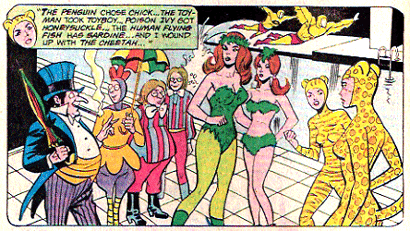
As I hope you remember, Sardine was introduced along with some other evil kid sidekicks in the famous story 'The Fury of the Super-Foes" in Super-Friends #1 (1976)

I was thinking of getting the other "Junior Super-Foes" made,
but I am NOT having "Chick" in my house.

I actually don’t have the comic (or any reproduction thereof) in which Sardine appeared and haven’t seen it since the '70s.  In fact, I can’t remember anything Sardine ever did, other than have the temerity to assert his own possible superiority to Aquaman.  I know at least that he never straddled Superman’s head in bondage-play, like Toy Boy.


There’s probably some fun Toy Boy slash fic, but good luck trying to google THAT.

We’ve certainly made much merriment at the expense of the Super-Foes story. But as friends have pointed out to me, villains having sidekicks isn’t just a silly Silver-Age-y idea.  In fact, it makes much MORE sense for villains to have sidekicks – young, easily misled cannon fodder – to assist them and serve as disposable decoys than it is for heroes to have them.  What kind of person intentionally brings underagers into a battle?  A bad guy, that’s who.   
Eventually, the villains had a spasm of conscience and decided to beat Chick to death out of mercy.

A theatrical, charismatic villain like the Penguin should have a Faganesque swarm of rugrats at his literal disposal, not just “Chick”, the dorkiest character in the entire Superfriends universe (which is QUITE an accomplishment).

Sardine sits on a "Dinah Soar" dial from Marvel Clix, which, frankly, doesn't bring a lot to the table(top game).  


But that's okay; I mean, "Sardine" shouldn't exactly be a game breaking powerhouse.  And at only 25 points, he goes nicely with the awesome Human Flying Fish (who sits on a fantastically hard-to-pin-down 75 point Catwoman dial):


Admit it, you're jealous now, aren't you?

Are there more effective ways to spend 100 points on a Heroclix team build? BWHAHAHA, of course.  But more FUN? I don't think so.  Besides, if there is even the remotest chance that, at some point, Sardine will be able to kayo that big-headed purple-eyed freak, Aqualad, it's worth it.

Thursday, May 22, 2014

Sensational News

As you've probably already seen, DC has announced the inception of a digital anthology series for Wonder Woman, titled Sensation Comics after the series in which she debuted.

As I’ve mentioned before, I like DC’s attempt to have a ‘pantheon’ of icons, to consciously choose who’s in it, and to promote the ‘trinity’ within it.  While all of that may seem like a foregone conclusion to younger or newer readers, it’s not.  DC’s history is full of instances where it would try to turn fleetingly popular characters into icons, rather than turning icons into permanently popular characters.  DC’s even tried to force characters into both popularity and iconicality™, such as Firestorm, Captain Atom, Stargirl, Atzek, and even Vixen.

This one's for you, Rico.

While current readers may take Wonder Woman’s iconic status for granted, that too was by no means inevitable.  Batman and Superman have had some rough patches, sure, but not like Wonder Woman.  In some way or other, she’s been ‘in trouble and on the bubble’ for most of her publication history.  She was very popular when she started out, but, once editors figured out why, they were shocked and terrified.  

Eat yer heart out, Jabba.


Squeezing out her bondage-loving creator, they vanilla-fied the Amazon, at which point no one had any idea what to do with her or her stories--particularly once she no longer had the Axis to kick around.

DC turned that around in the ‘80s, and the version of Wonder Woman currently starring in her current eponymous series is valid, coherent, strong, and well-rooted in the character’s essentials.  But it is not the only version possible.
I loved the biker shorts, and don't care what you think.

Batman and Superman are extremely archetypal characters, it’s true, and that is the root cause of their popularity.  But nearly as valuable to their longevity is their adaptability.  They have been presented in various ways and versions, adapted for different times and audiences, stripped down to their bare essentials and build up as the centerpieces of grand mythologies.

As one wise Absorbacommenter once said:
Trying to pin down what Wonder Woman is "about" may be too limiting.One of the great things about Batman and Superman is that they can be "about" all kinds of different things, depending on who's writing them. They are both icons, but they gain richness from the fact that they "mean" different things to different people.
When Wonder Woman has a strong enough mythos to be iconic, yet still open to interpretation, then she'll be part of the trinity.


It’s a bit ironic to think that DC’s most mythical hero may not be as ‘mythic’ as she deserves.  Myths don’t spring from canonical continuity; they spring from the ongoing process of syncretism among variant versions of a story. Myths are stronger and more powerful than mere stories, because myths are the result of evolution, not ‘creationism’, in which one creator casts in stone exactly what a character is for all time.  The more creators who get to put their spin on Wonder Woman, the more mythic she will become.  And the announcement of her new digital anthology, Sensation Comics, should be an Amazon-sized stride in the right direction.

Monday, May 19, 2014

Time for it to Stop

This weekend I watched some of DC Entertainment’s animated films.

I watched Justice League: Doom. It’s about replacing Aquaman, whom we pretend doesn’t exist, in the plot with Cyborg. That’s even though Aquaman is one of the four original “Super-Friends” whom the original “Legion of Doom” was gathered to fight.

I watched Justice League: War.  It’s about using Cyborg in the Justice League’s modern origin story to replace Aquaman, who again is completely shut out (although his pissy half-brother, Orm. shows up in the credit sequence).  This is major shift from the actual printed story, where Cyborg is used to replace the Martian Manhunter. 

At least I can look forward to the Superman vs. Batman movie, where there is no original comic story to ignore. So it will skip right to ignoring Aquaman totally, and including Cyborg, instead. 

Look, I have nothing against Cyborg as a person or as character—
Okay, wait, that’s a lie.

I’ve always thought Cyborg was a crappy character.  Great guy, but a crappy character.  Let’s start with the laughably ‘heroic’ name: VICTOR STONE.  Good heroes have names that undercut them, names that are boring or even wussy (“Bruce Wayne”; “Clark Kent”; “Peter Parker”; “Barry Allen”; “James Bond”, “Arthur Curry”, “Scipio Garling”,  et al.); it makes the superheroic identity seem like a contrast.  VIC STONE Is a movie star name (a PORN star name, really).  I can’t wait until he has a son someday and names him “Turok 2.0”.  Naming him “VICTOR STONE” cries out “this character is a HERO”, which is typical of the lazy, cheesy writing of his creator Marv Wolfman, the Man Who Could Do No Write.

"You have to love him. He's the captain of the football team!"

Then there’s his origin.  The iconic JL-level heroes have myths of self-creation (“I shall become a bat!”), happy accidents (“CRAAAAAAACK!”), or bequeathed legacy (“Speak my name”, “Doomed planet”, and “Oh, god, really, the ring choose YOU, WTF?!?! “).  Vic Stone’s origin is a “Doom Patrol” style origin: a BMOC (race car driver/movie starlet/jet pilot/football player) has a tragic injury that both marginalizes them from the norm and gives them special powers.  Why, it’s rather Marvelesque, isn’t it?  Like the origins of Daredevil or the Thing or the Hulk?  Almost as if Cyborg’s creator were writing for Marvel.

"DISHWASHING LIQUID?!?!"

At least Geoff Johns did a good job making Cyborg’s New 52 origin more epic (Red Room surgery with T.O. Morrow using alien high-tech to repair damage caused by Darkseid’s invasion!).  Cyborg’s pre-52 origin was that an experiment his parents should have been tending blew up at him because his parents were making out on a control panel; that’s Wolfman-style heroism. 

Huh; jive turkey!

And, of course, there’s the generic-ness of his powers/name.  Let’s slap some tech on him, that’ll let him do whatever we need.  He’ll be a cyborg. Named…. Cyborg.  Eventually he can hang out with Dark Vigilante, Strong Guy, Warrior Woman, Magic Lamp, Speedster, and Sea King.  Except when we just use him instead of Sea King.    It’s like he’s the result of an office bet at DC Comics: “I’ll bet you one dollar you can’t come up with a new superhero before the elevator ride’s over!” 

I guess it wasn't as egregious in his original setting in the Teen Titans, where Cyborg was introduced with Dark Mage Girl, Alien Metal Bra, and, um, Beast Boy.  He was always fairly colorless in the Teen Titans. No connection to any of the DC heroic dynasties or iconic characters, no independent stories or setting of his own, no special role on the team.   We all agree he was vivacious and charming, thanks to Khary Payton and fun writing, on the Teen Titans cartoon, but that’s hardly a reason to use him while benching Aquaman.

In all fairness, Canary's not a natural blonde.

I get that DC doesn't want its iconic heroes to be a ‘whites-only club’, and it’s laudable. And they've only got so much to work with.  Lord knows, all their attempts to level-up Vixen have consistently failed miserably, because, well… Vixen’s a much worse character than Cyborg, even.  You can put a pig in a dress, but you can’t teach it to dance.

Yeah, I'm guessing they all went in and were never heard from again.

But… Cyborg as a Justice League founder?!  Rather than Black Lightning, who’s got a much better publishing pedigree and Justice League connections?  Or Mister Terrific?  Or Vibe, who also got his powers from Darkseid’s invasion and is, after all, the world’s greatest break-dancing superhero, whether they show him doing it or not?

Anyway, I didn't intend for this post to become a diatribe against Cyborg as a character.  Or even against his choice as DC’s affirmative action choice in the Justice League.  It’s about EXCLUDING Aquaman from other-media projects.  About replacing him with Shazam in things (do NOT get me started).  About not treating him as one of its icons at the same time DC’s leadership trumpets its goal of refreshing his status as an icon.  Perhaps this is a split between DC Comics and DC Entertainment, I don’t know.

But I do know that it's time for it to stop.