Saturday, October 30, 2010

In Defense of the Riddler


Unless you’re living under a rock, you’ve probably already heard that the Riddler will not be the villain in Christopher Nolan’s next Batman film, “The Dark Knight Rises”. I certainly did hope that the Riddler would be the villain, and was looking forward to Nolan's interpretation of this underappreciated character. But I am okay with the announcement, particularly if the villain is the Catwoman, the Penguin, or Hugo Strange, all of whom arrived in continuity at least seven years before the Riddler did, and deserve their chance at a respectable turn on the silver screen.

What I am not okay with is the snark of the ‘thank god it’s not the Riddler!’ variety, particularly if the source of the snark is one of the many unread pop culture commenters who talk about comic book properties, but know too little about comic books.

Such commenters tend to make points like, "The Riddler is too much like the Joker."

“I think that there may be too many similarities with The Joker and The Riddler for one villain to follow the other in consecutive sequels.” Nick Newman at thefilmstage.com.

“So would it be a good idea to pit Batman against an enemy who, to casual fans, will appear to be exactly like the Clown Prince of Crime? Both are apparent maniacal lunatics and delight in using mind games to get under Batman’s skin as opposed to beating him senseless. For those who haven’t followed the comics, the two are far too interchangeable.” Gabriel Ruzin at shadowlocked.com.

Okay, I get it. If you draw from only a handful of non-comicbook media portrayals of the two characters and judge them a bit myopically by a few superficial characteristics, you might have this reaction. But really— you don’t have to have read any comic book portrayals of either to know that there is more than one way to play any character (certainly one that’s been around for seventy years). Anyone who doesn't understand that really shouldn't be a public commenter on popular fiction in any medium.

And, with even a little thought, the differences become obvious; they are intrinsic to the characters. If the Joker bothers to manipulate you, it's subtly, using ridicule and challenging your worldview. The Riddler delights in openly manipulating the hero, through forcing him to jump through hoops. The Joker is that annoying game opponent who psychs you out; the Riddler is the dungeon-master who delights in being fair- but only technically so. The Joker flaunts rules; The Riddler revels in using them to his advantage. The Joker is happy to tell you what his next crime is and dares you to stop him; the Riddler challenges you to figure it out. The Joker is an adaptive, philosophical challenge; the Riddler is a creative, intellectual challenge. As an opponent, the Joker's advantage is that you never know what he'll do next and neither does he; the Riddler's advantage is that he always knows what he'll does next and what you will, too. C'mon, people; is it really that hard for an average person to grasp the difference between a psychotic, chaotic, killer clown and an intellectual bully and control-freak?

Another common criticism based in an inability to look past previous media portrayals is that the Riddler is not a sufficiently serious villain.

"The next Batman movie should focus on one major villain from Batman’s rogues gallery – someone like Mr Freeze, Penguin, etc. (Riddler’s probably a little too goofy to carry a movie)." Oliver Wills, Like Kryptonite to Stupid.
"He’s a goofy character with a goofy gimmick, no matter how “dark and edgy” you make him. I’m of the opinion that the Riddler, ike the Penguin, is one of those characters who we only know about today and consider to be one of Batman’s Biggest Bad Guys because of the Adam West TV show." Phillip Mottaz Town

Sigh. I won't deny it: the Riddler can be goofy, in a way that Two-Face or Scarecrow are unlikely to. But so can the Joker (or the Penguin or Catwoman). But it doesn't mean they have to be. That's all the more reason that they need the occasional quite serious portrayal to re-emphasize that fact.

There's an undying appeal to game-playing villains and crimes posed as intellectual puzzles solved by intellectual means. Numb3rs. The SAW films. Hannibal Lecter. The works of Conan Doyle and Christie. The Zodiac Killer and Jack the Ripper. In the Batman mythos, the Riddler personifies this type of challenge. Sure, other villains have left clues (including the Joker and the Penguin). They've done it; but it's what the Riddler DOES. Perhaps he's not taken as seriously because writers aren't usually smart enough (or are too lazy) to craft intelligent clues for him. Or because (unlike most of the other examples I listed) he usually doesn't leave a trail of bodies in his wake.

But just because you-the-dullard-commenter cannot imagine a "non-goofy' interpretation of the Riddler doesn't mean that Christopher Nolan couldn't. You couldn't have imagined making "Memento" or "Inception", either.

Monday, October 25, 2010

Pep 36: The Rise of the Redhead


Hitler's ascension as Germany's Furher in 1934.


The Joker's re-emergence in Batman 251.


Stalin's Great Purge.


Palpatine's imperial rise.


Not even those memories can steel you for the ineffable horror of....


The Advent of the Andrews

Formerly, Pep covers had basked in eternal summers of fighting foreign foes and rescuing pointy-tata-ed blondes in red dresses. But that ended with the advent of the Andrews, who is to the MLJ-Universe as the White Queen is to Narnia. With the advent of the Andrews, a perpetual winter blankets Pep in its icy pall, numbing the souls of its denizens.

See the grim Hangman, punisher of evildoers, reduced to a broad-shouldered cheerleader for the Riverdale Regime. And The Shield--oh, pity the once mighty Shield. See how he has been lobotomized into some kind of joker-zombie by the surrealistic pseudo-humor of the Andrewstrosstruppen, his face frozen in the classic Riverdale-rictus. The pillar of justice is now turned into a litter-bearer for the buck-toothed dictator. Observe how the Shield and the Hangman are mocked by cruel youths behind them who have been indoctrinated by the copies of the Andrews' Mein Festnahme in their hands and ice-water in their veins.

It's not hard to tell who the other converts to the new regime are. That sickening sycophant, Captain Commando, grins idiotically at his master's victory, no doubt offering his trio of Boy Soldiers to be folded into the growing Andrews-Jugend organization. And Danny in Wonderland-- in retrospective it's so obvious that he was part of Riverdale's Fifth Column, with his red-hair and surreal adventures. Danny is clearly John the Baptist to MLJ's Anti-Christ.

Bentley of Scotland Yard and Sgt Boyd cannot hide their displeasure. They do not welcome their new inset overlords and know that their days are numbered. The lunacy of the Archieverse has no place for their kind of strict rationalism. Bently and Boyd? Expurgated and forgotten; yet the Riverdale Reich lives on.


Friday, October 22, 2010

What Kids Don't Know; Niles Caulder

You know, Niles Caulder wasn't always a
manipulative megalomaniacal jerk.

Once upon a time (1963 in fact), there was a very smart character named Niles Caulder. He was created by zany Bob Haney and Arnold Drake. Who were they? Zany Haney, well, let's just say he was a man who had his own perspective on the DC Universe, a view now dubbed the Haneyverse; if you're curious about that, just go here and search for Haney. Arnold Drake did many cool comic book things but all you really need to know is he wrote O.G.Whiz, which means I love him, and you do, too.

Arnold Drake wanted to create a character kind of like the ineffably cool Mycroft Holmes, Sherlock's smarter, older brother. Bob Haney liked to write, well, weird stuff about weird people. Behaving weirdly. Put them together and you got: The Doom Patrol.

The central figure they created to hold the Doom Patrol together was Niles Caulder, an inventing genius. Niles liked his work so much that wasn't quite picky enough about who he did it for, and it came back to bite him in the butt. Just like Leni Riefenstahl; but that's a different story.

Anyway, his one employer tended to confuse Quality of Life with Quantity of Life: General Immortus. Immortus wanted to live forever, possibly because it's really embarrassing to die when your name's "Immortus". He and Niles has a disagreement while Niles while working on making him an immortality serum. The disagreement was probably over the fact that Immortus had planted a bomb inside of Niles to keep him compliant. That's often a sticking point in union / management negotiations.

Niles managed to get the bomb out, but crippled himself in the process, leaving himself wheelchair-bound. But Niles was a great guy, with a great mind, so he wanted to help himself and other people like him, other great people whose greatness had been hampered by unfortunate accidents.

Daredevil race-car driver Cliff Steele, beautiful athlete and movie star Rita Farr, and hotshot test pilot Larry Trainer all become freaks after, um, freak accidents. Niles helped them cope with their conditions and find new purpose in life. They became not mere celebrities but heroes, using their new freakish conditions to help regular people and save lives.

Niles was a noble man, who not only overcame his own handicap, he helped others who might have otherwise wallowed in self-pity become saviors and inspirations to the world. And, after only five years on the comic scene, their final ending (in 1968) -- knowingly sacrificing themselves for a small group of total strangers -- was the capstone to their epic tale of rising above adversity.

UNTIL... two of most damaging blows ever dealt to the American psyche:

Watergate and Grant Morrison.

Of course, the Watergate scandal certainly wasn't solely responsibility for the American people's loss of confidence and trust in government and authority, but it surely symbolizes it. As a result of this growing cynicism, the world was ready for a less than flattering portrayal of the Doom Patrol's authority figure, Niles Caulder.

When the original Doom Patrol (more or less) were reunited in the late 1980s, Grant Morrison at liberty to write Niles Caulder cynically as a vicious, manipulative murderer. Since Morrison's re-start of the DP, we've learned that Niles orchestrated the accidents that gave the DP their powers, that he killed superhero Joshua Clay in cold blood, that he manipulates and lies to the DP and the entire superhero community. Lately he's been in cahoots with the evil President Cale of Oolong Island, the nation of villains, has commandeered a Kryptonian body and used it to attack the Doom Patrol and begin a takeover of the world.

Now, if you're a kid and never read any comics written before, oh, 1988, you might never know that this now-accepted version of Niles Caulder is just a cynical shellacking of a once great character with a modern disbelief in the idea of authority figures who truly wish to help change the world for the better while maintaining their own morality as well.

Once upon time, Niles Caulder (along with his teammates) was an inspiring model of devotion to the greater good, the human ability to overcome tragedy, and the power of avoiding self-pity through helping others. Now, he's a symbol of modern conspiracy-theory paranoia, distrust of authority, and anti-intellectualism.

The real Niles Caulder is still out there, kids; in fact, he recently guest-starred on the Batman: Brave & The Bold series. It's time you demanded to have him back as arole model, as my generation had, rather than the twisted mockery of him that your disillusioned elders have shafted you with.


Tuesday, October 19, 2010

King for a Haikuesday

I just love it when DC refuses to let any old character go permanently unused.

Often, it'll be a simple cameo. Just when you're not looking, the Crispus Allen will roll over that brutally beaten street cop whose mutilated corpse they found in an alley in Gotham's Abandoned Warehouse District and it'll be none other than Percival Popp. He was asking for it, really.

For example, who can forget when those lovable, well-meaning Three Dim
wits, so fondly remembered as whimsical irritants to Jay Garrick in his light-hearted Golden Age adventures, were found hacked to death in the Flash Museum last year? Good times.

I call these "Cameos... of DOOM!" Remember how Terry Sloane died?

Sometimes rather than a Cameo...of DOOM! they'll get the "quilt-patched". DC will craft more substantial roles for them, hoping to weave the half-life of the Q Ratings into some new property. Often it some sort of Frankenstein project, a patchwork quilt of characters with visas from Limbo stretched out over some 'modernizing' framework. You know the kind of thing: Checkmate, Suicide Squad, Primal Force, Shadowpact, the New Guardians.

Other times, they get better treatment, usually as a supporting character in the cast of someone more iconic. For example, the Quality Comics character Quicksilver was repurposed as "Max Mercury" to augment the Flash supporting cast. Maggie Sawyer, a wonderful, criminally underused and undervalued character in the Superman books...


whom the writers stopped using.

Now she's got a second life in the Batman books-- as a wonderful, criminally underused and undervalued character whom the writers stopped using.

Don't worry; Maggie's a big girl and can take care of herself. She'll be back, once lesbians are in fashion again. Probably when the latest vampire craze fades out.

On such character is King Faraday. King Faraday was a secret agent character introduced in 1950. When superheroes faded from fashion (just like lesbians!) after World War II, comic book publishers diversified again into a wide variety of genres, such as espionage thrillers.


You probably know him from his role as the Martian Manhunter's handler in New Frontier (the book and the movie). But now he's palling around with the Crusaders-- who are themselves re-imagined old characters (specifically the old MLJ Comics heroes, including regular Absorbascon whipping boys, The Shield and the Hangman).

Characters like King Faraday are impressively resilient and make places for themselves with their ingenuity. As demonstrated by his ability to haiku under pressure---
Don't listen to him!
He's just trying to martyr
himself for his cause.

So casually composed; very impressive! Have you a haiku to reply, or other commentary on Faraday and his ilk?

Friday, October 15, 2010

Jean Loring: Still Crazy After All These Years


"Um, yes, Jean, "Ray answered. "It was ... 'that man' who locked you, er, I mean, us in. I'll have the police take care him, don't worry.

"Now, just to be safe, I"m going to lock you in AGAIN, until a different man, a very nice one, in a nice white coat, comes to pick you up and take you somewhere safer... a nice, beautiful home in the countryside where you can wander, heavily sedated and supervised, through the gardens all day..."

Monday, October 11, 2010

Pep 35: Dear Libby's advice on Victory Gardens

Dear Libby,
I want to plant a Victory Garden in my backyard to help the war effort. But it's a too large for me to till regularly all by myself. I am SO worried I won't be able to handle it. What should I do?
VERY WARY QUITE CONTRARY, Roanoke VA

Dear Contrary:

Use a tank! They're great for churning up the soil and you can get them surprisingly cheap at the Army Surplus Store.

Be careful, though; sometimes the used ones still have previous operators lurking inside! Before use your second-hand tank, have your friendly neighborhood Hangman clean it out thoroughly.

Dear Libby,
Following your advice, I've been using a tank to till the soil in my garden. But how do I keep caked dirt and mud from clogging up the treads?
TREAD ON ME, Bangor ME

Dear Tread,

Simple! The answer is a point-tata-ed blonde.

Strap one of these Vicki Vale wannabes onto your tank treads, and watch as those wire-rimmed push-ups, pointy shoes, and teeth-filled shriek-holes simply tear up the turf. Remember, you'll need to change them after every few uses; nobody wants to plow with a dirty hoe.

Besides, hoe-girls are cheap. Certainly cheaper than tanks. Arm yourself with some of these bullet-bra babes and tank-gardening will be a truly harrowing experience.

Dear Libby,

Help! My backyard plantings were doing so well. But now it's infested with Japanazis! What's a victory gardener to do?
NIPPED IN THE BUDS

Dear Buds,
Uh-oh; those veggie-loving dirt-diggers can do some serious damage to a Victory Garden with those offensively exaggerated chompers, can't they? Recently, my friend The Shield had this problem. His own Patriot Patch was beset by Nipponese airmen. His solution...?
Fight flier with flier! Wrap yourself in an American flag, which they can't help but zero in on. Grab the first one that comes close and use it to beat the others senseless as they're drawn toward you like moths to a flame.

Wednesday, October 06, 2010

The Plunge


I've said it before, and I'll say it again:


Grant Morrison can never exceed the weirdness of the Silver Age, no matter how hard he tries.

Sunday, October 03, 2010

The Bat-Cycles


In a previous posts, we introduced the idea of the 'persona-cycle' as a means for varying the characterization of long-running comic book icons, and explored how the idea applied to Superman.

Batman, of course, has his own cycles.

*Sigh*. No, not the Bat-cycle. I'm referring to Batman's personality cycling between vigilante/lawman, loner/paterfamilias, night/day, old look/new look.

If Batman's literary depiction were controlled by a giant sound mixing board, some of the "levels" that one could adjust to ones preference would be:

  • Sanction: Batman's degree of sanction/cooperation from law enforcement authorities
  • Chumminess: To what degree Batman acts alone or with partners, colleagues, and groups.
  • Diurnalism: The likelihood of Batman being seen in costume during the day.
  • Spookiness: To what degree Batman's costume is dark and scary.
  • Localism: To what degree Batman's sticks to Gotham as opposed to globetrotting.

You may be noticing that Batman's 'cycles' aren't nearly as independent of one another as Superman's are. That is, there's a much greater correlation between their "settings". If Batman set at a 'low level of sanction" (operating in defiance of or at least without contact with the police), he is much more like to be a lone vigilante (low level of Chumminess), operating exclusively at night (low level of Diurnalism) in darker costume (high level of Spookiness) in Gotham only (high level of Localism).

In many ways, all these "settings" tend to be secondary aspects of one major choice in which version of Batman to portray, specifically:

Happy Batman

versus

Crabby Batman

Have you ever noticed that Happy Batman is often a lot creepier than Crabby Batman?

Batman's Crabbiness factor tends to determine the rest of his portrayal. However, it's not an absolute rule. For example, when Batman left the JLA to form the Outsider, or when he was in the JLI, he was pretty darned crabby... but had a high level of chumminess because he was working very actively with others.

But there are some other "levels" to Batman's depiction that operate more independently, such as:

  • Villainism: the degree to which Batman is fighting costumed villains as opposed to regular crooks
  • Mundanism: the degree to which Batman's world is non-fantastical.

Whether Batman is fighting the Joker or Two-Face or their ilk is charmingly unrelated to whether he's the grim figure of the night or ribbon-cutting Batman with a platinum police badge. Batman's villains are just as adaptable as he is, and tend to adjust their levels to whatever his are at the time. I've see Two-Face torture victims and steal shipments of chewing gum; I've also seen him act at intermediary between talking statues of Napolean, Caesar, and Benjamin Franklin possessed by alien Dronndarians and the Justice League. Batman's villains are nothing if not adaptable.

At first glance, you'd think fantastical elements in Batman would be inversely correlated to whether he's being all dark and gritty. That's not exactly what happens. If Batman's depiction is set to 'dark levels' it doesn't preclude fantastical elements; it just means that those elements are much more likely to be mystical rather than sci-fi. After all, one the first thing the grim Batman of the early Golden Age does is... fight vampires.

Are there other cycles that Batman goes through in his depiction that have occurred to you...?


Tuesday, September 28, 2010

Green on Green Violence in poetry


You know, it's funny how comic books continually expand your suspension of disbelief. Once you accept a man can leap an eighth of a mile or keep himself aloft with Martian-breath, you hardly notice when he starts flying. It's like boiling a frog.


Once you accept that there's a five-square mile blast area in the middle of Star City and a magical White Lantern that brings things to life, why, it only makes sense that the Lantern could -- and would -- bring life back to the middle of Star City. Life as in a gigantic old-growth style forest. In the shape of a huge star. Of course.

Given that, why shouldn't there be in the middle of the forest one Big Daddy Tree? That has a 'white lantern' tattoo? And that can talk telepathically? It only make sense!

When such a tree talks, well, wouldn't you kind of expect it to occasionally choose to express it....

in haiku?


This is not the Green
you will burn; this is not the
forest you will raze.


Leave it to a tree to include nature imagery in its haiku! What haiku does the White Lantern inspire YOU to compose today? Share it with us now...

Friday, September 24, 2010

Where does Batman vacation...?


In Florida, of course, like everyone. But Batman always goes to...


APEX CITY.

While in Apex City, Batman was asked to be a judge in
the annual Gertrude Stein Memorial Poetry Slam...
but he declined.


Probably goes there because he likes the weather in Apex. Hangs out with his pal, the Martian Manhunter, having lots of glum together. During the day they lurk about casting ominous shadows on sunbathers and handing out leaflets on skin cancer: "It isn't my job to judge them," Batman tells J'onn, "just to stop them." Sometimes the Phantom Stranger drops in, just to get together and prevent some laughs.

They stay up at night watching CSI: Miami reruns with the sound turned off, while they take turns riffing film noir voiceovers: "It was a hot and sticky night in the City of Flamingos, hot and sticky like a overweight drag queen's dress shields at Aqua."

Anyway, like any sensible man, I pattern my life as much as possible after Batman's (WWBD?)

So I, too, am in South Florida/the Keys this weekend with my very own manhunter. Catch you when I get back.

IF I come back!


Thursday, September 23, 2010

Superman's Persona Cycles

Character development is one of the important tools of fiction. Plot development makes sure the things happen in a story. While that is all that really needs to happen in a story, the events of the story gain more significance if they actually have an impact on the characters. Character development makes sure the things that happen in a story have an effect on the characters.

Character development is easy (or, at least, non-problematic) when your characters are meant for a one-time story (a short story, a novel, a movie). You can have events that change them quite dramatically. But for extended formats (television series, movie sequels, monthly titles) it's much harder to have a character develop again and again and again.

When your character stars in 1 to 6 stories a month for 70 years, it can be very difficult indeed.


And, so, whether by accident or intention, a natural means has evolved by which writers & editors can simulate character development with

the Persona Cycle.


We've outlined the idea of the persona cycle before, but it deserves a deeper look, which will be doing in weeks to come with some major iconic characters (Superman, Batman, Wonder Woman, Green Lantern, Flash, Aquaman, Green Arrow, and the Martian Manhunter).

Okay, sorry... I'll correct myself: "some major iconic characters AND Green Arrow."

We'll start with Superman. If you choose to comment, please do not move on to other heroes whom we will cover in later chapters, class. Save it till then.

Superman has at least two obvious aspects along whose spectrum he cycles: The Alien Aspect and the Authoritarian Aspect.

The Alien Aspect is how Kryptonian-oriented his stories are. We all know that Golden Age Superman had only passing reference to his being from another planet, and those were just hand-waving to explain his superpowers. Even better known is how Krypton-crazy his Silver Age exploits were.


I know your first thought was "AWESOME WALL POSTER!"
You just know you are eating this up.
Don't fight it; just don't tell anyone.


The Authoritarian Aspect is, well, it's Superman's 'suck-up' factor. How much does Superman rebel against / represent authority? In the Golden Age, Superman was a sort of 'super-activist', breaking in the governor's house, dragging socialites down into coal mines, and knocking down slum with his bare hands. Compare that to, say, his portrayal as a presidential errand boy in "Dark Knight".


Is Superman a citizen of Earth or a Kryptonian visitor? Is he an extra-legal agent of reform or the ultimate American cop / boy scout? Of course, the answer to either question is a resounding "yes".


Clark Kent (a character in his own right) also has at least two such aspects: The Awkard Aspect and the Agro Aspect.

The Awkard Aspect is pretty simply: how much and what kind of a goof is Clark Kent?

In the Golden Age, Clark wasn't clumsy or naive in the least. He was a hip urban reporter. But he was a milquetoast. Now, that's by Golden Age comic book standards. All it really meant was that Clark didn't hit people in the face at every possible opportunity, and didn't resort to violence as the first step in problem-solving.

Clark being "mild-mannered".


In the Golden Age, people hit each other in the face a lot.

Ever wonder why your relatives in all those old family photos look so ugly?
Well, now you know.

What Golden Age comic books called a milquetoast you and I would call "normal'", "sane", or "civil". For example:

Does this guy seem like a milquetoast to you?


In the '50s television show, Clark wasn't wussy in the least. He was thoroughly confident, in fact. Clark on "Lois & Clark" and "Smallville" was certainly never a loudmouth, but he was certainly much more sassy than sissy. In comics of the 1980s and '90s, Clark wasn't awkward at all (as long as you embrace the Mullet Retcon). In the 1970s, Clark Kent the Klutz was the stuff of Awkward Legend.

The Agro Aspect isn't talked about too much, but I think that's a shame. That Superman bridges rural and urban American is essential to his popularity. Golden Age Superman may have been raised on a farm, but you wouldn't know it to look at him. He was a sharper dresser completely at home in the Big City, who went out on the town in evening wear; and what's more urbane than an investigative city reporter? But Clark Kent of the 1990s was very much a farm boy, running (flying, really) back to Smallville at the drop of a hat to stare out into the fields. Each version of Superman decides how much to play up Clark's rural beginnings.


Think of these various aspects as sliders on a big mixing board of character. You can create a whole different version of the character every time you reset the sliders to different places. Add in more sliders (say, "Running After / Running Away from Lois", "Use/Restraint of Power", etc.) and you start to get a sense of how much can be done vary Superman as a character while still keeping him recognizable.

And 'moving the slider' can be done without a jarring reboot. Superman spent last year off-planet on New Krypton, at the far "alien" end of the spectrum. Now that's being followed by Superman's realization that he's grown out of touch, so he's walking America, saving elderly poor folks, playing basketball, and fostering civic improvement.

This is part of why Superman (and any similar long-term character) works. He can cycle back at forth along various aspects over the years, being always recognizable but never quite the same twice.


Discuss!

Monday, September 20, 2010

Pep 34: Upstaged!


Under ordinary circumstances, The Shield would probably be just staring up at the sky and thinking, "How the heck did Rorschach manage to colonize the MOON? Damn that man's publicity manager!"

But the tribal tattooing of our moon is literally upstaged by a closer horror: the freakin' Hangman occupying the foreground of a Pep Cover. Meanwhile, poor The Shield is so shocked to be relegated to a Dusty-in-the-distance shot that he's dislocated his jaw in open-mouthed astonishment. "What th--?! This is MY comic, you finheaded freak!! And what have you done with Dusty's CAPE STARCH?!?!"


It's all part of the "Quiet Revolution", of course, by which the Evil One, the Living Avatar of Surrealism, the Hell-God Andrews will make Pep his domain. The Big Reveal will be that the Hangman was in the pay of the Riverdale mob all along, undermining The Shield's position and authority in preparation for the takeover. As Darth Vader is to Emperor Palpatine, so is the Hangman to his lord and master, Archie Andrews.


"Go, Hangman, and do my bidding!"


P.S. Oh, yeah, and also the usual Pep cover regulars of a bound chick in a red dress, menaced by syringe-wielding Nazi vampires, two great tastes that taste great together.

Saturday, September 18, 2010

Wonder Woman's hobby


And what does Wonder Woman do in her spare time, kids?

That's right, you remember....!


MARCH MARCH MARCH.

Lynda Carter will be Grand Marshall of this year's Washington AIDS Walk.

Marching out in front.

Thursday, September 16, 2010

Barry Allen defeats Genre Blindness


This panel...


is the beginning of the end.

The end of what? The end of innocence -- or at least, or genre blindness -- in comic books.

Genre blindness, as any fan of the TV tropes wiki knows, is the obliviousness that characters have toward the conventions of their own genre of fiction. Horror characters always head toward suspicious noises instead of away from them, rom-com characters deem endearing the kinds of stalker behavior that a real person would get a restraining order against, and DeGrassi students never notice that every time they say "whatever it takes", they are doomed to some horrible fate, failure, or embarrassment.

DeGrassi's "Drew"
I'm guessing that in this case "whatever it takes" would be
about three pomegranate cosmos
and a promise not to tell anyone the morning after.


As the flux capacitor is to time travel, so is genre blindness to genre fiction.

For decades, comic books pretty faithfully inked between the lines of their own genre blindness. Villains created death-traps rather than just sniping a hero, supporting characters saw nothing odd about middle-school kids spending their nights fighting gun-toting gangsters on rooftops, and heroes just assumed the villain must have drowned when he fell in the Nearby Natural Body of Water.

Yup. That's right, Robin;
we'll never see that pesky "Joker" fellow, again.


Genre blindness was nearly absolute in comics. Until...

a police detective decided to act like a real police detective.


Barry Allen, forensics expert, decides
to follow a line of supply to locate a suspect.

Yup. Barry Allen decided to take a more "real word" approach to tracking down perps.

Oh, everyone makes fun of Barry. Lord knows I do. He's a milquetoast, he's a geek, he's totally whipped by the ultimate shrew, Iris "Just Plain Mean" Allen.

And yet, Barry Allen is the DC man who sets trends, breaks boundaries, and flouts all rules.

Who led the return of superheroes to the front of comicdom and started the Silver Age? Who actually crossed the line and killed his archenemy? Who routinely flouted all laws of physics, even beyond the normal "accepting the superpower as real" rule, in nearly every story? Barry Allen.

Sorry, folks. We all love the Big Three, but on the whole they don't set trends, they just reflect them.
You never saw Barry Allen going in for this sort of pop-culture folderol;
Superman simply does not know shame.

As far as the medium goes, "the Trinity" simply aren't leaders. Conceptual innovation usually starts with edgier, less valuable properties, and spreads upward. That's a thesis we may very well explore later.

Certainly, the Trinity didn't blaze any trails away from Genre Blindness. Heck, they embraced Genre Blindness like a warm blanky. Genre blindness requires them to ignore the fact that, hey, those purple suits, and cat-shaped planes, and killer umbrellas.? The villains must get them somewhere; if we can figure that out we'd have a lead on finding them.

What would the Big Three do to find their enemies? Batman would have put a fake notice in the newspaper about the priceless Van Landorpf emerald being on public display as a way to lure the Joker/Penguin/Catwoman out into the open. Superman would have left Lois or Jimmy find the foe, probably by getting attacked. Wonder Woman -- oh, heck, she would have been off marching with the Holliday Girls, don't fool yourself. Nazis can't resist attacking all-girl college marching bands. A lot of guys are like that, actually.

It was Barry "the Flash" Allen who decided to take a more 'real-word' approach to finding his foes. Barry Allen just asked the same kind of question the police might ask in the real world: where did the crook get that wacky one-of-a-kind outfit? They must have bought them somewhere and if we can find out where, we can trace our way to the perp.


As goofy as this sounds -- particularly since Barry himself doesn't have anyone else make his superbly tailored and elaborate costume -- it is still a casting off of a genre blindness. As such I think it was the first step toward the world of comics we know now, where writers constantly apologize for or subvert the conventions of the genre.

What do you think?

Tuesday, September 14, 2010

Penitentiary Haiku


You are not Bruce Wayne.

And you know why you aren't Bruce Wayne?

It's not because you're not a polybillionaire. Or an Olympic-level athlete and the world's greatest fighter. Or the world's greatest detective or multidisciplinary scientific genius .

No.

You are not Bruce Wayne because of this.

If you were falsely imprisoned for murder, and the only person who could prove your innocence was, well, you, you would whine and cry and sob.

And most certainly you would not casually express your situation ...

in haiku.

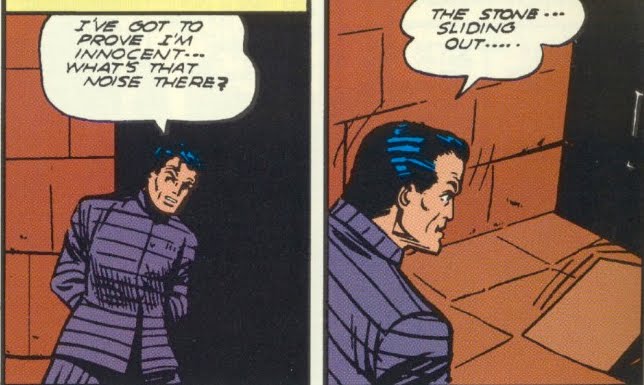
I've got to prove I'm
innocent--what's that noise there?
The stone--sliding out--

What haiku can you compose to celebrate the coolness that is haiku-spouting Prisoner Wayne?

Saturday, September 11, 2010

The Anguished Eye Turns Inward


Even in her own memories,


IRIS ALLEN IS A VICIOUS, EMASCULATING WITCH.

Thursday, September 09, 2010

Your Shield against errant AI

Old Glory versus Robots That Eat Old People's Medicine for Fuel

I told you we'd get back to The Shield.

See, what you civilian-types don't know is that, among the Pentagon's vast warrens is a secret bunker where I have a small team of experts applying their skills to craft me (um, oh, and the nation, too) a veritable army of custom clix. Why? Well, let's just say that some pretty unlikely things happen when appropriations bills have to get passed at the last minute, particularly when I'm the one controlling the deciding pocket borough.


Do you remember you the cover of Pep 1? Well, my crack customizers at the Pentagon do, so they crafted this astonishing reproduction, in which The Shield cracks apart a rockem-sockem with just one punch. Have you ever seen a more beautiful custom? Makes an American proud.

The Shield resides on a re-purposed Bulleteer dial (because, you know, it's not like I'd every play the Bulleteer). He makes a great sidekick for Wonder Woman or Uncle Sam, and, all in all, is great cannon fodder to send out in the forefront of your Heroclix forces.


Tuesday, September 07, 2010

"Well.. hardly ever!"

Note to the Dove World Outreach Church
in Gainesville, Florida:


Bookburning
is NEVER a good idea.


Okay,fine;
ALMOST never.

Monday, September 06, 2010

Pep 33: Nazis LOVE their opera


Hey, look, Dusty's back!


And doing what a young boy should: hurling legs-spead into the face of evil. Missed ya, kiddo!

In true "Pep" fashion, this cover has glowing yellow skies and some awesome 3D effects. The teeny weeny Nazi toy soldier in the far background, Dusty and his black snuggies in the background, the ever-charming Hangman in the mid-ground, and in the foreground, giving what-for to the dental hygienically-challenged, is our hero, The Shield. But we'll get back to him later... .

Wait, just what is the Hangman doing? OMG, that's so unfair, attacking poor Jesse James as he's trying to get to the opera with his date. Hey... that's not Kat Von D!!! Well, whoever that poor woman is, I applaud Jesse for taking a sword to that overly constricting dress. "Stupid hangman," Jesse grunts, "capes --are so-- last year!"

P.S. Don't believe the hype: the whole country is NOT talking about Capt. Commando.

Saturday, September 05, 2009

Look out, Mister Armstrong...!

Really, I can't imagine this panel being in anything other than a Starman story.

Anyway, I need to let you all know that the Absorbascon is now on hiatus. I've enjoyed it and I hope you all have, too.

Friday, September 04, 2009

Starman Saves Shakespeare


No, really; Starman saved Shakespeare from being kidnapped. Starman doesn't go in for abstracts or metaphors.

Thursday, September 03, 2009

Starman's Face-Off

The Golden Age Starman didn't mess around, boy.


Here he is telling a suspect to confess or
he'll use the gravity rod...
to RIP HIS FACE OFF.


Really; you did not want to mess with Starman.

Wednesday, September 02, 2009

8 Ways Starman Will Beat the Crap Out of You

Do you think Starman is dependent on the gravity rod?
"I-- I swear, Doris: this has never happened to me before!"


That he would be helpless without it?
You know, if this were anyone else, I'd say that sounded almost like... panic. But it can't be panic, because that's Starman. So it must be... DRAMA!


Think again.

We're talking about the Golden Age Starman, the hero who once defended himself against a bear by hitting it with a tiger. Starman doesn't need the gravity rod to beat the crap out of you. He'll do it with whatever objects happen to be lying around. And the more embarrassing they are the better (like Aquaman, Starman knows that it is not enough to merely defeat criminals; you must publically humiliate them).


The mundane!
"You cowardly rats have no understanding of conversational grouping!"


The desperately punful!

The usual weapon in unusual ways!
I can't recall ever seeing a hero bounce a gun off someone's face before.
It's delightfully disrespectful.


The bizarre!Where's Hal Jordan's head when you need it?


The sonorous!
Do you have any idea what one of those costs? You can tell Ted's really rich.


The childish!Whenever anyone at Joliet asked Charlie how Starman defeated him,
he'd lie and say he was hit with a tiger.


The artistic!Ted-- don't quit your day job.


The ironic!
Starman uses a magnifying glass to burn some young O'Dares,
like the ants they are.