Showing posts with label difference between DC and Marvel. Show all posts

Tuesday, November 05, 2024

Tuesday, May 23, 2023

Let's Talk About Spider-Man

Well, aren't Spider-Man fans in a tizzy lately?

I noticed this only because nearly every comic book vlogger seems to have simultaneously lost their cool--

perhaps I need a better phrase--

lost their minds over What They've Done to Poor Peter Parker Lately.

They, currently, is comparatively new writer Zeb Wells.  He gave Spider-Man a new status quo that started with a bang.  Actually, it started in mediās rēs, with that bang as the mysterious background incident behind the status quo.  I read the first handful of issues and, frankly, was very impressed.

I bet you didn't see that one coming.


You read that right.  Not impressed with the new status quo per se -- I couldn't care less about Spider-Man's love life -- but impressed with how well it was written. Spider-Man was an interesting, if flawed character. His villains were multidimensional, his world interconnected and coherent, the supporting characters realistic and independent in their motivations.  Wells work did a very good job of handling a situation that often trips up DC writers; he seemed to understand how created situations that emphasized, yes, having superpowers is cool, but it doesn't in fact solve every problem or most problems or ... any problem, really.  YOU do that.  Or not.  And that's a really great place for Spider-Man to be, narratively.

Psst. No one ever called them "long underwear characters".

In fact, that's where Spider-Man STARTED.  Stan Lee And Company knew what they were doing when they created Spider-Man and that's exactly the point they were trying to make with the character.  That tack (and other similar ones) is part of what helped Marvel distinguish itself from its Distinguished Competition, as they used to call it.  It was part of Marvel's niche, its competitive advantage.  Spider-Man was a superhero who powers not only didn't solve his personal problems, they aggravated them.  The Fantastic Four were a dysfunctional family (if you ask me).  Thor was a god, but hobbled (literally) by forced incarnation as a crippled man.  The Hulk's superpowers came at the price of a loss of self-control. You get the idea.

And what lesson did we learn from this today, Pter?

Or, at least, if you do, you're ahead of many contemporary Marvel fans, it seems.  They are currently rioting about the same thing they ALWAYS rioting about with Spider-Man, every time this happens:

Why does Marvel hate Peter Parker? Why won't Marvel let Peter Parker be happy?


Honestly, it would be funny if it weren't so sad. 

There's zero mystery. Peter Parker wasn't designed to Be Happy.  It is not his literary function and never has been. Honestly, I say --and praising Marvel isn't something I do unthinkingly-- good on Marvel for now, as always, making the point that: being good doesn't ensure that you will be rewarded.  It's an important message. You do good because it is right to do so and there is moral satisfaction in that, but riches and (a beautiful movie actress's or even just the public's) love do not logically follow.   THAT HAS ALWAYS BEEN THE POINT OF SPIDER-MAN.  It's a difficult, very adult message to try to convey, especially to the original audience of children.  But Marvel took that hill and held it.

Thanks to Zeb Wells, they still are.  There are lot of Spider-Fans who identify enough with Peter Parker, however, that they are incensed when he doesn't do well and accuse Marvel of "abandoning the character's development."  

Ahem, how does one put it politely? No ****, Sherlock.  

There are a lot of artforms you can seek out if you want Character Development, but expecting it (at least on a permanent basis) for IP that spits out monthly stories for five plus decades is disingenuous. Nobody wants to see THEIR version of Spider-Man (or Power Girl or whoever your fixation is) set back to a starting place, having, as a reader, stuck with them through all their struggles and watched them slowly start to get their lives together and get ahead. But comic book icons don't have character arcs; they have persona cycles.  Eventually the arc will bend 'round again.

Meanwhile, yes, YOUR version of Peter Parker has had the rug pulled out from under him again.  Well, if you want sappy, overly-optimistic comic books, where heroes suffer potentially debilitating tragedies (such as the destruction of their home planet or witnessing the murder of their parents or of being an apparently-totally-straight woman growing up on isolated island with nothing but other women) but still go on to live happy, successful lives anyway, where the public loves them and they have satisfying romantic involvements and perhaps build families ... there's a company that publishes those.  You're the one who picked the company that boldly made the tough decision to a harder, less pleasant message with their characters.  

"You knew I was a scorpion when you agreed to let me ride on your back.  It's in my nature."

Spider-Man isn't designed to be happy and stay married to a super-model. No matter how long it's allowed to go on, it's just a fanfic fever dream, but which the character and the company inevitably wake up from.  

Sunday, October 02, 2022

Our Heroes Have Always Been Above That Sort of Thing

A recent youtube video asked the question,

"Why do all superheroes sound the same?"

They don't, of course. What it really means is that "All Marvel superheroes sounds the same."  
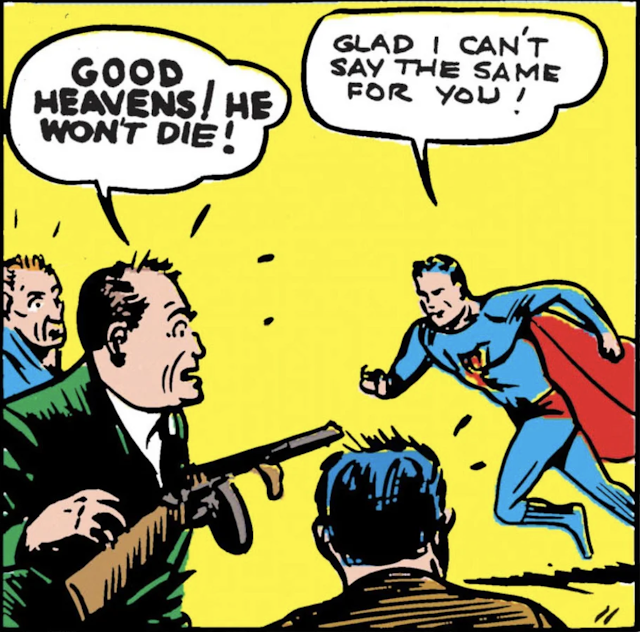
The other thing that won't die: comics-civilians lumping Marvel and DC characters together as if there's no difference.


I'll be frank with you: I didn't watch the video. Not one second. Why would you? You know the answer to the question and what they are going to say.  The only real interest is in how the question is mis-formed ("all superheroes" rather than "all Marvel superheroes").

Can you imagine a world or era where Batman was a wise-ass?


A lot of the commenters (including me) point that out. Most blame the modern screenwriter(s) whose hallmarks are annoyingly sarcastic, wise-ass, quippy dialog. You know: Joss Whedon, Brian Mumblecore Bendis, Sam Raimi, James Gunn, Peter David, Keith Giffen; pick one (or more).  

Fortunately, DC heroes don't treat life-and-death situations flippantly like Marvel heroes do.


Certainly, there is some true in that. Buffy Masters has much to answer for. You can blame a particular writer whose style that got copied.  Or the style of an era (the '90s) coming to its full, monstrous fruition.  

Marvel fans put up with the childish joking of their heroes because as a validation of their own childishness.  It's sad, really.


Sadly, a lot of people who watch superhero movies haven't really read many of the comics that underlie those characters, so I tried to point out the comic book roots of the problem.  It's not merely that some modern comic books writer affect a quippy, snarky, flip style of dialog for all characters.  It was, in fact, a hallmark of early Marvel comics. 

It's one thing if Marvel  heroes want to joke with one another but REAL heroes do not joke with their foes. 


The DCU is a quilt, patched together from different characters created by different creators and a times in different styles, sometimes for different companies.  The Marvel superhero universe is an afghan, knit much more coherently with an intentional plan as an integral whole. 

Wise-cracking is just built into Marvel's historical DNA.


Each approach has pros and cons.  DC's Quilt Approach naturally brings variety and diversity, both in characters and styles, which means you have a chance to appeal to more people. 

Marvel heroes just don't take what they are doing seriously enough on a consistent basis.

It also offers separability and deniability!  If some contradictory development crops up between titles you can ignore it more easily.  If some title or part of your publishings doesn't work, you can cut it out entirely, and probably patch it up easily.

Some quippy characters? Sure. But it's EVERYONE in Marvel, making it tedious and oppressive.


Marvel's Afghan Approach offers coherence and consistency. If read something in one comic, you know it 'counts' in every other; if you liked Title A, you will probably like Title B.  Its world-building is organic and, well, more seamless.

Only Marvel heroes go for the wisecrack rather than use their powers judiciously.

One of the cons of the integral approach is that a "house style" can be suffocating and unnatural.  Everyone looks the same and sounds the same, which isn't how people are.  Or, at best there's a small handful of speech patterns assigned based on which stereotype a character most clearly aligns with.  

I think it's the sarcasm, the snarkiness of Marvel characters that really irritates me. Make mine DC.


If you want to know what those are just read any Jack Kirby story with Fantastic Four or the Newsboy Legion; I'd rather not suffer through them here.

I'm safe from that sort of non-stop meaningless prattle in DC stories.


But it just doubles-down on the point: "all Marvel superheroes in the movies talk the same because they are MARVEL heroes."  To the degree DC heroes do that in movies, it's because writers are aping Marvel writers (or because Marvel writers have been hired to WRITE DC heroes).  

Marvel can't even manage to allow its cosmic figures maintain their seriousness and dignity.


It's certainly not because DC heroes naturally or historically speaking with that annoyingly sarcastic, wise-ass quippy dialog style.


At least Marvel manages to avoid the lowest form of humor: puns.

Saturday, February 22, 2020

"May God bless and keep Dan DiDio..."

In Fiddler on the Roof, the rabbi is challenged to give a proper blessing for the czar of Russia (who was no friend of their Jewish community), to which the rabbi archly replied, "Of course: 'May god bless and keep the czar... far away from us!"

Well, likewise, may the gods bless and keep the czar of DC Comics, Dan DiDio, who has presided for 10 years over a vibrant period of the DCU.  And I mean that in the same way real estate ads describe dangerous and distressed neighborhoods as 'vibrant'.

Vibrant, like Hub City. And we all know the source of this rot.
We've known it for years yet we don't do anything about it.

Some of that vibrancy is inherent to our times; although the intellectual properties owned by the comic book industry are now powerful currency, that doesn't always help the bottom line of comic book publishers. Some of it, however, lies squarely at DiDio's feet.  Not only do many DC readers feel this way, it appears DC's masters did, too. DiDio was posting on DC's behalf and meeting with creators Friday morning and "no longer with DC" by Friday evening, which doesn't sound like a conscious uncoupling to me.

Pictured: conscious uncoupling.

A lot of great things happened at DC during DiDio's tenure, such as the amazing work on Hanna-Barbera properties like the Flintstones, Snagglepuss, and Scooby-Doo.  Dan DiDio could have stopped lots of creators from doing interesting, innovative, thoughtful, and entertaining work, but he didn't.  The pattern of his decisions suggest that he was very receptive to change and experimentation.

Which was, perhaps, the problem.

Our flaws are often merely the flipside of our virtues and I suspect that was the case with DiDio.  In the same way that DiDio didn't stop good things from happening, he didn't stop bad things from happening, either.  By bad things, I mean things like:

  • the Destruction AND THEN Befoulment of Wally West (I don't even LIKE Wally West and I know how very wrong that all was);
  • nerfed Bart Allen's unique personality, aging him up to become the Flash, and then vanishing him 12 months later;
  • Tom King and his Crimes Against Batman (does anyone REALLY need ME to expound on this, when the entire internet has it covered?);
  • the unpardonable MESS of "52" and "Countdown", which really just should have been renumbered as continuations of 1985's DC Challenge;
  • preventing Batwoman's wedding because "heroes aren't supposed to be happy";
  • driving out steady professional types like Greg Rucka, Len Wein, Mark Waid, and Geoff Johns (writers interested in what they can do for a character) and handing flagship characters to idiosyncratic 'auteurs' like Brian Michael Bendis, Grant Morrison, Tom King, and Scott Snyder (writers interested in what they can do to a character).


People have been describing this as 'the end of an era', which it is. But that isn't the "DiDio Era"; it's the "DiDio versus Johns Era". Like some sort of real-life Anti-Monitor and Monitor, DiDio and Johns have been waging a barely disguised universe-threatening battle over whether the DCU would be positive or negative.

And you know which one you'd swipe right on.

You can trace it through nearly everything that's happened in the last 10 years. The New 52 versus Rebirth.  Wally West the symbol of hopefulness versus Wally West PTSD-crippled mass murderer.  Dark Multiverse versus the Metaverse. Eventually, Johns, realizing that his power over DC's characters in mass media gave him greater influence than DiDio's power over them in comics, left DC Comics for DC Entertainment.  And without Johns to counterbalance DiDio's negativity, DC Comics became sour enough that readers finally started to spit it out rather than swallow it.

Dan DiDio doesn't seem like a bad person who wants bad things to happen to damaged heroes.  But he does seem like a dumb person who thinks that is what makes comics interesting.  Like many (so, so many) creators at DC, he's infected with Marvel-Envy, thinking that DC's characters need to be overwhelmed, unhappy and put-upon, damaged, distressed, disturbed, and alienated to be, ya know, COOL and popular like Marvel heroes.  Totally blind to the fact that historically, DC's characters were cool in a different way; they were cool precisely because, despite personal adversities, they were NOT any of those things.

DiDio's not bad. He's not even bad at his job, I think. He simply doesn't get DC.  Here are a few examples.

He wanted to KILL Nightwing / Dick Grayson. Who thinks that way? Is there a more beloved character in DC comics?  Who even comes up with the IDEA of killing the Sensational Character Find of 1940, let alone pushes it so hard that Geoff Johns simply flat-out REFUSED to do it?   
Do NOT mess with Dick Grayson,
'cuz he'll make it look like an accident.
He wanted the Spectre to kill Shazam because Shazam "doesn't fit in with the rest of the DCU".  Is Shazam a unique and unusual property? Yes. But if you can't even imagine that he can be made to work in the DCU somehow then your view of the DCU is too narrow for you to be in charge of it. 
Well, Dan, Billy's still working within DC.
And you're not.
He gave the Phantom Stranger an origin. As Judas the Discipline. I can think of nothing that so clearly shows how deeply someone doesn't understand the DCU as that.  He managed to besmirch the Phantom Stranger, Western Civilization most awesome character, as a damaged, tortured, fuck-up tied to a particular religious system.  That's a tragic level of stupidity, right there.   
Dan DiDio not pictured.

At the 2019 San Diego Comic-Con, DiDio showed how little he gets readers:

“We do these Facsimile Editions where we reprint older issues of comics including all the old ads and stuff…and in some cases these are selling more than the new comics with these characters. People are more interested in buying the stories from 30 or 40 years ago than the contemporary stories, and that’s a failure on us. We should be focused on moving things forward, always pushing the boundaries and finding new stories to tell. That’s how we’ll survive and grow this industry.”

DiDio assumes that people fall back to reading older stories because the new ones aren't "moving things forward, pushing boundaries, and finding new stories to tell."  What he really means is that people are reading old comics because we aren't forcing them to forget about continuity and the history of who the characters are and what they are like.  The perceived antidote is to wrest by force the idea of what those characters are from the dead claws of nostalgia.

You're too late, Dan; it's been done.

But the way to get people to focus on the tree's seasonal blossoms isn't by tearing up the roots.  People don't read comics starring characters who've been around for 80 years because they are aching to move things forward and push boundaries.  Nor do they read them simply out of nostalgia.  They want to read stories that depict familiar characters in familiar ways but in a new story or a new situation.  The value of character familiarity and consistency is that, for both the creator and the reader, the focus can be on the story and its plot.

Which often require a LOT of focus.

It seems like the modern assumption for why a comic book isn't more popular is that something is wrong with the character, so the character must be changed.  Does it ever occur to anyone that maybe your stories just suck?

Truth hurts.

Two of my favorite series this year have been Sholly Fisch's Scooby-Doo Team-Ups and Matt Fraction's Jimmy Olsen.  That's certainly not because Scooby-Doo or Jimmy Olsen are favorite characters of mine.  It's because those (really good) writers took those characters at their ridiculous face value and wrote stories that, rather than try to change the characters, actually take full advantage of who and what those characters are.  I wish more modern writers would give that a try and stop wasting everyone's time trying to put Their Stamp on the characters.

Sassy Sombrero Superman never really got the chance he deserved, though.

If you want to write comics where you can do anything you want with the characters, then create those characters.  But iconic, flagship characters are worth more than any individual creator; Batman, Superman, and Wonder Woman are known much more broadly than anyone who writes or draws them. They always have been and always will be.  So preserving and cultivating the character should be the priority, rather than indulging the writer. Heck, you could probably pick one and switch it to on-spec writing. "Hey, everyone; submit us a story for Heroperson that colors between the lines of their existing world."  You would get 12 interesting stories a year, from different perspectives, memorably unique, none of which had to be part of an 'arc' or 'change the character forever', and it would probably show more continuity that DC can manage with its golden stable of auteurs.   The reason that doesn't happen is that DC is convinced the creator fame is what lures readers to buy comics. Well, I guarantee you anyone reading Superman or Legion now is doing so despite Bendis not because of him.

Although he was great in Human Centipede 2.

Not understanding such principles is at the core of DiDio's failure. DiDio's leadership at DC often went awry because it didn't combat these negative and chaotic tendencies.  I am no fan of Marvel's Stan Lee, god knows, but I like that Lee wasn't hampered by being a fan of comics; he simply published them.  He was enough of a realist to know that, in his own words, "comics survive not on change but on the illusion of change", something that DiDio wasn't woke enough to understand.

If I like Stan Lee more than I like thee, then,
it's fair to say I don't like thee very much.

I am told that Dan DiDio loved comics; but loving something doesn't mean you know how to do it well. Now that he's no longer in charge, a new era can begin.

My question is: will this new era (with or without the new '5G' timeline) be a repudiation or a repetition of DiDio's mistakes...?

Tuesday, July 22, 2014

In which I admire Marvel and damn DC


DC asks the question, "Is this character sufficiently popular and iconic to sustain a film?"
Marvel asks the question: "Is this character sufficiently unknown that we can use a film to make them iconic?"

DC is cowed by their trusteeship of important cultural icons and afraid to misstep.  Anything they do can only damage the character's reputation, they feel.
Marvel is content to keep throwing liver at the wall to see what sticks.  "Oh, THAT"s what will make Hulk work...!"  Anything they can do to put their characters before more people improves their reputation, they feel.

DC is afraid to make a Legion movie because the Legion is such a notoriously niche-y property.  I mean, how well can a movie do that's gotten nothing but teenagers in it? With superpowers.  And ethnic diversity. Who live in space in the future.  With lots of relationship drama and sexual tension.  Whose every financial need is taken care of, and live in one giant awesome house with space cruisers.  Who fight crime and galactic-scale villainy.  Yeah, there's no way to sell that.

Marvel looks at Guardians of the Galaxy and says, "A talking racoon! Voiced by an Oscar nominee! The kids'll love it!"

DC inherits a universe that was originally separate characters in their own separate worlds, interacting sparingly.  As a result, each character that's old enough has a grand legacy around them, but they don't fit well together in the same space.  DC inherited characters and then had to try to form a continuous world around them, something they still can't get right, which causes them to reboot every few years, in an ongoing attempt to reconcile the irreconcilable..

Marvel created a universe and start populating it with characters, who therefore all fit in it quite nicely.  Their interaction was their selling point, and while, as a result, none of them stand out too far apart from any of the others, Marvel has a very easy time selling its entire universe in the medium of cinema.  No one seems ridiculous or off-the-table because they are all of a piece.

DC is terrified people will laugh at Aquaman.
Marvel intends to sell people on Ant-Man.

DC is terrified any movie it creates won't satisfy existing die-hard fans.
Marvel is focused on making sure their movies satisfy everyone else.

Wednesday, June 04, 2014

Can you answer "The Captain Atom Question"?

The “Captain Atom Question” concerns the incorporation of characters from pre-existing literary universes into another, larger literary universe, once their original universe is gone.  The question is: can this be done successfully?

My answer is essentially “no”.

Among the various literary media, this phenomenon is pretty much confined to comic books.  Comic book companies go defunct for various reasons and their intellectual property—their characters—get bought by another company.  


Usually this company is DC.  DC, you see, is a compulsive hoarder; “I could use that character some day!  I paid good money for that!  It’s going to come back in style just you wait and see!”  Occasionally, it reaches Crisis proportions and there’s an intervention where some nice folks from reality TV come in, negotiate to get rid of DC’s old crap by enticing it with new living room furniture (“There’ll be room for NEW characters, DC, sweetie!”), and clean house.  Then DC immediately starts filling the house with crap again.  Repeat cycle.

This, by the way, is in contrast to Marvel. It’s not a hoarder; it’s an obsessive-compulsive that spends all its time putting things in order.  It writes guidebooks that tell it how tall everyone is and classifies them by how much weight they can lift, sketches out all possible permutations of its universe with “What If?” stories, (“What if… Iron Man had had EGGS for breakfast?!”) and insists that all of its stories are part of one big *ahem* perfectly organized consistent continuity (despite any evidence to the contrary).  If DC is Oscar Madison, then Marvel is Felix Unger.

Sometimes even they get confused, however.

So, every time there is a publishing yard sale, DC goes out bargain hunting with a reticule full of one dollar bills and snaps up collections of old characters as if they were beanie babies.  The Shazam family of characters, the Wildstorm stable (the Authority et al.), the Milestone properties (Static, Icon, Hardware, Xombi, et al.), the Quality characters (Plastic Man, the Ray, Black Condor, Manhunter, Phantom Lady, the Human Bomb, Uncle Sam, Doll Man, the Red Bee), the Charlton heroes (the Question, Blue Beetle, Peacemaker, and Captain Atom, for whom this question is named)—all these are characters the DC acquired by lot at going-out-business sales.

With one possible exception—Blue Beetle—DC has tried repeatedly to incorporate all these characters in the DCU…and failed.  That exception was mostly confined to using Blue Beetle as comic relief, and even that success was spotty at best.

Other attempts to use such characters as comic relief have been mostly....
regrettable.

As a general rule, these imported characters simply don’t “take”.  Like transplanted plants, they simply can’t survive well enough outside of their native soil.  Back in the heyday of the Multiverse, DC seemed to accept this fact. Rather than try to bring these niche characters into the searing sunlight of the superfriends’ world, full of its  Underroo trees and constant crossovers, DC recognized them for the hothouse flowers they were and kept them isolated in their own hermetically sealed environment of alternate earths.   If the Freedom Fighters made sense in World War II, well, then, DC gave them an earth where WWII was still going on.  If the Shazams required talking tigers and worms to thrive, then give them a world that has them.

"Segregation now; segregation forever!"

You can try to claim that “DC just didn’t try hard enough because they didn’t care about someone else’s characters”, but I’m not buying it.  DC has repeatedly moved heaven-1 and earth-1 to get its readers to care about Captain Atom and consider him part of its pantheon, to no avail.  

Batman does NOT salute.  Let alone salute Captain Atom.

To incorporate Shazam, DC has tried a host of solutions, from surrounding him with every possible shiny toy from his homeworld, to aiming him at kids, to giving him several grim’n’gritty make-overs.  

Whatevs, Billy *eyeroll*.  Not even Geoff Johns can make you 'cool'.

I say that, for whatever reasons--call it vibrational frequency, if you will--such imported characters cannot work. Like transplanted organs they require great pain and effort in the form of constant editorial doping just to keep the host universe from simply rejecting them. So, perhaps, more precisely, it's not that they absolutely cannot work, but that the energy and effort required to do so is well beyond the point of diminishing returns from the character.

You are welcome to try to prove me wrong.

DC sure hasn't.


Friday, April 27, 2012

Recently, I received a spate of visits due to someone plugging a very old post from me on "the difference between DC and Marvel".

It's a popular topic among fans of superhero comics. So it seems like a good time to re-post links to some of most salient posts on ...

the Difference Between DC and Marvel

Is there, by the way, an aspect of the difference that I've missed, that I haven't touched on yet? Let me know your thoughts...

Thursday, July 07, 2011

The Art of Protest

Oh, dear.

As reported at Robot 6, a groups of fans are actually going to protest the DC re-launch at the SDCC.

Now, I'm not going to make fun of them for protesting. I've lived my entire adult life in Washington, D.C., whose economy rests squarely on the idea that the self-righteous will pay good money to parade their moral superiority through protests, not because it ever accomplishes anything, but just because it makes them feel good. Enjoy your stay in the nation's capital and remember to re-hydrate!

Nor will I take the easy pot-shots at them for the "trivial" nature of what they are protesting. Yes, they could and perhaps "should" be off protesting "important" things like world hunger, or taxes, or Crocs (lord knows someone should). But there are other people doing that and what difference would they make doing it too? People don't protest things because those things are "important"; they protest them because they are angry. And don't tell me you've never been angry at something that was done in comic book or with a comic book character. Maybe not angry enough to go out and protest publicly... but that's you, and this is them. Television fans 'protest' on behalf of their shows all the time; perhaps they do not take it to the streets, but neither do they generally have a ready-made venue like ComicCon.

However...

I will point out one thing.

As far as I can tell, this protest comes from "art people" not "writer people". There's some pro forma bitching about the reboot, but the genesis of their discontent actually seems to be the costume re-designs. And THAT is amazing to me... yet predictable.

I have always maintained that there are two types of comic book fans: those for whom the art is a means to an end (telling the story) and those for whom the art is an end in itself. As I've written before, DC has always been story-focused and plot-driven, whereas Marvel is more about characterization and art.

As such, writer-types tends to be DC fans and artist-types tend to be Marvel fans. Yes, yes, 'protest' all you want that I'm painting with a broad brush, and you yourself aren't like that, and aren't we all just the same, wanting a Coke and a smile. Fine. But I used to own comic book stores and if there was one constant it was that every customer who was an amateur artist had a sub full of Marvel and every amateur writer had a sub full of DC.

Given that, DC fans, I think, tend to be a more philosophical lot. Writers know that the essence of writing is re-writing, and that the essence of comic book history is being constantly re-written. Every writer does something slightly different with a character, and characters and continually being evolved, their backstories filled in, their interpretations broadened. Writer-ly types know that it doesn't matter whether the frog is boiled slowly through monthly tweaks or all at once with re-launch... it's still gonna get boiled.

But artist-types? I don't think they understand that as easily. Individual artists have their own style, certainly. But they don't get to actually change costume designs. So all these simultaneously costume re-designs come as quite a shock to the art-fans' systems, I think.

Writers (everyone knows, LOL) are Old, World-Worn, and Cynical. Artists are Young, Fresh, and Idealistic. These young artists types are shocked at the lack of exceptionalism in the fandom, completely taken aback that what happened to the comic book fans of Golden Age, and the Silver & Bronze Ages, is now happening... to them.

The writer types? Not so shocked. Not so ready to protest. We're too busy sunning at the sidewalk cafes in San Diego, sipping demitasses of Cuban coffee and clucking at the naivete of the artists marching by with their artfully letter protest signs.

What I find amazing is that there are that many DC fans who care that much about the art...


Saturday, August 22, 2009

Clip Week 1

I am out of reach this week for very pleasant reasons. Rather than time-release posts without being to attend to the commentary thereupon, I'm offering a retrospective on some of our favorite topics here. [I've noticed that the labels function on Blogger doesn't always pull everything, which is why I'm not just using that to do so.]

Today's topic is one of our specialties and a bone of contention for many:
The Difference Between DC and Marvel.

The Difference between DC and Marvel, I
The Difference between DC and Marvel, II
Why Gorillas are in Comic Books
Marvel Musings
A Serious Difference between DC and Marvel
The Legion
Thus Stalks the Dazzler
Why Vibe is Nothing Like Dazzler
This Diva, This Monster!
The Absorbascon reads Spider-Man, Again
There's a Skrull in My Sub
Ivory Soap
All that No Longer Glitters
Anti-populist Rant
Marvel gets it and DC doesn't
Cerealized Fiction

Thursday, August 20, 2009

Cerealized Fiction

As everyone of my age cohort knows, there is an absolute dividing line that splits us. Unlike divisions over religion, politics, and philosophy, it permits no synthesis, brooks no compromise, and suffers no neutrals. Since the need to maintain a unified polity and veneer of civility are essential to the continuance of our society, we lives our lives in a conspiracy of silence, never speaking of it openly to one another, lest the Western be riven in twain, brother again brother. "Never again," our elders made use swear; "never again," we repeat silently to ourselves and we look at children happily playing with others.

But we all know the truth. We are all, still and forever, on one side or the other:

Quisp or Quake.

For those of you too young to have experienced it, the Quisp/Quake conflict was the defining advertising event of my entire micro-generation. Quisp and Quake were two popular breakfast cereals for kids, similar to Capt'n Crunch, produced by the same company. But no one ate both. you either ate Quisp (named after its strange space creature mascot) or you ate Quake (named after a burly earthling miner).

That's because the commercials, masterfully produced by Jay Ward of Rocky and Bullwinkle fame, with Quisp and Quake voiced respectively by his buddies Daws Butler and William Conrad, depicted the two as archrivals. Quisp and Quake hated each other.


Note the use of the voice cast from Dudley Doo-Right, another Jay Ward property.

They appeared in joint commercials and even when they had solo commercials, the rival would often intrude himself, just for spite.


Brilliant as this hook was, it gets better: except for shape, Quisp and Quaker were... the same cereal. Same formula.

Now there are some cynics who say that Quake was never supposed to be a real cereal, that Quake was just a gimmick to drum up sales for the real deal, Quisp. Yeah, then why did Quake get a makeover from being a miner to a cowboy, huh? How do you explain the Orange Horror, huh? Nutcases; these are the same people who think there wasn't a moon landing.

The companies genius didn't end at producing one cereal as if it were two, then marketing them against each other, brilliant though that was. Once the rivalry was solidly established, war was declared. There would be an election among cereal-eaters, and the loser's cereal would be discontinued. The election ran for two years. Naturally, the loser was Quake. Because Quake SUCKED, and Quisp RULED!!!!! Ahem. Although I believe we put it differently in those days.

Quisp and Quake are the dichotomy that symbolizes all other dichotomies. Sky and earth. Speed and strength. Alien and native. Brains and brawn. Gay and straight. The future and the past. Humor and seriousness. Consistency and variability.

The world of comics has its own dichotomy: the "Big Two", as they are called. There are some who'll tell you that there is no difference between them, that the same formula is used to make both. But, they are wrong, because, as we know from Quisp and Quake, tone and form and style are what count; they are remembered, when content is forgotten.

I remember in the 1990s when Marvel was teetering toward bankruptcy. I remember exulting. "Quake" was finally going to lose. The cheery '90s would be no place for Marvel's dark cynicism!

But eventually, I reversed my thinking. Would DC start changing its tone or adding Marvel-ish characters to pick up wandering ex-zombies? Would DC's existing Marvel-style characters start to crowd out its native sons and daughters like Wolverinish weeds? Even worse, would DC buy Marvel's characters and incorporate them into the DCU, like so much trailer-trash left homeless by a financial twister, bringing with them their tawdry domestic disturbances, their raucus in-fighting, their soap operas, their gun-toting yahoos, their cigar-chomping, g-droppin', dullards, and their screeching drag-queen-faced dime-store divas and teenaged tarts? Shudder!

I realized that to keep that from happening DC needed Marvel; I needed Marvel as a gathering place for ... those kinds of characters. Fortunately, Marvel did not go bankrupt because they gave themselves over to crass commercialism; I mean, more crass. As in Hollywood.

Funny thing. Quisp and Quake feuded from 1965-1972. But after the election, Quisp's popularity steadily declined until it was removed from regular grocery shelves in the late '70s. Nowadays, they still make it, but it's available only on the internet as a nostalgia item; it doesn't really live as a current brand, and no children have ever heard of it. Turns out that maybe Quisp needed Quake more than he realized.

Long live Marvel.

Friday, May 29, 2009

Marvel gets it and DC doesn't.

Today I discovered that Marvel seems to completely understand something that DC doesn't seem to grasp at all.

It has to do with marketing their products.

On the desk in front of me is the "Marvel Reading Chronology 2009", a free publication send in quantity to retailers which presents "Marvel's stock of in-print collected editions inventory organized in a fun new way!"

This publication is, perhaps, the single greatest marketing tool I've ever received from a publisher. One of the things I do for Big Monkey is produce guides, both to specific publications and to topics. For example:


While I have done guides for eras, topics, and creators, I hadn't done any yet for particular characters. I was dreading the quantity of research needed to identify all the appropriate TPs, GNs, and HBs for all of Marvel's characters. I'm not exactly an expert on the history of the Hulk, ya know... .

Marvel, wisely realizing that customers are interested in boning up on particular characters and that it's a easy avenue of approach for retailers, has compiled these lists quite thoroughly in this new publications, which is colorfully but elegantly arranged, and includes pictures of the all the covers, what each volume contains, and who its creators were.

It's so obvious.

To Marvel. But, not to DC.

I spoke with my DC rep today to convince them to do something similar. I got some palaver about checklists of the titles involved in crossovers being listed on the DC website. That's nice, I said, but you don't seem to understand. I couldn't even get an understanding that retailers need a visual aid to sell Showcase and Archive Volumes (which are simply impractical to stock in full-- there are way too many, and, while they are wonderful and unique offerings, they do not exactly fly off the shelves). Yes, DC thanked me for having given them that idea in a previous conversation, and they were planning on making a checklist of those, too.

Yes, that's nice, I said. But you don't seem to understand.

I want a publication, something that... that combines words with pictures of what the words are taking about. I need a piece of writing with attendant images, a sort of... graphic literature. Can't DC produce some form of graphic literature that I can use to promote my sales of your products...? Surely, DC, you have some grasp of the power of combining pictures and words into a unified whole for the presentation of an idea or story?

I've stated before that Marvel's approach to comic books is more rooted in the visual than DC's approach, and that DC's is more rooted in the verbal than Marvel's. Ordinarily, I'm fine with that. Ordinarily, I like that.

But, oh, the comic book irony...! Unfortunately, it seems to mean that Marvel understands the need to create for retailers easy visual references to their products.... and DC does not understand it.