Showing posts with label Metropolis. Show all posts

Monday, March 03, 2025

Mystery Analysts: Metropolis

We're reviewing my candidates for franchises of Gotham City's "Mystery Analysts" and we've just arrived in Metropolis.


Melba Manton

Now, according to the last census, a good 17 percent of Metropolis works as a reporter or in journalism, so the place is lousy with nosy reporters.  But the one the Mystery Analysts deserve is that sassy, snappy  dresser, Melba Manton.

To be clear, I am not talking about the diluted version who mugged for the cameras at WGBS

LIVE from Crime Alley.

No, I'm talking the O.G. crazy-bold Melba Manton, whose escapades made Lois Lane look like Lucy Ricardo and whose wardrobe made Quentin Crisp look like a prison matron.

Really, how could you miss someone wearing THAT outfit?


Inspector Henderson

He's the classic police Authority Figure in Superman history.  He's not flashy, but unlike Metropolis's other well-known cop, Dan Turpin, he's low-key, slow on the trigger, and even-tempered.  He's the Cool Cop the Mystery Analysts of Metropolis deserve.
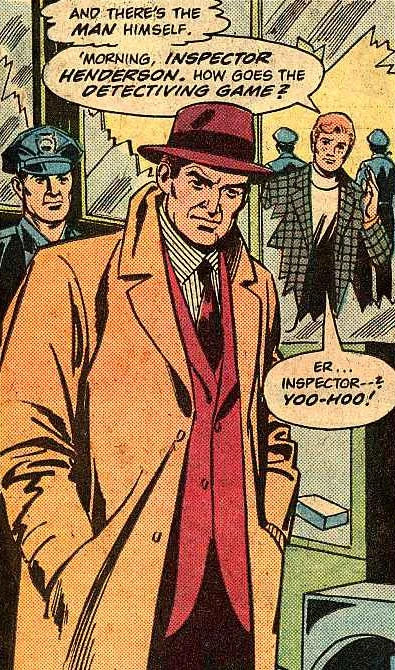
Shut up, Jimmy. Unlike Superman, Henderson has no time for suck-ups or any of your "Mr. Action" nonsense.

Maggie Sawyer might have been up for this role, but she moves around WAY too much.  Besides, she was always more of an action-cop than a detective.


Franklin Lester

It's not easy to forgive a character for being created by Cary Bates, but in Lester's case I will make an acceptation.  The original version of Franklin Lester was a private investigator trying to root out Metropolis's Masher Mob and resorted to becoming a costumed vigilante named "Tartantula", based on a cancelled TV series his son used to watch.

Not hard to see why the show was cancelled. That costume doesn't really scream "TARANTULA!" In fairness, Spider-Man's costume is astonishingly non-spider-like and I wonder whether this character was a riff on that fact.


Now, we like costumed vigilantes BUT we do NOT like ones who kill people, and he killed a lot of people.  

Special exceptions can be made, of course.

A redux of the character could simply be a private investigator, with some cute nod to the character's history, such as having him be the writer of (or writers' expert consultant) a "The Tarantula" show or comic book.  

Continuing to STRETCH to find usable pre-existing characters....


Chief Smith

No first name needed, with such a unique surname.

He was the pre-Crisis police chief in Metropolis.  He's a blank slate but could fill the "police authority" slot in Mystery Analysts of Metropolis. I mean, it's not like you ever actually saw JIM GORDON solve a crime, is it?

Really desperate at this point. I disqualify the 10,000 named reporters in Metropolis, because they would be redundant with Melba Manton. So...


Jose Delgado

Only in Metropolis do gang members carry rayguns.


Look I know "Gangbuster" isn't really anyone's idea of a DETECTIVE, per se.  But, you know, he must have been able to at least track down gangmembers and leaders so that's something.  No one's done anything with this character for many years, so he could be reintroduced as either a retired vigilante or just a crusader against low-level semi-organized crime.  

See, José has already proven his worth as a detective by finding the next member (and saving him from a runaway piano)!

Slam Bradley


Slam! One of comics' original hard-boiled private investigators.  He was created by Siegel & Shuster (the creators of Superman), so he's a natural for the Metropolis Mystery Analysts franchise.

Well, technically he was conceived by Malcolm Wheeler-Nicholson, the mad comic book publishing pioneer:

"We want a detective hero called 'Slam Bradley'. He is to be an amateur, called in by the police to help unravel difficult cases. He should combine both brains and brawn, be able to think quickly and reason cleverly and able as well to slam bang his way out of a bar room brawl or mob attack. Take every opportunity to show him in a torn shirt with swelling biceps and powerful torso[.]"

But Siegel & Shuster actually drew and wrote the character.  He's perfect!

The Mystery Analysts of Metropolis actually seems like an interesting group of people. Certainly more lively than their Gothamite counterparts.

Monday, July 08, 2024

Seven Things About The Map of Metropolis

I do so love maps.  What can we learn from the map of Metropolis, newly visible in set pics from the forthcoming Superman film?


1. Metropolis is in Delaware, as indicated by the Delaware Bay.

Locating Metropolis in Delaware is pretty traditional and has always made sense.  Metropolis is pretty clearly intended as an East Coast city and Delaware is a "gap" among existing large cities which allows you to locate Metropolis there without moving or eliminating any significant places or landmarks.

Although I am sure Jack Lingo would disagree.

Architecture fans like to imagine Chicago as Metropolis because of the presence of Art Deco and elevated trains.  And fans of Smallville, KS, often picture it as being closer to the heartland.  But those aren't as consistent with the history of Metropolis is portrayed in the comic books.


2"It is a crag! ... a peak! ... a promontory! ... A promontory, did I say? ... It is a peninsula!"  Or, at least, so it appears. One cannot see what's beyond the western edge but it doesn't feel like it tapers off again into an island.

3.  It has many streets. Almost of which have been named after Superman-related comics creators.  In fact, there are TWO Robinson Streets, even though that almost certain would not happen in real life.

4. It has many smaller parks rather than one large one.  This is very consistent with what we have always been shown of Metropolis. There always seems to be a small park in walking distance of, well, anything.  The park that Superman winds up fighting someone above.  

5.  It has no marked neighborhoods. A little odd for a tourist map, where most people will be looking for general neighborhoods rather than every little specific street.  

Pity. I was REALLY hoping to find out just where Little Africa was.

This saddens me, as neighborhoods are the real handles by which we can pick up and drink lore from a huge cup like Metropolis. Metropolis does have neighborhoods that have been defined (or mentioned) in the past, even if not so aggressively as Gotham City.

One of many ways in which Gotham City is more aggressive than Metropolis.

I did see in other material from the film that the neighborhood of New Troy is being used, so there is hope for more neighborhood being mentioned, too.

6.  The city has a more historic "lower end", which gives way to more strictly planned later development.  This is the Manhattan model and, although Metropolis is not Manhattan, it is very logical layout.  The tip of the peninsula would have been developed first by settlers, using a more organic street layout, followed in later decades by more standardized city street planning in the American way.

Which is one of the things Superman protects.

7. It's a shipping/port town, as indicated by all the wharfage.  This might seem so obvious as to not need mentioning. But it is important to note since Metropolis is somewhere along Delaware's coast, better known for beachfront property than shipping.


The Metropolis map has Delaware Bay mapped clearly.  This locates it somewhere NORTH of Rehoboth Beach, since anything south would be labelled "Atlantic Ocean" rather than "Delaware Bay".

Wednesday, February 13, 2013

Weather Week: Metropolis


In this series, we're examining the weather in the DCU's fictionopolises (starting yesterday with Gotham City).
When I first had this idea, I thought, "I can just go through every single story set in each city to which I have access, mark down the apparent season based on visual clues, tabulate, and look for patterns!'
Then I thought, "Sh'yeah, as if!  That's a job for my fleet of post-docs."
Then I realized, "Oh, wait; I don't have a fleet of post-docs."
So, my 'analysis' of the seasonal ratios in the various DCU cities is cobbled together purely from my own recollections of stories I've read. Now, that is a fairly large sample, but perhaps my own impressions of the weather in those stories is distorted.  After all, unless the weather is part of the plot, the creators don't usually bother with making it any particular season at all.  Unless they're John Byrne. 
A lot of artists take the easy way out and have the same characters wear pretty much the same thing all the time.  For example, in the pre-Crisis DCU, Clark Kent was famous for wearing the same blue suit/red striped tie combo every day for about, oh, 40 years. 
"And I'm not coming back until YOU stop wearing those stupid public underpants and get yourself a proper mandarin collar on your shirt!"

Some of those habits stem from the origins of comic books as a medium for children thanks to The Golden Rule of Color Conservation.  It states that whenever convenient, characters should wear the same colors in their civilian identities as they wear in their superhero identities; it makes them easier for the readers to identify.  Golden Age Dick Grayson did this a lot, and Clark Kent's habit of wearing a blue suit and red tie comes from the fact that Superman wears a blue outfit with red accents, too.
Bruce Wayne: easy-going guy, good sense of humor, fun date. 

Even when the color carries no semiotic signifigance, it's just easier for artists to draw the same character the same way all the time.  Bruce Wayne wore the heck out of that nasty brown suit yellow shirt combo in Batman The Animated Series, until he swapped it out for the black suit red tie look when his eyebrows got all frowny. 
Bruce Wayne: Uptight, dour, control-freak. With tiny, tiny feet.

John Byrne is not one of those lazy artists; he's the opposite, in fact.  Sure all his people look the same, with their giant lipless frog mouths brimming with explanations of how their powers work.  But their clothes!  John Byrne believes that no one ever wears the same outfit twice.  In John Byrne's DCU, the clothes donation bins are full to bursting all the time.
Therefore, John Byrne makes the seasons change in his stories not because it is relevant to the plot, but so he can draw different clothing.  He'd have been happy as a pig in slop if he'd been working back in the day on Katy Keene.
In fact, without John Byrne, I'm not sure Metropolis would have even seen winter. The only time I can remember seeing winter in Superman’s city was when John Byrne was writing it. He really bit down hard on the idea that, "okay, sure, Metropolis is an expy for Chicago," where it's cold and windy a lot. 
Wherever Metropolis is, it’s seldom been imagined as being in the south or somewhere winterless; yet winter is almost never seen (except for, of course, an occasional Christmas story, because it’s ALWAYS snowing in Christmas stories). 
As a result, I visualize Metropolis's seasons as something like this:
Spring is definitely the season where Jimmy undergoes amazing transformations;
In Summer, Superman can often be seen loosening fire hydrants so that, say, poor hot children can play in them, endangering thousands of lives if a fire breaks outin one of their homes.
In Fall, Superman remembes he owns a superpowerful dog and take him for a romp.
In Winter, Lois Lane runs around in ridiculous runaway winterwear and Superman answers his mail at the Metropolis post office. 

Friday, April 06, 2012

Fictionopolis Skylines #2

The second in a series. This is, as I hope you will recognize, Metropolis and Central City.


If anyone thinks, by the way, that I am exaggerating the Central City skyline: you're wrong. That skyline is directly copied from a Carmine Infantino-drawn Flash story.

You'll notice that I am using similar styles, colors, and effects across the series to help them tie in together. I think this will improved the effect when the entire triptych is hung.