 Jake has an interesting new post on Two-Face
that prompts me to make one of my own. I would have replied on his blog but I didn't want to go on and on in a comment. That's what blog posts are for.
Now,
I could write about Two-Face all day. Every day. And, before you ask,
yes, that
has come up in therapy. Now, that could be because I'm secretly a wanna-be supervillain, desperately sublimating my destructive impulses by punishing criminals instead. Or, maybe Two-Face really
is one of comic's most fascinating and potentially deep characters.
In either case, like Jake, I was a little dissatisfied with James Robinson's recent portrayal of Harvey Dent (although for different reasons). What bothers me most about Robinson's Two-Face -- indeed, most post-Crisis interpretations of Two-Face -- is, appropriately enough, two-fold:
1. Two-Face/Harvey Dent is portrayed as two sides of a split personality.
2. The "good" and "evil" sides of Two-Face as being in conflict.
I don't think Two-Face should be a "split personality". I don't want to see Two-Face "talking to Harvey Dent", or vice versa. For one thing, as I understand it, that's not how "split personalities" work at all; they are mutually exclusive "modes" of the subject. They can't "talk to each" any more than "on" can talk to "off". In fact, the inability of the multiple personalities to "talk" with one another is part of their problem to begin with.
When Two-Face was created, the writers knew what a split personality was; in fact, they used the schtick in other contemporary Batman stories (particularly the "Adam Lamb" story). They weren't rubes who tried to write a split personality story and missed the mark; they were going for something more sophicated and scarier.
There's little uniqueness of characterization for Two-Face if he's just another "multiple personality" killer. There are plenty of those (and better ones) in literature, in comics, even in Gotham (or at least there were, until somebody rugged out the Ventriloquist & Scarface). Two-Face, in my opinion, stands for something much more frightening... .
Similarly, I never want to hear Two-Face refer to himself in the plural ever again. Two-Face is NOT a "we"; that doesn't sound scary, it just sounds silly; the man's a psychotic, not Queen Victoria.
I can accept a portrayal of Harvey Dent as having a "good side" and a "bad side", with impulse toward both that are at odds with each other; that's true of us all. But when Harvey Dent becomes Two-Face, it doesn't represent the triumph of the "bad side" over the "good side". It represents something much much worse: someone who's given up on trying to choose between the two.
Harvey Dent isn't the "good side" and Two-Face the "bad side";
yawn. Harvey Dent was a man having trouble reconciling his personal views about good and evil with how the world works; he became Two-Face because Two-Face doesn't have that problem at all.
Two-Face isn't Harvey Dent's problem; he's the solution to Harvey Dent's problem.A very unpleasant, dangerous, and unwise solution, yes. But still a "solution" that resolved Harvey's inner conflicts and that is why Two-Face survives and Harvey Dent doesn't. And here's one of the scene that proves it: his origin ...
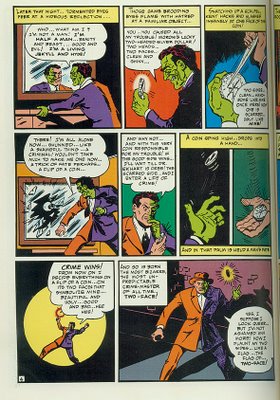
Two-Face doesn't (or shouldn't) struggle with the difference between good and evil; he's abrogated all that decision making to the coin. As a crusading District Attorney, Harvey Dent spent his life trying to ensure that bad deeds got punished and good deeds rewarded. His scarring flew in the face of that worldview; in Gotham, bad guys get away with murder and good guys like Harvey Dent pay dearly for their attempts to right the world.
In such a world, Harvey lost the motivation to make sure he was doing the right thing. If your efforts to enforce the difference between right and wrong don't make any difference, why bother? Why distinguish them in your own life? It's really just in how you and others look at things any way, so if you look like a monster, why not be one?
If you look at some of the pre-Crisis Two-Face stories, you'll notice some pretty fascinating psychology at work, with Two-Face able to justify actions as either good or bad in disturbing or novel ways. I've read all of the Two-Face stories over the years ... but never a Two-Face scene more chilling and sophisticated than this one:
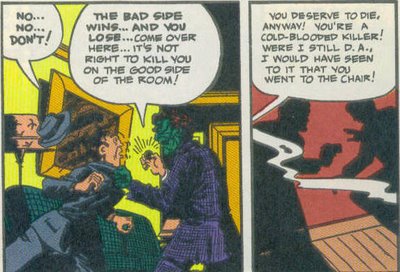 Now, that is Comic Book Irony ... and perhaps the cleverest two-panel scene in the history of DC comics.
Two-Face's "evil" action (killing his incompetent henchmen) is perfectly equated with the "good" action he would have taken as Harvey Dent (sending a killer to the electric chair). Two-Face doesn't represent our fear that our bad side will triumph over our good side; he represents that idea that we will lose (or abandon) the ability to make any difference between the two. As such, he's a conceptual threat to the entire moral framework of the DCU.
The irony, of course, is that he muddles the differences between good and evil in the name of preserving the difference between the two. Being a lawyer helps, I suppose. Almost as a necessity to doing their jobs, attorneys have to set aside their right to judge the accused in the process of defending or prosecuting them. So the very training that led to Harvey's career as a Champion of Good may have helped weaken his moral certitude enough to enable his career as a villain (good becomes evil, and vice versa).
There are many unkind things than can be said about what was done with Two-Face in the film
Batman Forever. But they did get one thing right: Two-Face's obsession isn't good vs. evil, it's justice versus random fate. The heart of Two-Face's distress isn't the scarring of his face, but the monumental injustice that it symbolizes.
While I may not have liked everything that Robinson did with Two-Face, Jake may well be right. Robinson may be creating a more self-understanding Two-Face, one who is Harvey Dent's "solution", not his problem. A Two-Face who (like the original one in the story shown above) became who he is through his choice in how to react to an unjust world that judges poorly and often by appearances. A Two-Face who, in denying that our personal choices between good and evil matter, does so by an active choice, thus contradicting himself.
How ironic.

 If you're read any of my previous posts on this subject your probably already know that. But I've never really focused on it before.