Showing posts with label Penguin. Show all posts

Thursday, February 12, 2026

Maybe I am Snob... but so is the Penguin

By all accounts, Phillip Kennedy Johnson is a nice guy; very well-rounded and highly talented.  A veteran, an accomplished musician, a popular comic book writer.

Poor Oswald.

But he clearly has no idea what "itinerant" means (something or someone that travels from place to place, from the Latin "iter/itineris", meaning "journey") or cares to make sure he knows the words he has his characters use.  If there is anything a brick-and-mortar medical facility is NOT, it is "itinerant".

That is ignorant and lazy writing and I myself don't have patience for that in my comics.  Golden Age, Silver Age, Bronze Age writers--well, they BUTCHERED science constantly beyond all recognition.  Plotting? Insane; absurd. 

But ... words? They were WRITERS.  Words were their craft.  With few exceptions I can recall, they knew the words they used and used them correctly. It doesn't seem like that high a standard to insist on.

You COULD make up a case that this is intentional; it's to show that the PENGUIN uses words he doesn't know.  But we both know that's not the case here.  It's particularly insulting that this bungle is forced upon one of DC's characters known best for erudition and eloquence.

I was about to buy this comic. Then I saw that. Honestly, if the writers AND EDITORS at DC don't care about what their characters are saying...

why should I?

Wednesday, December 03, 2025

Some Thoughts on Batman #4

On the whole I have been enjoying the (ridiculously re-numbered) current Batman series.  

But it's occurred to me that perhaps the entire system for numbering comics should be rethought.  The "old" system, whereby one title would continue to advance numerically forever, was based on the idea that the LARGER the issue number, the more venerable and stable the title seemed; you were buying into a character with legs who wouldn't vanish after you've invested interest in them.  But then venerability became interpreted as stodginess and stagnation, and the default switched to re-starting the numbering on a title when it got a new creative team or the hero got a revised chest logo. That habit then necessitated categorizing titles into "volumes", a designation that exists ONLY in online cataloging and is marked nowhere on the comics themselves.  This benefits no one and confuses many.  Why not simply label each issue of a comic with its YEAR and a sequence within that year (#1-12)?  "Batman 2025 #4" is pretty easy to understand and is a unique identifier.  That said...

I have some issues with the current issue.  They aren't really BIG issues, but, somehow, that is what makes them more irksome.  They are minor issues that seem as though they could have been avoided and they mar what is otherwise an interestingly written (and VERY well drawn) run on the Caped Crusader's adventures.  

The issue introduces a new Gotham villain ("The Minotaur"), who is (another) baddie whose shtick is "But THIS time, I will ORGANIZE ALL of Gotham City's crime!"  It is BY NO MEANS an original schtick but it's not unwelcome or unworkable (obviously, since it's a repeated one).  And the Minotaur seems acceptably colorful.

He wears a bull-mask and has seven fingers on his right hand.

The bull-mask and matching suit is all quite sensible (as far as villains go), but ... seven fingers?  I can't think of anything that would make someone EASIER to identify than having seven fingers (given its rarity).  His hook is having made seven crime organizations interdependent. Fortunately for his theming, Gotham has EXACTLY the right number of crime organizations.  

Magic seven? Did Geoff Johns secretly write this?

Once again, the Penguin, a character with a rich 84-year-and-counting history as one of Batman's top five villains (and one who has had his OWN TELEVISION SERIES), is cast as Just Another Crime Lord (albeit one more recognizable and colorful than the others).  I'm done ranting about what an inappropriate waste that is; after all, whether I like it or not, this fact may be part of exactly WHY the Penguin is still around.  It's not a flaw, it's a feature; the Penguin can be SCALED to fit the situation.

The Penguin can fight Firestorm to a standstill, shoulder to shoulder with FREAKING VALIDUS.


Next week, he can get the snot beat out of him by Harvey Bullock.


He can also just BUY a super-robot to kick Superman's patootie in front of all his super friends.

Penguin aside, there are five other crime lords who are distinguished by name, location, style, and speciality. While I might not agree on the specifics of these choices, I appreciate that in one issue Matt Fraction has done more to give us a picture of Gotham and its crime environment than all of Batman's Bronze Age stories combined.  Matt Fraction, gods bless him, does NOT do "decompressed" story-telling.

But it's the sloppiness that Fraction needlessly introduces that irritates me.

Um.... that's not something you can guarantee, Minotaur.
What it is, the Amway of Crime?

You clearly don't know what "internecine" means.  
My version of the Penguin would shoot you for that alone

How miraculously tidy that the losses were distributed exactly evenly among all the crime groups. What are the odds?  The simple insertion of "an average of ... per" would have solved this.

How?  That seems to be the hard part in Gotham.  It's simply stated as a throwaway.
How exactly did you 'bring to heel' a panoply of costumed crazies, off-panel?


That's Lonnie "Anarchy" Machin. You remember him; his schtick was being a TEEN GENIUS. He wants "whatchallit State's Evidence".  I should think a criminal teen genius would not need to "whatchacall" that concept.

Really, now.  This is the name of your Italian crime lord?  What is this, Dick Tracy?  If "Roy G. Bivolo" is supposed to be amusing, don't expect me to take "Lupo Capitolina" seriously.


I love the touch that, while regular crime lords have people they care about, but the only thing The Penguin cares about is a pet penguin. HOWEVER.
The tallest real world penguin is 39 inches tall.  This monster towers over these seated humans, who are A MINIMUM of 48", seated.  If you are going to depict a penguin, don't be so lazy you don't check the internet to see how tall they are. There is no excuse for that.


NO ONE RUNS ON A TREADMILL IN CROCS.
Certainly not a genius like Dr. Zeller.  
Don't use shorthand like "Crocs means she's practical and not girly!" without thinking it through.


Is this sloppiness the fault of Matt Fraction? His artist? Their editor?  I don't know, but it's silly and it's distracting from the good work they are doing.  Get an editor, people.

Saturday, June 08, 2024

Bachmotifs for Batvillains


Shirley Walker, the composer who did the music for Batman: The Animated Series, was a skilled crafter of leitmotifs (musical themes to used as the signature music for particular characters).  Sometimes she missed the mark a bit (what possessed her to give Two-Face a theme that's in THREE, I cannot imagine).  But the fact that themes for the Penguin, Two-Face, and (especially) the Joker are all based on Elfman's Batman theme is simply genius.  

In this episode ("The Strange Secret of Bruce Wayne", Oct. 29, 1992), the three themes are all played in immediate succession as they get off the plane to visit Hugo Strange.

But what if Walker had not been available and we had to rely on an earlier musical talent? Say...

J.S. Bach.

Batman may merit a more serious composer.
But I have still chosen Bach.


That is to say, what pieces of J.S. Bach would one use as leitmotifs for Batman's most iconic villains? Here are my choices.


The Joker 

Die Kunst der Fuge, Contrapunctus IX, BWV1080

Bach wasn't exactly a free spirit.  A obsessively hard working perfectionist with anger issues, who still had a tender side.

Reminds me of someone else, seen here firing Alfred's predecessor. 

Bach was pretty strait-laced. But if there is any Bach piece that can be said to sound unhinged, it is Contrapunctus IX.  Boldly themed, it leaps out of the gate with an octave jump and pell-mell scalar run that always remind me of a madman's laugh, its theme punching through frequently, almost mockingly, above the melee of the voices. 

The exemplifying performance I offer you is by the modern madman of the keyboard, Glenn Gould.  I find it easy to imagine this version playing as the accompaniment to scenes of chaos perpetrated by the Joker as he is chased by Batman.  In fact, when I listen to it, I find it hard to picture anything else.


The Penguin

English Suite #5, Prelude (BWV 810: I)


This piece, like the Penguin, has a peculiar rolling gait. Bach's having a bit of fun with the "English" style; it's a bit precious and seems almost to take itself too seriously. It's trying to be dignified with its pompous theme, but can't help coming across as risible.  


However, the repeated reassertions of the theme give it a diehard dignity with a dark undercurrent. This is still Bach, after all, and despite his rolly-polly appearance, his ability is not to be underestimated. And genius disguised as gentility is the hallmark of the Penguin.

This harpsichord version by the impish Chiara Massini captures this feel.  The Prelude is the opening part, but you might enjoy the rest of the suite as well.


Two-Face  

Now, some people would have gone right to Bach's Two-Part Inventions, which are all about the interplay between two voices with related themes.  But I am not among those people, because I think Two-Face is a much more complex character than that.

I mean, c'mon; it's music for KIDS.

Instead, I have thematically chosen not one, but TWO pieces that could serve as leitmotifs for Two-Face.; one is for keyboard, the other is choral.

Canon 1 à 2 from J. S. Bach's Musical Offering (BWV 1079).

You don't see the Soprano Clef often.
Let alone a REVERSE Soprano Clef.

This deceptively simple-looking piece is more commonly known as Bach's Crab Canon.  A crab canon is a piece that can be played forwards or backwards, and --

here's the tricky part--

forwards and backwards SIMULTANEOUSLY.  Let that sink in a bit.

If you are old enough to, like me,  have suffered through the painfully baroque Goedel, Escher, Bach, you will already be familiar with this piece, or at least its structure.

The forward and backwards versions of the canon are like the obverse and reverse of a continually flipping coin. They are two opposite melodies that nevertheless fit perfectly together, both balanced and inextricably intertwined. Neither can "triumph" over the other, since they are the same thing. As such I think they well represent the "good" and "evil" sides of Two-Face and how he views those as merely two sides of the same coin, each implying the other.

It also sounds pretty creepy, and I have chosen Jos Leys' version for your listening AND watching enjoyment because it illustrates its unique nature well.

That is my cerebral, "amoral" choice of theme. My other (also creepy) choice is a more emotional and morally charged choral piece: the opening motet-style chorus from the cantata Siehe zu, daß deine Gottesfurcht nicht Heuchelei sei (BWV 179).

Mein Gott, what a terrible translation.


Boy, this baby had them squirming in their pews in Leipzig on August 8, 1723! "Mind that your fear of God isn't hypocrisy" is a rather scoldy title, even for a hard-ass JSB church cantata.  But he wasn't kidding around here; the work is considered his musical condemnation of, well, people who were two-faced.  Being Bach, he built that into the musical structure. Each time the theme enters, it is answered (in stretto!) by an inversion of the theme as a counter-subject, with some chromatic spin, which is Bach's nifty (and salty) way of demonstrating (and condemning) two-facedness.  

It can be hard to pick out by ear if you aren't looking at the score and lyrics can be distracting, so I offer you a malinowskigram of the piece that may make it easier to perceive and, if you really want to get into it, here's a detailed analysis of the chorus.


The Riddler 

The Fugue in A minor (BWV543, No. 2)

What were you expecting: Schubert's Ave Maria?


This one was easy.

It's a fugue, because only a fugue could convey the complexity of the Riddler's schemes. It's in A minor, because the Riddler is weird and creepy.  It's relentlessly driven yet still capering, like the Riddler; its hiccuppy melody evokes Frank Gorshin's manic giggle; its frequent suspensions mimic the tension of confusion that the Riddler causes in those he challenges.

For decency, I must present you with music-stud Matthias Havinga's definitive organ interp, for atmosphere, I offer you Michele Bianco's plangent accordion version; and for clarity, a version that follows the score AND an especially helpful malinowskigram.

And, no, don't be silly: I didn't consider any of his "riddle" canons. Those are "riddles" only in historical context and nothing in their musical nature is appropriate to the Riddler.


The Catwoman

Ricercar à 6 from Musical Offering


Like the Crab Canon, this six-voice fugue is from Bach's Musical Offering (BWV 1079), which has a bunch of separate but related pieces.  It's a little sad, a little slinky, with an oddly jumpy melody that's a bit like a cat walking on a keyboard.   Being a ricercar, it's not strict and formal like Baroque fugue, so it's got a meandering quality, as if it simply can't be bothered to follow the rules.  And that reminds me of Catwoman.  Like Catwoman, the piece is actually more complicated than it might seem. 

Ordinarily, I don't approve of Bach played on a piano, but this version captures the Catwoman feel I get from the piece. Stretch out and relax to listen; it takes its time.

Tuesday, November 01, 2022

What is: The Penguin? A Freaking Genius

 This:

Burgess Meredith 1, Scenery 0.

is not The Penguin.

In contradistinction, this, however:


Well, Oswald, the tie's too matchy-matchy, but on the whole, much better.

IS The Penguin.


Both these scenes are from One Bad Day: Penguin.  It does some things I dislike a lot. It starts with the premise that the Penguin has lost his entire criminal (a story that has not only been done before bt it on the verge of becoming a personal trope) because it was taken out from under him by a scheming assistant (I can't be the only person who remembers the "Emperor Penguin" storyline), the guy who used to hold his umbrella for him (which is of course the Penguin's OWN origin on Gotham). Oh, and he's obviously been beaten up (you know how I feel about Penguin being used as a punching bag.) And so the plot is: Penguin fights to get his empire back, needs to get his hands (and, apparently, teeth) dirty, and learns that the REAL empire is the friends he made along the way.


It's just like that scene where Dr. Manhattan notes that reassembling himself after losing his intrinsic field was the first thing he ever did, so doing it again later wasn't much of a challenge.  Taking over organized crime was the FIRST thing Penguin does in his original story.


That's certain not very original (except for the making friends part). But I'm going to go easy, because this comic gets most the essential elements of the Penguin right.


The Penguin is an aristocrat. Even if not by birth, he is one by choice.


I can understand the choice of, say, The Batman (2021) to make him a rough-and-tumble mafia boss; but it's wrong.  Even on Gotham, where the Penguin is an obsequious little weasel or in Batman Returns where he's a sewer-dwelling freak, he's still eventually shown to be a born aristocrat.  

There's a purpose to this: so that the Penguin fits in with the very class of people he preys upon.  The character is based on A. J. Raffles, the Gentlemen Thief (although he clearly had other visual inspirations).

Being a gentlemen is, in fact, one of his principal weapons.

It's why the Penguin carries an umbrella, the sign of an English gentlemen of Raffle's era.  Comics have not sound, but if they did, you know that the Golden Age Penguin would have an actual or affected British accent (or at least a Trans-Atlantic one).


The Penguin is always underestimated

The Penguin is consistently underestimated for a variety of reasons. He looks very unthreatening, silly in fact.  


The Penguin's very first appearance.

His name, Oswald Chesterfield Cobblepot, is silly.  He has a silly sobriquet, which is pointedly self-chosen, as noted in a first Golden Age clip above.  His outfits are silly, his weapons are silly, his affectations and interests are silly.  And Oswald leans INTO it, with good reason.

Trivium: The Penguin's name was revealed in the Batman comic STRIP, not in a comic book.
In this light-hearted storyline, a sympathetic Batman helps Oswald deceive his naive aunt, who thinks he's a legitimate businessman.


Even his protestations that he is a "legitimate businessman" are a way of reducing any sense that he is a threat.   The key here is that the reason is the Penguin is underestimated is because he WANTS to be; it's one of his great advantages.  

In the One Bad Day story, during his final confrontation with Umbrella Man, the usurper savagely beats the Penguin in an extended sequence where the Penguin essentially offers no defense.  It's brutal. But it has the intended effect of lulling Umbrella Man into a false sense of security. Then the Penguin kills him quickly, something made possible only by the fact that Umbrella Man underestimated him.


The Penguin is a cold-blooded killer.

My distaste for the scene where Penguin rips out his foe's throat with his teeth is only due to thee method not the murder. Unlike the Raffles archetype, the Penguin not only is willing to kill, he's remarkably sanguine about it.


Always polite. No throat ripping required.


The Penguin adapts but doesn't change his style.

The Penguin is actually the most adaptable of Batman's major foes, although no one ever notices.

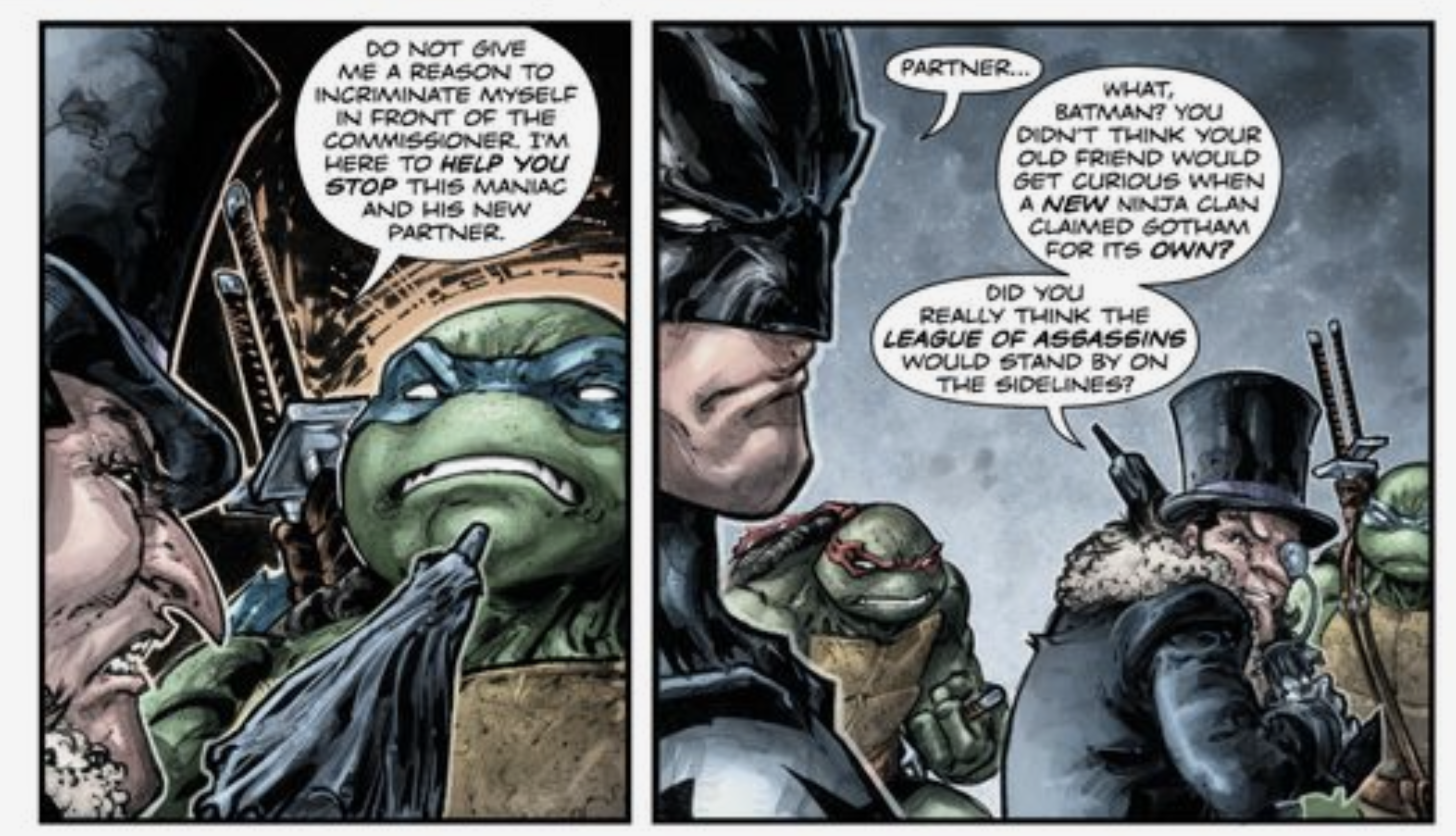
Try to imagine, say, Two-Face or Catwoman on that robot's shoulder.
Nope. Only the Penguin.

Who else is going to negotiate with the TNMT straight-facedly?  
The Joker? The Riddler? Nope. Only the Penguin.


ONLY.
THE.
PENGUIN.

These examples are, of course, on top of his roles as a Gotham mob boss, a thematic super-criminal, a behind the scenes arms-dealer and power-broker, a (three-time) mayoral candidate, a nightclub owner, and 'legitimate businessman'.  

Nobody gets tattoos of him.  Nobody wants to dress as him for Halloween.
But, in case you've never noticed it: the Penguin is always the enduring star.


Of Batman's six classic foes (him, the Joker, Two-Face, the Riddler, Catwoman, and Scarecrow), the Penguin is only one who didn't suffer a large gap in appearances between the golden age and later ages. Believe it or not, the Penguin is Batman's most consistent foe.  And he never really 're-invents' himself.  He doesn't suffer existential crises, he doesn't change his costume or M.O., he doesn't need a new origin.  He's the Penguin, and he's a lot more famous than many supposedly "cooler" villains, none of whom have their own shows on HBO; he was around before them and will be around when they are gone.

The Penguin gets away.

In the Golden Age, the Penguin was a very popular villain, used repeatedly. To facilitate this, the Penguin almost always...got away.


In modern time, the equivalent of these escapes is that the Penguin maintains his facade as a legitimate businessman and doesn't slip up to get sent to jail. But think of just how significant that is; his foe is the world's greatest detective and yet the Penguin remains free while continually committing crimes.  

Comics Archaeology said it best: what we tend to forget about the Penguin is that "he's a freaking genius."


Sunday, January 06, 2013

A Post-Penguin World?

As I've mentioned before I'm a reader of Dick Tracy, particularly since the new creative team has been, well, getting so creative.

Their most recent storyline has guest-starred two private citizens who've taken their cos-play as masked adventurers (the Cinnamon Knight and the Black Piranha) to the streets and become embroiled with Tracy's battle against a returning foe, Broadway Bates.

 He looks oddly.. familiar.

If you're thinking, "oh my god, Dick Tracy totally ripped off the Penguin," you are horribly, painfully wrong (although that certainly has happened on other occasions).  Broadway Bates first appeared in 1932, kids, seven years before Batman himself did.  If anything, the Penguin was clearly, ahem, "inspired" by Broadway Bates, a dapper 'gentlemen criminal' with a monocle, pointy nose, cigarette holder, and walking stick for a weapon.

In Dick Tracy's world, people still read newspapers.


Despite being the obvious copycat character, the Penguin is about 90,000 times more famous than Broadway Bates ever was (and if you think that's an exaggeration, ask yourself how many people could without the internet tell you who Broadway Bates is, compared to the Penguin). The current creative team, however, holds no grudges for that, and ingeniously turned the entire situation on its head by hilariously lampshading it.  Without ever actually saying the words "Penguin", "Batman", or "Gotham City", they've made it clear that Broadway Bates is, in fact, the Penguin's less successful brother.  Talk about yer Ivory Soap maneuver!

Yeah, I'm sure that'll happen any day now, Pengers.

Meanwhile, as the Dick Tracyverse is treating the Penguin with all the reverence due his legendary status, the DCU is possibly kicking him to the curb.  For those not following the current "Death of the Family" storyline in the Batman family of titles, the Joker has extorted the Penguin into attending some big affair at Arkham (ostensibly the Joker's wedding to Batgirl, but that's not important right now).  And they've spent considerable effort in setting up his sidekick, Ignatius Oglivy, to usurp his role as the new "Emperor" Penguin, in the expectation that old Oswald won't be returning from his latest jaunt with the Joker.

I've been complaining for some time that DC's been dissing the Penguin for some decades now, really unsure of what to do with him and unwilling to use him as a "supervillain" per se (which if you ask me is a waste of someone who can fight Firestorm to a standstill armed with nothing but an umbrella).  They've  tried to take advantage of the post-Crisis reboot by making him an untouchable crimelord and arms dealer, who, with his family connections to Gotham's early elite, passes as a legitimate, if not highly respected, businessman.  

But really, there's only so many times you can see (1) the Iceberg Lounge destroyed and (2) a member of the Batfamily or (embarrassingly) of the GCPD beat or extort information out of poor Pengy before your respect for him starts to stagger.  Most recently, as the Joker outmaneuvered him and his sidekick was scheming rings around him, the unthinkable happened and I've begun to question my devotion to the character.  Is Oswald Chesterfield Cobblepot, the Penguin, a character whose time has come and gone?

Once upon a time, the ideal of a "gentleman thief" was startling and innovative, a reversal of the expectation that criminals were all low-brow knuckle draggers whose criminal tendencies were easily divinable through the shape of their craniums.  Nowadays, when anything other than white-collar crime seems almost quaintly old-fashioned (do people actually 'rob banks' any more?), the Penguin seems, more than any other member of Batman's rogues gallery, to be an artifact from a different society.

The Joker?  Clowns will always be scary and he's proven himself wildly re-interpretable in various decades and media.  Two-Face?  People will always fear the potential for evil within themselves.  The Riddler?  Well, while "riddles" per se are a bit musty, the concept of an intellectual villain who poses puzzling challenges and plays games with the police is more popular than ever (judging from the plot of about 10,000 films and shows in the last 20 years). As for Catwoman, well, as long as there are still adolescent-hearted straight men interested in costumed cops'n'robbers, there will always be a place for a slinky, self-centered sexpot dressed in a leather catsuit and brandishing a whip.

But the Penguin?  Where is his niche gone? In a time when class conflict and the backlash against society's elite are quite high, you'd think he'd be a natural.  Has his comedic appearance and overtones finally weighed him down permanently?  Is he a victim of the prettyfication of popular culture, wherein all pop stars must look like they could also be porn stars?  Is the tall, handsome, blond Mr Oglivy the Penguin for a new millenium?  

Has the Penguin outlived his usefulness as a character, while Broadway Bates still trudges slowly along 80 years later...?


Monday, October 06, 2008

Arkham Asylum Villains

Very soon -- but not soon enough -- the next set of DC Heroclix, Arkham Asylum will be out.

The set is full of gems, but I want to highlight a few of my favorite villain in the set.

BLACK MANTA

Yes, he is riding a shark with a frickin' laser beam on its head. Because that is how evil he is. There was a Black Manta in the very first set of DC Heroclix. But they were still getting the bugs out of the system, and he quickly gained a reputation as, point for point, the most useless piece in the game. Well, no one on the beach will be kicking sand is this one's face. The figure represents his eyebeams with the penetrating Psychic Blast and Energy Explosion, and his underwater prowess with Superstrength, Toughness. And his "Pirate" power lets him Perplex up his stats or those of another aquatic figure.

Like Black Manta, the Riddler appeared in the first DC Heroclix set and was of questionable utility. That won't be said of the new one, who is a masterpiece of capturing what a Batman villain does without making him a powerhouse. He has Stealth and Leap/Climb, which are pretty key when fighting the Batfamily. Mastermind and Exploit Weakness made him a threat at close range, and at a distance he's got some "riddle-related" powers. One givex him Outwit and Perplex at the same time; it's a special version of Perplex that allows him to lower an opponent's battle stat by 2. Those ultra-high-defense figures, like Jay Garrick, might be in for an unpleasant surprise when the Riddle catches them off guard with some puzzle, and they let down their defenses. And "Riddle Me This" is a special version of Incapacitate as a free action (with the possibility of double-incapping an opponent). The Riddler can seriously mess up your opponent's team, as long as you have other character to do the actual punching for him; which is exactly as it should be.

The villainous Riddler is 90 points. But there's also an LE version, Edward Nigma, which for 60 points represents the reformed Riddler, the private detective. It has the usual Riddlerish powers (Outwit, Incapacitate, Perplex, Leap/Climb, Mastermind).
The Penguin is another villain whose remake was badly needed, as his original version was useless. This time, they figured out that his crime umbrellas are an excuse to give him nearly any power, including Energy Explosion, a special joint power for Smoke Cloud and Blades/Claws/Fangs, and Defend. That Defend is going to make him popular on Batman Enemy teams, where he can lurk behind others and keep their defense values high. His criminal acumen is represented by Mastermind (passing damage on to adjacent allies), Willpower (the ability to more twice in a row without penalty), and Outwit (the ability to cancel someone else's power from a distance).

Like the Riddler, Two-Face has two versions: the regular criminal genius version and a Limited Edition "reformed" version. The regular version has some expected powers, like Stealth, Mastermind, and Perplex. Flurry (the ability to attact an adjacent character twice) is a nice touch, but even nice is a special power that represents his coin toss, giving him either Incapacitate or Psychic Blast (either of which makes him useful against the big boys). The "reformed" version is similar, with both Flurry and Mastermind. But it is more of a personal combatant, with Combat Reflexes, Exploit Weakness, and a special power that grants Outwit and Willpower. The best touch is giving him the Batman ALLY ability. This "permanent stealth" will force most foes to come face to face with him, where his Combat Reflexes and Exploit Weakness will be to his advantage.

As welcome as all these figures are, they are capped by the creation of a new generic Thug with the Batman Enemy Ability (sharing Attack Values among adjacent Batman Enemies). These guys will be perfect to put in front of a supercriminal to share his Attack and absorbs his Damage (courtesy of the Mastermind Batvillains often have). That figure's dial hasn't been made public yet, but the generic has an LE version that has been revealed: The Henchmen. He's only got five clicks, but he's packed with a grab-bag of abilities that make him a great utility player. He's got a special ability that makes him a wildcard for team abilities and keywords for all the major villainous groups, which makes him the ideal sidekick for most any villain.

Thursday, March 27, 2008

The Iceberg Lounge

Ah, the Penguin. So underappreciated.

While I don't discuss it here often enough,
I'm a big fan of the Penguin, and think he doesn't get the respect he deserves from modern writers and readers, who don't take him seriously enough.

This is ironic, since a big part of the Penguin's original schtick was "No one would take this funny looking man in evening wear seriously", a fact he frequently used to his advantage. Most people underestimated the Penguin, and he made fools of them of because of it. Batman, however, wasn't fooled, because (1) he's achingly smart and (2) people who dress like bats know better than to judge by appearances.

Well, the Penguin did effectively fool many others-- unfortunately that includes many of the people who've been writing comics over the last twenty years. As a result, the Penguin's frequently been written as a comedic foil or a weaselly stoolie rather than a serious threat (the Riddler has suffered similarly from a lack of understanding by writers, but don't get me started on that). Weak writers can only use hypermuscled heavily-armed "bad-@$$" characters as threats; weak writers need characters with obviously strengths, because it doesn't require them (or their readers) to be clever. Strong writers enjoy exercising their literary muscles proving that an effete little fat man or a triangle-headed geek in a leotard can be a threat, even to Batman. Strong writers delight in characters with hidden strengths.

Chuck Dixon brought a fresh approach to the Penguin in I guess it was 1995 when he re-imagined him as a not-so-reformed supervillain turned "legitimate businessman", and owner of a posh nightclub, the Iceberg Lounge, which served as a front for his nefarious doings. Fresh, I might add, does not mean completely novel; the exact same thing happened some thirty years earlier on the Batman television series (Dec. 7, 1966, "The Penguin's Nest"):
Robin: It sure is a shame, Batman. A restaurant with such terrific chow turning out to be a mere front for some criminal scheme.
Batman: Look at it this way, Robin. That $100 cover charge is pretty stiff. Penguin's "terrific chow" is hardly within the budget of the average worker.
Robin: Gosh yes, you're right, Batman. All the needy people in the world, all the hungry children.
Batman: Good thinking, Robin.

In fact, the Penguin did something similar in the Golden Age, once in "Birds of a Feather" Batman #11, Jun/Jul 1942 (his third appearance, in which he opens a 'honest' casino in Florida), and again in "The Penguin's Nest", Batman #36 Aug/Sep 1946 (on which the television episode was based).

Dixon understand that the Penguin was a smart guy and an old-time operator, a Batman-style crook with flair and gimmick, not a superpowered Firestorm supervillain (although he could swing that way, when he wanted). Parlaying his infamy into PR for a high-class joint that could both provide him with legitimacy and give him a front for criminal affairs is exactly the kind of thing the Penguin would do.

Good thing, too, for although Dixon meant for the restauranteer/crimelord concept to bring respect for the Penguin, other writers took the restaurant more seriously than they did its owner. Thus, the ICEBERG LOUNGE has become a permanent part of the Gotham City landscape, one of those places that always exists no matter how many times it's destroyed (like the Daily Planet building or the Flash Museum).

As in comic books, so too in Heroclix, where the Penguin also has gotten no respect. In fact, his clix is almost legendarily bad. But all the major Batman villains will get remade in the special all-Batman heroclix set this July, and some of them made again in the larger, villain-oriented "Rogues Gallery" set in the fall. This means at least one if not two new, and almost necessarily more useful, Penguin heroclix figures are coming our way.

So I want to prepare for those Penguins (and other Gotham City folk) by giving us all a new map for them:

THE ICEBERG LOUNGE
Click on map for a penguin's eye view.

No place is cooler than the Iceberg Lounge! Using this picture as inspiration,


I tried to capture some of the elements commonly used to depict the Iceberg Lounge: the pool in the middle, the icebergish sculpture in the pool, the ship shaped dancefloor, the polar decor. I didn't have the ability to put a tuxedoed dance band on the sculpture, I'm afraid, but I was able to substitute with some actual penguins.

I threw in some special rules for windows and doors (which are long overdue on standard Heroclix maps anyway). You wouldn't think an all-white room would be an easy place for stealth, but with clusters of tables serving as hindering terrain and some balcony seating for leap/climbing, it's a pretty Batman-friendly map. Can't wait to have Batman and Robin leap to the top of the pool sculpture and hurl some batarangs at tuxedoed goons. And who knows, with all that water, maybe Aquaman might join in the fun!

Still, the elevated terrain is pretty exposed, so it's not exactly a dark Gotham rooftop; beware. The Dynamic Duo might need to duck for cover into the upstairs bar ("They may be drinkers, Robin, but they're still human beings and might be salvaged.")

Note that the Penguin has his own private dining area, upstairs near the bar where he can oversee everything. Because, you know, he would. In fact, if you could see the map at full size and detail, you'd see he's about to chow down on a big plate of sushi. Yes, really.

Later, I think I'll expand the map to a 3x3 version that includes the hidden areas of the Iceberg Lounge: private dining for wanted felons, the casino, the Penguin's office and armory. Or perhaps instead I'll make another 2x3 map that's a generic gambling joint. Then it can be a stand-alone map OR can be placed to the right of this map to serve as the Iceberg Lounge's hidden back rooms.

Remember, there's always more to the Iceberg than meets the eye! But for now I wanted to see how you like this version. And please be kind; it may not look like much, but it took of lot of trial and error to get the look I was going for.