Showing posts with label mischaracterization. Show all posts

Friday, November 04, 2022

What is: The Catwoman? A Criminal.

Of Batman's Five Top Villains, I find Catwoman least interesting.  This is literally the first post I've ever made tagged with her name. The Penguin, The Riddler, and Two-Face are all definite and potentially interesting characters. The Joker's rather abstract, but he's iconic and variable enough that you can do a lot with him. Catwoman, however, is just... a lady-as-cat metaphor and occasional femme fatale. There are 10,000 catwomen in comics; she's just the one who snagged the actual NAME first.
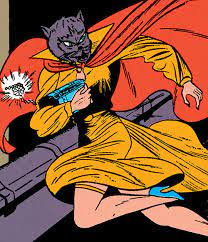
Although she was originally called 'The Cat' and they stopped calling her that immediately because it sounded STUPID and still does so... stop CALLING her that.

But that doesn't mean I think it's okay to misportray her; it doesn't mean I don't think she has definite characteristics that should be adhered to. To wit:

The Catwoman is self-centered. 

Catwoman: "It's me and you against the world!"

Batman: "What about Robin?"

Catwoman: "Well, I'll have him killed. Painlessly, of course."

This scene is, of course, played for comedy.  But the beauty is in the immediate, innocent logic of her reply, which she sees nothing wrong with.  Catwoman's not so much about being immoral as about being amoral.

Look, it's nothing personal.  She doesn't have anything against you. She just doesn't have anything for you either. It's all about her; she'll be on your side if that seems advantageous to her at the moment, and if not, then not.

If only there were some sort of avatar for this attitude.

Batman '66 got it. Batman '66 NAILED it.

And who can blame him?

If you can't get this right, then go write Batgirl.


The Catwoman is a criminal, not a hero.

This one is the crux of my list and of my complaints about how Catwoman is mischaracterized. Catwoman isn't a hero. She's not an anti-hero. She's not your naughty girlfriend who will punish you with her whip when you've been bad.

No, I'm not looking at you, Tom King.
I'm looking right through you.

One of the worst things that has been done to the Catwoman is reform her. Again and again.

It's not character development. It's sexist bullcrap.  

One of the posts that has received the most attention (and hits) over the years is this one, in which I simply noted that in the real world there are way way more male criminals than female ones, so that parity in the numbers of male and female villains in comics wouldn't be very realistic.  

And realism is essential to good comics.

Many (putative) comics-blogging feminists railed against what they viewed as the sexist idea that 'women couldn't be as evil as men', which, obviously, wasn't what I was saying.  I'm sure they can be and whether they can or not is irrelevant; the fact remains that statistically they are not as criminal.  What I really wish is that people would stand up for the rights of female comic book villains to remain villains.  Because every time a comic book villainess gains enough popularity, writers turn her (either progressively or suddenly) into a hero.  

We've lost Batman's three highest profile female villains to this insidious process: Catwoman, Poison Ivy, and Harley Quinn. 
Thank god Nocturna escaped.
In her nocturnaballoon.

Who's next? Orca the Whalewoman? Baby Doll? 

We don't do this male villains. The Joker is popular; nobody tries to use that as a reason to turn him into a hero//anti-hero.

Well, except for Sean Murphy

And, of course, the same people who made Harley Quinn the hero of her own animated show.

Because, you know, if we like a GIRL, then she can't really be BAD. She got a bad break or is misunderstood or was mislead.  Or got amnesia from being in a plane crash, and so went from being a stewardess to a thematic costumed criminal overnight.

That's Selina Kyle's ACTUAL GOLDEN AGE ORIGIN, because writers were already wussing out before the Silver Age arrived. A smart writer many years later retconned this as a LIE Selina told to give herself the opportunity for a fresh start. 


Just like any woman, all she really needs to give up her own plans and career is to fall in love!

Batman #15 (1940)
"If I had the chance to marry a handsome billionaire, I'd give up my life of crime."
Impressively noble, Selina.


Where's the feminist outcry over this continual, repeated rehabilitation of female villains and Catwoman in particular?  It galls me infinitely that no critics and only one character (and only one writer) has called BS on this trope as applied to Catwoman.

The character? The Joker, who took it upon himself to simply fix the issue in Detective #570 (1987).

The writer? Enemy of Society Mike W. Barr. You cannot imagine how much it me pains to admit, "Mike W. Barr got something important right and everyone else got it wrong."
But truth is truth.

Stop sugar-coating it. This is what every attempt at making Selina Kyle into a hero is about: "domesticating" her into a girlfriend for Batman, from a wildcat to a housecat.  I'm not a huge fan of the Catwoman, but even I get royally ticked at this. I'd be a much bigger fan if DC didn't insist on regularly declawing one of their most iconic female villains just to satisfy male fans who want to imagine her as their naughty girlfriend and female fans who want to identify with her as a strong female lead who isn't saccharine. 

I could say something about how a similar role as a domesticated secondary character has befallen Golden Age badass heroine Black Canary,  who's gotten stuck as Green Arrow's Girlfriend.
But I won't.


The Catwoman is not a killer.

Generally, this point is consistently held (the Batman '66 version notwithstanding).  Usually it's because it's a genuine moral line she draws and that's legit; there are plenty of criminals willing to commit crimes but not willing to kill.  Sometimes it's portrayed more as a practical consideration; nothing is worth that rap.  

It's worth noting that in The Batman, Catwoman is willing--eager--to kill someone. Batman simply convince her it's not in her best interest to ruin her own life by becoming a killer.


The Catwoman is a thief.

This may seem like a stupidly obvious point, but for a comics villain it needs to be made. The Catwoman isn't a terrorist, or a blackmailer, or a criminal performance artist, or a serial killer, or a thrill-seeker, or a mob boss, or a gangster, or a revenge-seeker, or an ideologue, or a fanatic, or an obsessive, or a lunatic, or an anarchist, or a mad scientist. She's a thief. She's steals stuff. Sometimes she has henchmen (usually only if it's a convention of the medium, such as in Batman '66); sometimes she's working a more elaborate scheme.

Like operating a beauty parlor. Or a dance studio. Or posing as Kitanya Irenya Titania Karenska Alisov, of the Moscow Bugle.

But generally the purpose of those more elaborate schemes is: to steal stuff.


The Catwoman is not Batman's girlfriend.

Look; we get it. There's an attraction there. There's supposed to be. It was written there from the beginning.

So, she was just wearing old lady make up. With a peek-a-boo blouse.
Did she use wrinkle make up on her boobs? This is what happens when you don't pay attention in Madame Fatal's class, Selina.

But there's a reason for it, and it's really simple, people. Selina doesn't get the hero because she's a villain. Period.  Or forget comic books rules for a second.  The principal indicator of success in a relationship isn't common interests, like fetishistic dark animal costumes, Olympic-level gymnastic combat techniques, and rooftop repartee.  

Not pictured: repartee.

It's common values and complimentary personalities, which Bruce and Selina do not have and have NEVER had. The Batman film got this quite right, which is why they go their separate ways (after an ACHINGLY long motorcycle ride through Golgotha).  The Batman '66 show got this right, episode after episode (except in the third season, where it went unaddressed for... societal reasons).  

Pictured: societal reasons.

The Batman Returns Catwoman understood better than most writers do. "I would love to live with you in your castle… forever, just like in a fairy tale. I just couldn’t live with myself."

Once of the lessons of adult relationships is: being attracted to each other isn't enough.  Loving each other isn't even enough.

Even to Tom King it was obvious it wasn't right for them to be together.
Why wasn't it obvious to his readers?

Bruce and Selina are classic case of people who will always be attracted to each other but are inappropriate for each other.  It's realistic; it's mature. Just let them be what they are.  Stop clinging to this silly fanboy/girl fantasy and let them look elsewhere for romance (if romance they want).  Obviously what they both need is someone who is remotely normal who will put up with their nonsense, a Lois Lane of sorts.

Stop pretending that THIS person makes sense as the Catwoman.

Show the Catwoman some respect. Let her be a person who has sex when she feels like it, whose emotional needs are met mostly solo or with friends and acquaintances, and for whom romance just isn't a priority. 

Or is that just IMPOSSIBLE for anyone to believe... of a woman?

Thursday, November 03, 2022

What is: Two-Face? The Solution

Poor Two-Face.  One of comic's most (potentially) interesting characters, yet almost always badly botched in execution. And the saddest part is, all anyone has to do is read his FIRST STORY to know better.

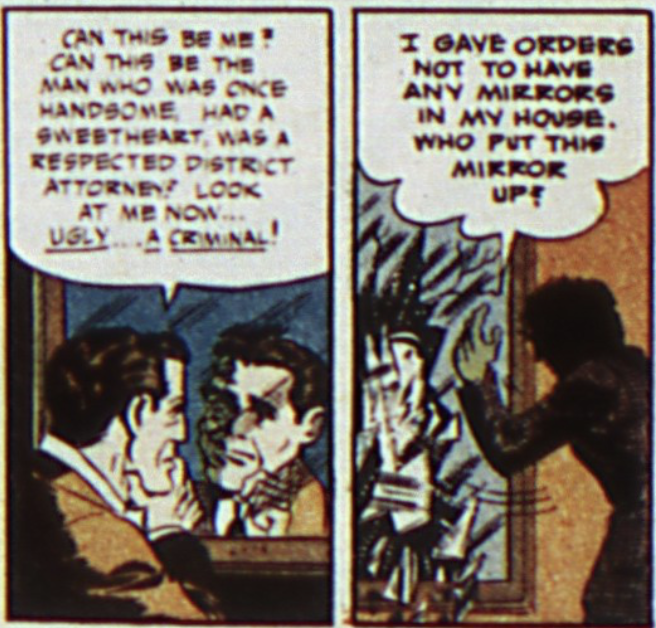
Two-Face is about appearances. 

It's the FIRST and foremost point made about him in the first panel of his first story.

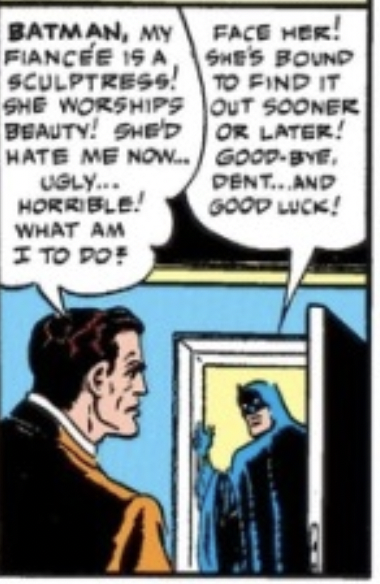
Or, perhaps it would be more accurate to say, "Harvey Dent was about appearances."  Harvey Dent was very handsome and, frankly, vain, and his fiancĂ©e was written as an artist who worshipped beauty.  

It's the reason Maroni's revenge was to throw acid at his face; it was the only way to truly hurt him.


This is an aspect of the character which has been somewhat forgotten, I suspect, because (1) it's been so long (from out perspective) since Harvey Dent was around and (2) it seemed like simplistic Golden Age psychology.  The idea that someone would go supervillain-insane just from getting scarred probably seemed naive to later writers. 

Note the order: handsome, loved, respected.


But nowadays in our image-driven culture where being camera-ready and telegenic is more important than ever before, it's an aspect of the character that should be revivified or at least remembered.  


Batman is not really the friend you turn to for advice on how to deal with tragedy.
"I recommend a strict course of weightlifting, chemistry, and criminology! Steady on, chum!"


The movies actually did a better job on this aspect than the comics. I don't mean that they focused on Dent's vanity.  But, unlike the comics, they acknowledged that as a District Attorney, Harvey wasn't a public employee--he was a politician, one for whom public image, appearances, were paramount.  And that Harvey Dent was the Bright Knight of Gotham.

The Billy Dee Williams was also portrayed as a handsome reformist politician.
Although the Tommy Lee Jones version's origin was sloughed over, if you do a search for young TLJ, you'll probably be shocked to learn he certainly looked the part:
It's so easy to imagine this man beating the crap out of Jim Carrey.


Two-Face is an attorney.

Sigh; but every actor wants to direct.

Sure, everyone knows he's a lawyer. But there's significance to it that many people miss.  It's exactly the right profession to prepare Harvey Dent to become Two-Face.  Attorneys are not trained to be on the side of Good or Evil. They are trained to look after their client's interest.  They are trained to make a case, not to decide what's good or bad.  In fact, the profession is premised on the fact that not only do the innocent get representation, so do the guilty. A case must be made for the Good; a case must be made for the Bad.  An attorney must be prepared to make a case on behalf of either the Good or the Bad, at a moment's notice.  You don't get always get a choice which you are arguing on behalf of.  

That is, of course, exactly what Two-Face does, every time he flips his coin. Two-Face isn't a bizarre split from Harvey Dent; he's a logical continuation of him.


Two-Face is stable.

Let me unpack that statement, because it's my most important one.  Too many--sadly, most--modern writers portray this characters as a sort of split-personality, with Two-Face as the "evil counterpart" of Harvey Dent. 

Well... those people are idiots.

Ordinarily, I might be kind and simply call them "naive".  After all, the most obvious model for Two-Face is Dr. Jekyll & Mr. Hyde,  and that's how those guys rolled.  Or it is "roled"?

It's on his splash page, after all.

But it seems pretty clear none of those writers has read a single Golden Age Two-Face story and for that, I condemn them as idiots and posers.  In his original stories, Two-Face wasn't an evil alternative personality to Harvey Dent; he was a morally ambivalent replacement.  Yes, Two-Face is a criminal by default, but that's only because of the toss of a coin.

They never DO explain where he got that suit.

Harvey Dent didn't immediately snap and 'become evil". This is enormously significant. What happened is that his commitment to keep up appearances of being good was shattered when he realized he would look evil anyway.   

Essentially, becoming Two-Face just dawned on him as the only sensible reaction to the random cruelty of the world.  

Remember: in the Golden Age, no one in the Golden Age is ever officially crazy UNTIL they make That Pose.  The technical term is The Golden Age Goofy Foot.


Yes, he becomes a criminal, but one just as happy to do good as to do evil.  And look HOW HAPPY IS IS ABOUT IT.  

HEE...HEE!

And why shouldn't he be? It's an enormous relief.  He no longer has to take responsibility for any of his decisions. Two-Face is, on the whole, happy and stable... something that we realize in later years Harvey Dent probably wasn't.  This is what makes Two-Face scary; this is what makes Two-Face threatening.  Not that he's some "evil half" that can't be overcome.  Some pretty basic therapy would get Harvey Dent to accomplish that if that were the issue.  The problem is: he already has. THAT'S WHAT TWO-FACE IS.  


Two-Face isn't "Harvey Dent's evil half". Two-Face is Harvey Dent's way of reconciling his impulses toward good and those toward evil. The reason Two-Face is so hard to exorcise is that Two-Face isn't Harvey Dent's problem; he's his solution.

He's not Jekyll. He's not Hyde.
He's Jekyll AND Hyde. Two-Face isn't evil; he's good AND evil.
How much clearer could it be?


So when I say "Two-Face is stable" I mean: not only is Two-Face not a split-personality, he in fact represents the stable integration of any possible conflicting impulses within Harvey Dent, and that's why he is resistant to treatment.  As long as he has his coin as a scapegoat, you can't offer him an easier alternative.

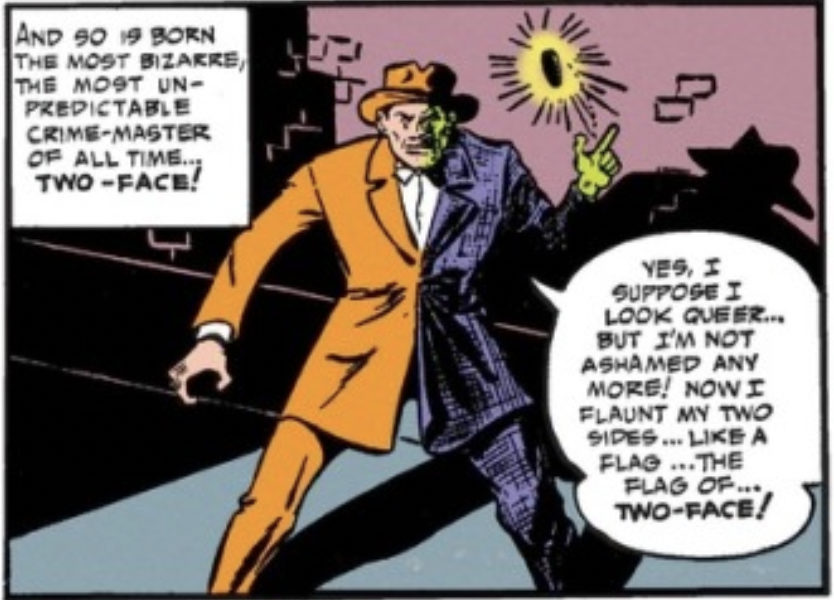
"YES, I SUPPOSE I LOOK QUEER... BUT I'M NOT ASHAMED ANY MORE! NOW I FLAUNT MY TWO SIDES... LIKE A FLAG..."
Perhaps updating Two-Face might have more sense than Tim Drake.

Two-Face has his cakes and eats them, too.

This one's tricky and one only the best writers pull off.  But it's a logical extension of the other concepts we've been discussing: Harvey's focus on appearances, his background in the morality-neutral field of law, and reconciling power of his identity as Two-Face.  In short, Harvey Dent/Two-Face often finds a way to do good and evil at the same time.

In his Harvey Dent days, this is usually shown as a willingness to use shady tactics in his prosecutions.


In his Two-Face days, it's usual shown in schemes to control both the police and the underworld at the same time.

As he does on Harley Quin. I have to note that even the Harley Quin animated series, not known for 'respect', manages to get Two-Face better than most authors do.

A lesser author writes Two-Face as a zero-sum game: either his 'good side wins' or 'his bad side wins' in any situation.  A greater author writes Two-Face as smarter than that. They know that Two-Face can arrange things so that both Good and Evil are satisfied... at least, in his own mind.  

Here, he steals, as criminals do.
But from another gangster. And gives the loot to an orphanage.
Both good and evil are served.

The perfect--and most chilling example--is right there in his very first story.

The coin lands bad so Two-Face decides to be villainously unforgiving and kill a henchmen who made some mistakes.

But killing him is exactly what he would have tried to do as D.A.
Good is served at the same time as Evil.

That's... some deep and twisted stuff.  And more psychologically sophisticated that 99% of everything in every subsequent Two-Face story.  Especially when you consider that what's underpinning this is Two-Face's OWN guilt:

Spoiler: Batman's not actually dead.

Two-Face's is feeling guilty about having been Bad and for making a mistake that day and (apparently) killing Batman. But unable to face the responsibility for his actions, he punishes one of his own gang for making a mistake that day and being a killer ... and paints it as an act of virtue.

Now, that is psychology. Not "Harvey" talking to "Two-Face" in two different color word balloons as if he's the Ventriloquist.  That's not merely unsophisticated, it's goofy to the point of childish and dysfunctional to point of crippling.

Wednesday, November 02, 2022

What is: The Riddler? A Poser

Surprise, surprise: Tom King screwed up the Riddler with character assassination (One Bad Day: The Riddler).  Tom King being the best at what he does (character assassination), he also managed to do so to Batman at the same time. So let's recalibrate with my definitions of what the Riddler is.


The Riddler is theatrical.

This may seem redundant, since he's a Batman villain; aren't they all theatrical? But think about it; Catwoman; Scarecrow; Penguin; Two-Face.  Thematic? Yes. Dramatic? At times.  But not in-universe theatrical; they don't really 'put on a show.' The Riddler, on the other hand...

I bet he put on the "Jeopardy" thinking music.

He's corny, too.

Even Judd Winick gets it.


The Riddler is an intellectual not a goof.

Most creators get this right; it's hard not to.

I mean: even Tom King got that part right.

It's an essential part of his characterization. The unfortunate result is that most writers can't write the Riddler because they are not sufficiently intellectual; it's pretty daunting to be asked to write a villain who comes up with puzzles that stump BATMAN. So, as discussed in the post linked above, they cop out and just make him goofy.


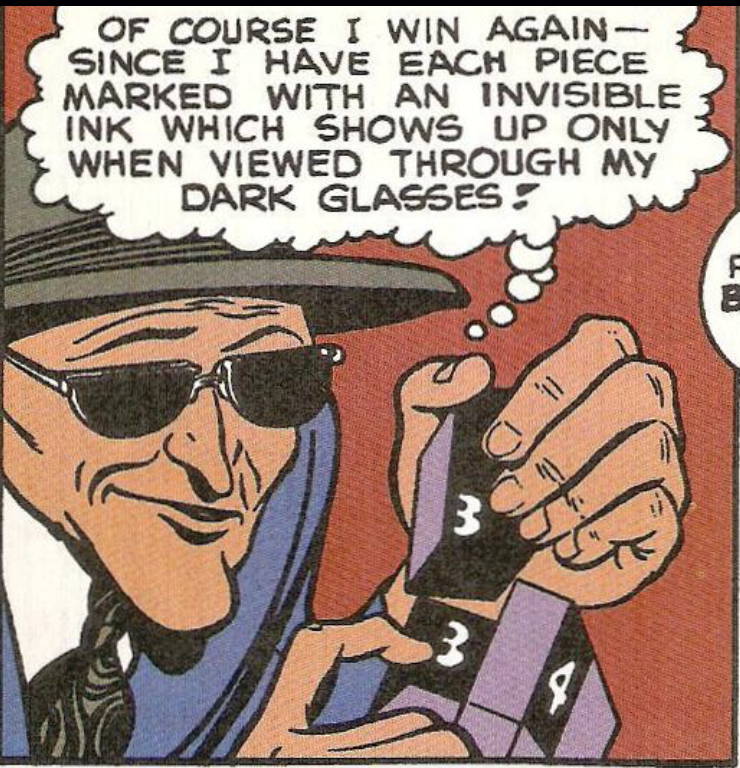
The Riddler is not about solving problems; he is about posing them.

Not to put too fine a point on it but: He's not called "The Solver"; he's "The Riddler".  This is why all those interpretations where the Riddler reforms (to a some degree, at least) and occupies himself with solving mysteries are ... incorrect.  The Riddler already knows that--given time and opportunity--he can solve any riddle. He'll cheat if he has to to SOLVE a mystery.  

It's part of his origin, after all.

But the Riddler would never cheat by giving you a mystery that can't be solved. 

The Riddler is an inversion of the Batman, in this respect.  The Riddler is a criminal who creates mysteries for his own sake; Batman is a detective who solves them for the sake of others.  


The Riddler isn't crippled by a 'compulsion' to give clues.  

I remember when this idea was introduced (well, I remember when I bought the comic wherein it was).    As I've mentioned before, Golden Age writers got what made villains VILLAINS, rather than mere criminals.


Well, yes, presentation; and the Riddler certainly has that and it's part of what I mean.  But what I meant was classic villains are not minimalists. They are not trying to do the least they can do, to just score some swag under the radar, and not get caught; that's what criminals do.  

Villains steal things because those things are thematically appropriate, not simply things that are valuable. Villains don't always hide their crimes; they let you know that they did (or, sometimes, even what they are about to do).  Villains aren't avoiding challenge, they are looking for a challenge. Villains are performance artists; they are putting on a show, even if they are the only audience.  

The Riddler is a true villain. He's not "compelled" to give clues; he chooses to. It's the point of what he's doing; the crimes are just a macguffin.  The Riddler's M.O. isn't a fatal flaw; it's a distinguishing feature.

Another one of the many things Tom King does not understand.


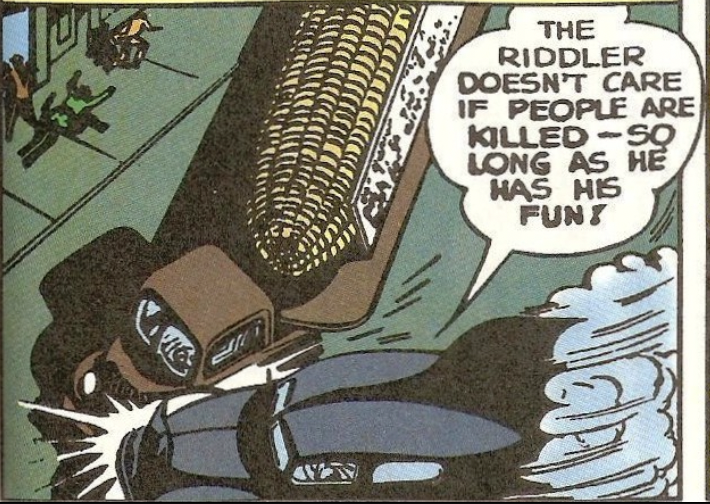
The Riddler doesn't kill ... gratuitously.

Certainly, the Riddler WILL kill: He loves his Batman-deathtraps.

It's part of his origin, after all.

But it's never the goal.  In fact, it's generally not among his repertoire.  Why? Well, it's never stated explicitly, but it's a pretty easy mystery to solve.  The Riddler doesn't kill for (essentially) the same reason that Batman doesn't:  it's too easy.  

Sure, he might kill you accidentally, but that's your own poor luck.


Oh, sure, Batman has "a moral code" whereas the Riddler's has "rules of the game".  But the Riddler, as a truly classic villain, has to impose limits on himself, and allowing himself to kill would spoil his game; it's too powerful an advantage.  

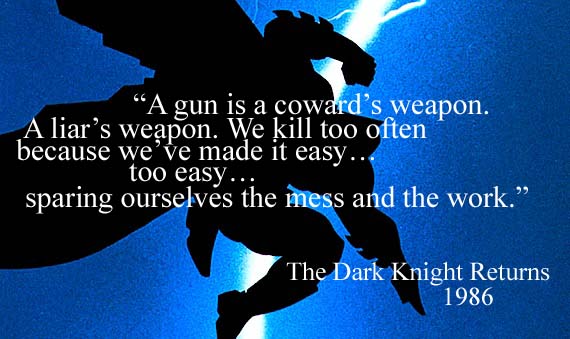
Batman doesn't use a gun because it would make killing too easy.
It's part of his origin, after all.

So naturally Tom King in One Bad Day: The Riddler not only has the Riddler become willing to kill, his character arc for Batman has HIM becoming willing to kill, too. It all makes perfect sense...if you're Tom King, the kind of writer who's only interest is in 'taking characters where they've never been taken before". 

Well, when a character's been around as long as these have, if they haven't been taken to a particular "somewhere", it's probably because it's a terrible idea, not because you're the First Writer Brillant Enough to Think Of It, Tom.

Peter Milligan went there first, anyway.