Friday, January 06, 2012

GIANT PENNY WEEK, #4: Death Trap!


When last we left the Penny Plunderers, Joe Coyne had re-acquired one of his lost gang members, one who desperately hopes Joe doesn't realize that he ratted him out to Batman. But Joe does know. Penny for your thoughts, Joe!

Extra style points to Joe for taking the time and trouble to set up that damning fortune in the weight machine. Anyone can be evil; being a villain is about style, people!


I bet you probably don't find Joe Coyne very threatening. He has no superpowers or special weapons. He has no disturbing deformity or demented worldview. He's just a creative hood with an obsession for pennies and less fashion sense than Jimmy Olsen. But you know what? He's still a Golden Age villain:

Golden Age gangsters are happy to shoot you dead, in a darkly ironic way. We may laugh at Joe Coyne because he's no Lex Luthor or Joker, but he's a great example of the transition of villainy that occurs across the Golden Age and into the Silver Age.

Old school crime comics had a host of gangsters, who to us would seem mostly interchangeable. Usually they were not distinguished by their appearance or obsessions, but rather by their criminal rackets. They were The Guy Who Fixed Prizefights or The Guy Who Preyed on Trucking Companies; how exciting. But Batman changed all that.

As has been pointed out a zillion times, Batman was, in many ways, not particularly original. His various characteristics (detective, polymath, pugilist, acrobat, wealthy socialist, dark vigilante, etc.) had all been seen in other characters, even in combination. There were other heroes who could do all the things that Batman could do. The difference is that the focus shifted away from
what Batman could do-- because, as we know, Batman can do anything you need him to--and toward the way Batman did things. Batman was about STYLE, and that was the key to his popularity.

That, and his bottomless well of human sympathy.


His slate of foes, over time, naturally evolved in that direction as well. The emphasis shifted from scheme to theme. This was very liberating for the writers; once they had villains who were intrinsically engaging due to the style, they could focus on coming up with interesting, even outlandish, schemes for them to perpetrate. The combination was much more potent than the the old "Manny the Mafioso" gangster stories, and, to this day, colorful villains tend to squeeze out other, more mundane criminal threats.

[Oh, and for That Guy who's about to object that Dick Tracy and his villains Did It First: EHHNNKH! Sorry, wrong answer. If you'll check the debut dates of Tracy's villains, you'll notice that prior to Batman's debut in 1939, Tracy's foes are mooks like "the Smuggler", "the Squealer", "the Tramp", "the Stabber", and "Larceny Lou". With the possible exception of "The Blank", it wasn't until the 1940s that Tracy villains really went wacky.]

That's Batman's "sympathetic face", by the way.


Any way, Joe's basic tale is a classic gangster story of kid who makes the wrong choices. But his perception of a theme to his failure, his obsession with turning this theme to his advantage, the predictably his mania creates and the fact that his mania proves his ironic undoing: these are style markings of the supervillains to come. As is his use of thematic weapons to capture Batman and Robin when they show up:

Really. Supervillain or not, you have to respect someone who can beat the crap out of Batman and Robin with nothing but some pennies. In just two panels.


Then, in another moment of budding supervillainy, Joe, having knocked out Batman & Robin with nothing but a bunch of pennies, cobbles together a death trap with ordinarily household items.

One of those pennies should actually be colored GREY not ORANGE. It'll be important in a minute. Oh, and note the spices.


Batman, not to be outdone, spanks MacGyver's mama by getting out of trap using the two cents that Joe couldn't stop himself from tossing them in order to be an ironic asshole, some blotting paper, and salt water. Really, this is either the most awesomely absurd or absurdly awesome death-trap escape from anything, ever (you choose):

Thank goodness they store their condiments with the unused arcade machines. And that everyone in comic books knows Morse Code!


I tried to come with some reason while Batman would do this rather than just, say, pick the lock on the door. Only possibility: this means of escape was the optimum intersection of "awesome" and "ironic".

Thursday, January 05, 2012

GIANT PENNY WEEK, #3: Attack of the Giant Penny!


When last we left "the Case of the Penny Plunderers", Joe Coyne had pretensions of remaking himself as a "villain" rather than a mere crook by hewing to a lunatic "crime symbol". Using the power of free association that allows them to divine the schemes of the madmen they fight, Batman and Robin have not only figured out, just by reading the paper, that there
is a "Penny Plunderer", but they've divined his next target.


The One-Penny Black, by the way, is a real thing. Golden Age writers like Bill Finger used to hang out in illicit trivia dens in Chinatown, lying on divans, soaking in all sorts of bizarre useless data that they might later incorporate into some plot point. You kids, with your internet, you know nothing of sacrifice.

The first appearance of the Giant Penny. And the much less famous Giant Stamp Tongs.


Rather than alert the police (because, you know, where's the fun in that?), they just lurk around in the shadows, until Coyne and his gang show up, whereupon there's lot of Patented Punning & Punching. And Batman showboating by means of functional giant props.

Just once I'd like to see one of those props turn out to be paper mache, so I could see Batman go crashing through it to a faceplant on the hard, cold floor, while the photographers from Picture News go to town. But I'm sure that's against the Gotham City Civil Code on Giant Props.


But sometimes the gods punish hubris immediately and Batman pays for his showboating with...

a roll of pennies to the forehead.

Hm. What's the word I'm looking for? Oh, yes:

BWAHAHAHAHAHAHAHAHAHAHA!


Batman's humiliation is deliciously augmented by the fact that Robin--and a roomful of Gothamites--are watching as Batman gets pwned by a Grade Z hoodlum with some pennies and falls off a giant stamp to the hard, cold floor. Where's Vicki Vale when you need her?

Before there were blogs, there were the Gotham tabloids.


The bad guys do the logical thing, which in Gotham means "escape via the rooftops after climbing up the giant postage stamp and out the skylight." Because, you know, the rooftops are the perfect way to flee from Batman. But one of them doesn't make it, and Batman, tries desperately to salvage his self-image by intimidating a skinny gunsel. Boy, I sure hope a member of Coyne's gang isn't eavesdropping from the skylight and kidnaps the squealer....!

Uh-oh. This won't end well...

P.S. Oh, I almost forgot....!

This is what the Giant Penny does:

Small wonder that the Giant Penny is the standard by which all other Giant Props are measured. But what's it feel like to get hit by a Giant Penny? Well, we'll be discussing that later.


Batman actually uses the Giant Penny against Coyne's gang, NOT vice versa. Then it's not seen again until it shows up three years later in the original Hall of Trophies story ("The Thousand and One Trophies of Batman", Detective #158, Apr 1950).

How did Batman get his gloves on the Giant Penny? Most readers think grateful citizens just up and give Batman trophies after he saves their asses (or gets them publicity by getting pwned on the front page of Picture News). Or they think that Batman pockets trophies from crime scenes when the police aren't looking. But that's silly. Clearly, Alfred spends most of his day on Ebay on Bruce's behalf, buying up relevant giant props from previous cases. And thanks to the Gotham City Civil Code on Giant Props, the expense is actually tax-deductible.

Wednesday, January 04, 2012

GIANT PENNY WEEK, #2: Meet Joe Coyne!


The Case of the Penny Plunderers begins with the origin of our antagonist, Joe Coyne.

"Penniless"? "Coyne"? "Business in pennies"? Hm; I think I'm sensing a theme here...


"A measly two cents? What can I buy with that?" In 1947? Probably a new suit. In fact, sell 2.75 more newspapers, Joe, and that'll be enough for you to buy an automatic washing machine, a year's supply of gasoline, carpeting for the living room, a vacuum instead of a plastic broom, not to mention a forty-inch television set.


Actually, according to the on-line inflation calculator, Joe cannot, in fact, buy much with 2 cents, since in 1947 it was only worth the equivalent of 19 cents currently. But Joe could still buy almost ten times as much we could, so no sympathy for him here; heck, we can't even buy a stamp for 19 cents.


Yes, Joe; other guys have 'big bills' and you have only pennies, as you stand there in the Gotham night under a streetlight. Of course, some other guys with big bills have to stand in the Gotham night under a streetlight and watch their parents lie there dead in pools of their own blood. Beware of envy, Joe. Well, perhaps, as you say, it will be different when you grow up.


Or maybe not. Writer Bill Finger, with astonishing efficiency, let's us know that Joe got his chance, and he blew it. It's not just that he got a good job and got fired. He wasted it on, well, penny-ante gambling. But the key is: Joe didn't stop when he got caught once. Because Joe is a weak fool.

See? I told you.


Joe is weak and turns to crime. And he's clearly a fool for not casing the joint better. Joe, you shoulda spent some of those pennies on some crime comics and you'd know that already. Oh, and speaking of weak fools... who's your tailor, Joe?

But the Gotham penitentiary has its usual salutatory effect and Joe sees the error of his ways.

Psych!
Stop whining, Joe; at least you got a nicer outfit out of the deal.


Um... Joe? Brooding's not healthy. You just said "I hate pennies", which is crazy talk, and you keep shouting "COPPERS!" and "PENNIES!", kind of like Mr Crocker from
Fairly Odd Parents. Now you're just making irrational, baseless connections in a paranoid attempt to displace your own failures and follies onto some sort of external conspiracy. Kind of like Umberto Eco. And you're doing that thing with your hands that people do right before they become comic book villains. Turn back, it's not too late, Joe, it's not too late!

This really needs in some museum somewhere. Or in every museum, everywhere.


Uh-oh; it
is too late. You're making absurdist vows, are talking about having a 'crime symbol', and have degenerated to the point where you can only portrayed by John Astin or Raul Julia. And since both of them are dead, that's ... a bad sign.

Yep, Joe's definitely turned what I call "the Mad Hatter's Corner", the point at which, after a series of questionable decisions of increasing dubious morality, a character gets that one final chance to suck it up and be a normal person but instead says, "What the heck, I'm a Gothamite, I'm just gonna choose to round that corner into Crazytown and set up shop there!" Vowing to avenge your parents' death by fighting crime doesn't seem quite so crazy when compared to vowing to base on your crimes on pennies.

So... Joe embarks on a life of crime based on... pennies. Which is sure to turn out so much better than his previous life of crime. You know... the one ruined by pennies.

Well... at least Joe's dressed for Crazytown.


Let's see: penny arcade machines (heck, ANY pinball machine), bank tellers with no plexiglass barriers, no coin counting machine. It's seeming less and less likely that Joe Coyne will be in the next
Batman film trilogy.

But how many opportunities for penny-related crimes can there be? I mean, even in Gotham?

Guys, guys; use bubble wrap!!!


Piggy banks. Of course Gotham has a millionaire with a "priceless collection" of something bizarre that relates to the villain's 'crime symbol' that he's willing to ransom back for a fortune. Because that's the kind of place Gotham is. At least piggy banks are more likely than Estruscan snoods.

Well, Joe should be okay; it's extremely unlikely that he's going to draw Batman and Robin's attention with these kinds of low-rent, low-risk heists. Unless Bruce and Dick are bored (since they have nothing to do other than fight all the crime in an enormous city, maintain the Batcave, and do all their millionaire philanthropist stuff) and are just sitting around trolling the newspaper for weird crap they can stick their noses into.


Oh, dear. This won't end well...

Tuesday, January 03, 2012

GIANT PENNY WEEK, #1: Case of the Penny Plunderer!

We are familiar with the Giant Penny because of its prominence in the Batcave. For many decades, the Giant Penny has been constantly visible in the main area of the Batcave as one of its essential pieces of recognizable decor (along with the Robot Dinosaur and the Giant Joker Card). Indeed, the Giant Penny and its buddies are the icons by which artists let us know that we are in the Batcave. Rather than, say, the JLA Secret Sanctuary or the *snort* "Arrowcave". One wonders what trophies might be used to easily distinguish the Arrrowcave; probably a giant wooden nickel. But that's a discussion for another time.

Nowadays, we wouldn't hardly know the Batcave without the Giant Penny. But originally, the Giant Penny (along with its fellow Batman trophies) was housed in a separate, locked vaulted area within the Batcave: the Hall of Trophies. The Hall of Trophies wasn't introduced until 1950...three years after the Giant Penny first reared its head (um, so to speak) in this story:

Remember you have Bill Finger to thank for the Giant Penny. Meanwhile, do not look closely at the questionable perspective that is causing the bullets to hit the giant penny instead of Batman and Robin. I blame the artist; some guy named "Bob", apparently.

But do spend time reading that lovely Preface Box. So philosophic, so loaded with .... thoughts. I really miss Preface Boxes; they used to set the tone, they let you settle in as reader to hear the tale. They were like a warm cup of cocoa as you sit down at the fire to hear someone tell a ghost story. Through the Golden, Silver, and Bronze Ages, Preface Boxes were to comic books what the
Invocation of the Muses was to ancient epic poetry. Since we've lost them, comics have changed from being a slow descent in a hot tub to a sudden jump into a chilly stream; oh, sure, you warm up once you start swimming your way through it, but it's not the same experience at all.

In the gentleman days of yore, the Preface Box was a warm hug before a long conversation over a candlelit dinner. Nowadays, it's not uncommon to put the title and authorial credits for a comic book story at the END of it, which is the literary equivalent of tossing someone your name and number only after rockin' it in the back of his van in the discotheque parking lot.


And the "Penny Plunderer" Preface Box is lavish enough not only to set up the mystery of why someone would be daft enough to focus their criminal career on pennies (unlike normal people, who never think about pennies at all, let alone think about pennies while shooting at Batman) but to set up its bizarre antagonist with such poetic elan, in a haiku titled "We Handle Pennies All the Time and Never Give Them Another Thought":
But, it was not so
with Joe Coyne. He thought about

pennies all the time.


Wow; Joe Coyne, elegantly wrapped up in 17 syllable, much like... like a roll of pennies. Don't you wish your current comic book writers took that kind of interest in their craft?
Before we delve into the story proper, what kind of haiku can you compose to honor antagonist Joe Coyne, writer Bill Finger, the Giant Penny, or the late lamented Preface Box?

Monday, January 02, 2012

GIANT PENNY WEEK, #0: Better than Sauerkraut!


There's an old New Year's tradition where I'm from of putting a penny on every window sill on new year's day to earn fortune. Or keep the devil away. Or instead of sauerkraut. Something like that.

So I'm going to observe that tradition this year with YOU and the most famous penny of all: The Giant Penny in the Batcave!

As we have discussed before (in what is apparently a seminal article, since every time I do research on the Batcave, the internet keeps taking me back to it), the Giant Penny comes from a very obscure, early Batman & Robin story (World's Finest Comics #30, 1947; reprinted in the 100-page giant comic Batman #256, 1974; and again in the marvelous trade paperback anthology Secrets of the Batcave, 2007) with an old-school, one-shot foe: Joe Coyne, the Penny Plunderer.

We've admired Joe's inspiration and his poetic prowess, but we've never really read his story together and what better time than Giant Penny Week?

What do you think, Joe?

Um...Ooooo-kay, Joe. I'll take that as a "yes".

So get your vinegar, lemon juice, and a pinch of salt together, and get ready for ...

Giant Penny Week.


Enter at your peril!

Monday, December 26, 2011

The JLA Satellite Heroclix Map!


Like all decent citizens of the DCU's future, I celebrate Klordny; to Freedom, Friendship, and Frunt!

The "JLA Fortnight" series, chronicling the JLA's transition out of the Silver Age and into the Bronze Age and particularly their move from the Secret Sanctuary to the Satellite, has all been a build up to my Klordny gift to your: a custom Heroclix map of the JLA Satellite.

In designing the map, I had to review the published diagrams of the Satellite, which are rather inconsistent, except that they are all, you know... round.

Here's an excellent description of the history of the Satellite I found on an apparently inactive JLA site:

The Justice League's second headquarters was fixed orbit satellite orbiting Earth at Roche's Limit, 22,300 miles from the surface, and was constructed by Hawkman Katar Hol, Superman, and Green Lantern Hal Jordan. Originally, the main entrance was a teleportation tube (utilizing a Thanagarian Relativity Beam) inferred to be atop the building that at the time published DC Comics in New York City. It was never stated why this location was chosen, or whether this was the only terminal in existence. The JLA is shown to have the capacity to "beam up" people and things that are not in the terminal, ala the Star Trek transporters (JLOA-118, -129). This modification would, of course, eliminate the need for terminal tubes anywhere on the surface, since the teleporter could lock onto the homing mechanism in each JLAer's signal device and beam them aboard. Evidently it was an improvement Hawkman brought back from Thanagar (JLOA-117).

Although initial diagrams of the satellite depict but one of the decks (JLOA-78, -95), the entire satellite complex was eventually revealed (JLOA-130). These diagrams depict the satellite as it was at the time of its original construction. The varied appearance of the meeting room facilities would indicate that the space station was modified from time to time to fit the JLA's changing needs and tastes. Noteworthy areas were the Souvenir Room, the gymnasium, the computer facilities, and the outer rim (JLOA-104). An alien called the Dharlu resided in suspended animation in the station's computer terminal (JLOA-130). A device to travel to parallel dimensions called the Transmatter Cube was also installed (JLA-107). Another contribution from Hawkman's homeworld was the Thanagarian "healing ray" in the JLA's sick bay (JLOA-118).

The satellite was ravaged in the wake of a Martian invasion of Earth (JLOA-228-230). It was also subject to subsequent destruction following the Great Crisis in which a transformed Red Tornado exploded within the satellite (JLOA-A3). The remainder of the once-great orbiting headquarters fell to the onslaught of a rampaging Despero.


Ordinarily, I'd just link to such a thing, but I'm afraid the link will go inactive if the site is closed.

Anyway, the first diagram of the Satellite is this one:

DCU architects must be union. "You want more detail? That'll cost you extra, mister!"


A little later it got filled in a bit.

By "individual offices" we mean "phone booths". Only Clark and Ray seemed okay with them.


Eventually, the JLA seems to realize that the Satellite had no doors or hallways, which is inconvenient when only one of your members can vibrate through walls. So a new diagram was introduced. But first, a brief digression into utter madness!

Not NOW, Jean! Later!


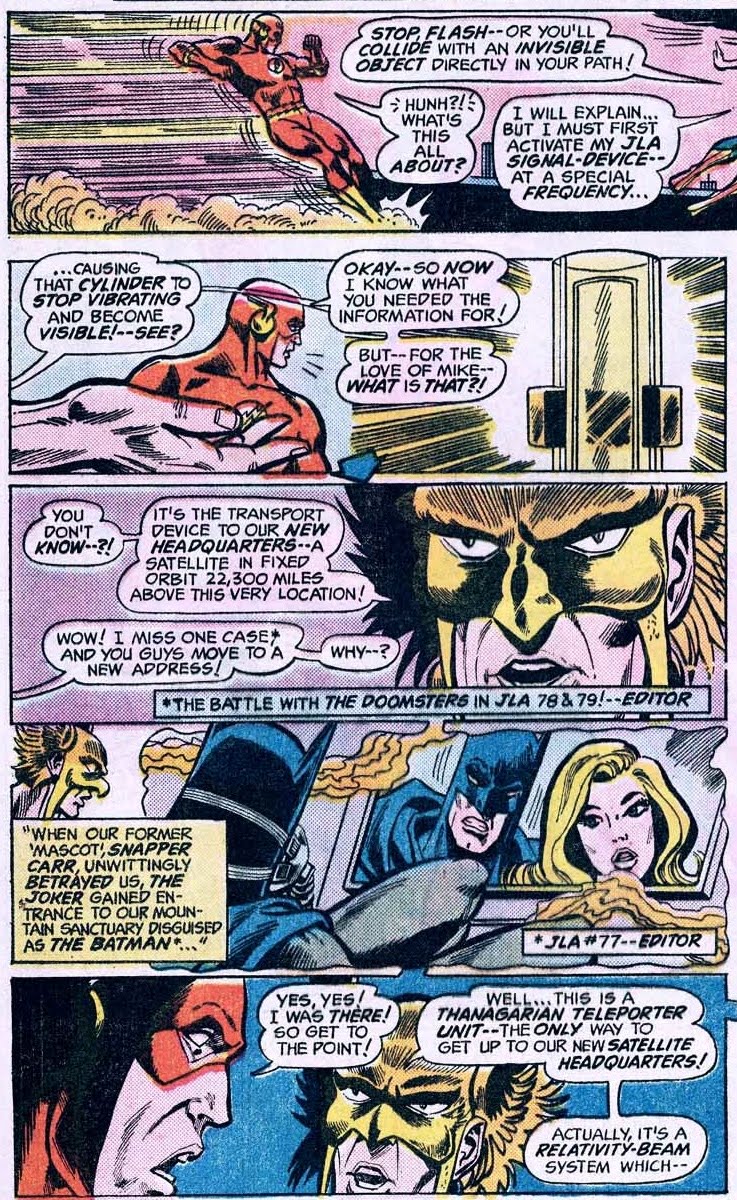
In JLA 130, for no reason at all, DC re-does the "Hey, we have a new HQ in space" scene, replacing Flash for Green Arrow, even down to using some of the same dialog (which sounds ridiculous coming out of Flash's mouth, rather than Green Arrow's).

"Yes, yes! I was there! So get to the point!" Actually, Barry... that is the point. You were there... repeatedly. Flash was in the Satellite when it was introduced, had been shown to be in it repeatedly over the intervening FIFTY issues since then, and, in fact, was JUST IN IT LAST ISSUE (Justice League of America v 1 #129). In short, this scene one of the most flagrant, nonsensical, egregious, and pointless violations of continuity of all time. Oh, and it's stupid and out of character. Nice lettering, though.

Okay, I'm being unfair; this is presented as an "Untold Tale", an obvious excuse to re-introduce the Satellite with a new map. Still, writer Marty Pasko blundered badly in using Flash instead of Green Arrow. But this, I suppose, is far down on the list of crimes of the man who created Kobra and Ookla the Mok.

And it did give us this, the first multilevel diagram of the Satellite:

Hm. Architects on strike again, I see.


The original plan is kept as the "B" Deck. The all-important Observation Deck (which is just about the only part of the Satellite we ever really see) becomes "A" Deck. "C" Deck is added to house some HQ basics with private quarters on "D" & "E" Decks.

Once the Satellite goes multi-level, all architectural heck breaks loose in this next diagram from later in the series:

Oh, look there's an Annie's Pretzels next to the Apple Store!


Very thorough! WILDLY out of scale perhaps, but thorough. Somebody seemed to realize that imposing square room designs on a round satellite didn't make a lot of sense, got out their Trivial Pursuit pucks and went to town on this one.

This was the diagram that I used as the model for my first attempt at a custom Heroclix map for the JLA Satellite, but I found it unworkable; the six decks couldn't be well enough represented on even an expanded 3'x3' map. I would be "accurate" but awkward and not fun.

So, rather than go "literal" with the map, I decide to compose it in such a way as to include the elements of the existing diagram, with some more realistic proportioning. I also took inspiration from the way the Satellite scenes are drawn, rather than just the diagrams. So much of the action takes place on the Observation Deck that had to be the
key place on the map not just the top sliver.

Also, with changing times, certain rooms now make more sense than others (even in "the past", as it continues to roll up behind the moving comic book timeline). For example, a physical library seems amusingly quaint in a satellite and was omitted. Conversely, the idea of a 'virtual training room', seen on various media versions of the Satellite, seemed like a must. I also had to do some creative "explosion" of the sections of the Satellite: the four areas beneath the Observation Deck are 'exploded' out and placed in what would otherwise be empty space between the hub of the Satellite and the outer ring.


Note that they kept the table from the original headquarters. Because they would. Also note the color-coding of each member's private quarters and the connection between the amphibious quarters and the pool (because, stupid though that is, they would have it). And if you look really really closely at the Atom's quarters, you'll see that, sitting on a table, is a miniature version of the entire room, just so that he can relax there at his miniature size.

All in all, I'm happy with the result and hope those of you who've been eager to play a Heroclix game set on the JLA Satellite will enjoy it.

Sunday, December 25, 2011

JLA FORTNIGHT: Dennygration

So, as you've probably noticed, the architect of all this chaos for the JLA at the end of SilverAge was Denny O'Neil. DC's iconic characters definitely needed some sort of revitalization; the goofy antics of Generalissimo Demmy Gog (JLA #66) seemed horribly out of place in the tumultuous late 1960s. O'Neil did more than his part to shake up the Silver Age's goofy status quo. O'Neill:

  • made Batman's world a serious one again,
  • brought Wonder Woman away from her mythical fantastical connections and grounded her as a non-super woman on her own,
  • raised Green Arrow's consciousness,
  • tried to wake up Green Lantern from his brain-dead stupor,
  • shipped the toxically ludicrous Martian Manhunter off-planet,
  • gave Snapper Carr a very dishonorable discharge,
  • classed up the JLA by getting them out a cave in New England and giving them a high-tech palace in orbit.
O'Neil was, in short, the Geoff Johns of his day.

I haven't presented the whole process in a tidy order (hey, this ain't the Comic Treadmill!), so here's a recap:

JLA #66: Denny O'Neil comes on board. Writes the "General Demmy Gog" story, one of the worst JLA stories ever written. Really, one of the worst stories ever written period.

JLA #67: An all-reprint issue.

JLA #68: JLA fights another Giant Amorphous Godlike Space Entity/Simpleton (in this case, "Neverwas").

JLA #69: The revelation that Wonder Woman is now powerless; Diana Prince goes on "permanent leave".

JLA #70: Denny and DC try to foist the "Mind-Grabber Kid" on the readers. Crickets are heard.

JLA #71. The Martian Manhunter, who's actually been absent from the title since #61, finally makes it official and leaves Earth. Oh, and everything and almost everyone on Mars is destroyed. More crickets are heard.

JLA #72: Red Tornado arrives and becomes the guest who never leaves. The Atom seems to be the only one with the guts to talk about the problem out loud.

JLA #73-74: The Aquarius story, in which Larry Lance is squished flat by a giant lint ball and his widow, Black Canary takes two panels to abandon her entire life and moves to Earth-1.

JLA #75: The 'canary cry' is discovered and Black Canary joins the JLA. She is the first member never to have had her own book, making her the Patron Saint of every crappy also-ran ever to join the League (I'm looking at YOU, Ralph Dibny).

JLA #76: Another all-reprint issue.

JLA #77: Snapper Carr (who, like the Martian Manhunter, hasn't been seen in some time any way) betrays the Justice League to the Joker. Crickets clap loudly.

JLA #78: The Satellite is introduced. Remarkably casually, I might add.

In fact, the Satellite in introduced almost absurbdly casually, even for the breezy Silver Age. The JLA is needed, so Superman and Green Lantern pick up Green Arrow and his new ridiculous facial hair and take him to.... the rooftop of DC Comics. Oh, it's not mentioned by name, but it's "That publishing company that's always bugging us for stories."

Oh, I'm sure their just begging for stories about YOU, Ollie.


The folks at DC (in exchange for a few licensing rights, I'm sure) have allowed the JLA to install a teleporter on their rooftop. Because NO ONE will notice a teleporter on a rooftop. Fortunately, there's no flying machines in the DCU and no one other than the Justice Leagues can fly!

"Heh. You're a funny guy, Arrow. You do realize that if I were to, say, accidentally sneeze right now or have a hand spasm, I might easily crush your left shoulder into paste? Kind of hard to use a bow and arrow when you only have the use of one arm."


As to why it has to be in an incredibly insecure place like a rooftop in downtown Manhattan, well, I guess the signal from the teleporter needs to be unimpeded by a roof. Or a passing plane. Or a flock of a geese. Or the horizon, given the fact that the Satellite, being in geosynchronous orbit must be above the equator and the rooftop of DC Comics is WAY north of the Topic of Cancer, and... oh, never mind, I'm getting a headache.

"Heh, by Rao, you sure are 'comical', Arrow. Yes, the tube is small, but that would help contain the debris if were to, say, accidentally sneeze or have an eye spasm and nuke your insides with my super-vision till you explode in a bloody mess."


Anyway, the teleporter is handwaved as Thanagarian tech (presumably based on the Twin Dogs of Sebek, but that's another story), and the Satellite is explained as...

as...

Um. Well, it's just... there. Who built it and when? How was it paid for? Who chose the color scheme for the decor? And how (literally) on Earth do the governments of the world feel about a Satellite of godlike beings hanging over their heads?

"Surprise! It's actually not a teleporter, just a big Kryptonian crystal cannon that shoots you out to land as a green blotch somewhere on the lower east side of a very large city on the Eastern seaboard! See, Ollie, I can be comical, too!"


And (most amusingly), how did all this happen without Green Arrow knowing a single thing about it? That, I think, says everything you need to know about Green Arrow's place in the Justice League (as even written by Denny O'Neil, who loves him most).

You know damn well the Martian Manhunter would have known about the Satellite. In fact, since he's a crazy homeless person, he'd probably already be living in it and named it something weird, like "M'artha".


And so, with the introduction of the Satellite (Feb 1970, by the way), the Bronze Age begins for the Justice League of America.

Tomorrow: JLA Satellite.... THE MAP!

Friday, December 23, 2011

JLA FORTNIGHT: BETRAYAL!


So, who was it who ended the might "Secret Sanctuary" Era, which gave us the Justice League at their most iconic, reintroduced the superhero community back into the DCU, and set the model for all subsequent versions of DC's team of top-tier heroes?

Why, it's obvious, really: it was their weakest link, Lucas "Snapper" Carr.


As mentioned, Snapper Carr was the hip teenaged mascot of the Silver Age Justice League. Gardner Fox's idea of putting DC's greatest superheroes into one team was genius; his idea of creating giving them a "typical teenager" mascot for the readers to identify with... was
not genius.

Aaaand... that's Snapper riding a magic carpet with Merlin while singing the Air Force theme. Sigh.

Snapper's horrible, mangled faux-hepcat lingo was an assault to the senses, an icepick in the ear, the offspring of the English language being raped by a hundred maniacs. Poor DC; they were just trying to reach out to The Young People, but the writers--laughably unfamiliar with young culture through anything other than its dated, funhouse portrayals on television--were no more prepared to do so than your grandmother would be ready for her improv rap solo at karaoke night.

The pain of "Snapper-speak" aside, Carr's presence in the JLA was going to be a problem regardless. Snapper was put in the awkard position of either

(A) being a useless distraction for the JLA from actual crime-fighting
or
(B) of saving the day with some ridiculous "Wesley Crusher" moment.

In a series where you have DC's seven most powerful and popular superheroes--each of whom did (or could) fill one or more comics a month with their own exploits-- vying for panel-space, every second wasted on Snapper's birthday cake, Snapper's finals, Snapper's date at the funhouse, Snapper's flying jalopy, or Snapper's homework assignment was an eternity of wasted opportunity for the reader.

See? Crowded book.


Snapper was an attempt to connect the Silver Age Justice League with someone "ordinary". And that was what doomed them. In a story that was, per Denny O'Neil's usual style, an interesting underlying concept but terribly written, Snapper is seduced by a grassroots movement for 'normal' people, distressed at how extreme and super people like the JLAers were overshadowing the mass of regular people who don't just occasionally dabble in saving the world, but who keep its spinning every day with their efforts.

It's all about YOU, isn't it, Clark?


Snapper's seduction into this movement isn't well handled or made believable... but it
is a great idea. In Marvel, citizens are often shown to fear and distrust many of their heroes. This is a harder sell in the DCU, where any superhero worth naming has his own hometown museum and is on the authorities' speed-dial. But the idea that regular people would simply resent superfolk and worry about becoming reliant on them is quite realistic. This was also underlying concept of the well-written LEGENDS crossover miniseries that launched the post-Crisis DCU and was the only time, in my opinion, that Darkseid has ever been used well, if you're interested.

So Snapper-- the "JLA mascot"--becomes a movement spokesperson
against the JLA. It is a devasting PR coup for the Normal Movement, masterminded by "Joe Dough, the Most Average Man in America" (heavy-handed character name and sobriquet courtesy of Denny O'Neill, the Most Non-Subtle Writer in Comics). After "Dough" convinces Snapper to give him the location of the JLA's "Secret Sanctuary", he is revealed to be none other than... the Joker.

Ouch; that hurts. On the one hand, the Joker is a supremely odd choice for orchestrating the undoing of the Silver Age JLA. For one thing, the Joker, for all his popularity and cultural resonance, is not exactly a "take on the JLA single-handed" level of villain. Plus, his reveal at the end is a one-way panel throwaway twist at the end of the story. He didn't
need to be the villain of the piece at all; it might as well have been some 'normal person' bent on overthrowing the JLA.

On the other hand, the Joker is a perfect choice. First, he's "powerless", and his triumph (he kicks the JLA's asses with some crap from the Trophy Room)
is a victory of the non-superpowered over the godlike Leaguers. Second, although powerless, he is very very much NOT normal. At all. That the Joker, of all people, should pass himself off as the sympathetic spokesman and leader of 'the common man' is a horrifying deception. Third, the Joker's victory is ideological, ironic, and accomplished through superior psychological gamesmanship, all of which is very typical of the character. Fourth, after 15 years of fighting a host of new and entirely ad hoc universe-shaking adversaries, the JLA is taken out by a single villain from one of their member's Rogues Gallery-- in fact, the most familiar villain imaginable--is a cruel irony, indeed.

Perhaps it was a brilliant commentary by Denny O'Neill on the JLA's problem: they were too distantly focused on otherworldly issues (or Snapper's birthday) to focus on cleaning up their own backyards of the villains who preyed on the common folk. Or perhaps it was a lazy last minute twist. In either case, you do not mind-wipe the Joker, so the Secret Sanctuary's utility as a headquarters for the Justice League was over.

What's a supergroup to do...?

Thursday, December 22, 2011

JLA FORTNIGHT: Race war to the stars!


When we last left the JLA in the final throes of its "Secret Sanctuary" Era, the powerless Diana Prince and her blind guide, the absurdly named
I Ching, were at a carnival.


"Being with you is pointless, Ching; you are so Asian-y inscrutable."
"Of course you don't understand, Diana; you're a moron. And probably wearing something that makes you look highly scrutable, I'll wager."
"What in Gaea's name can I learn from CARNIES?"
"I don't know, Diana. Perhaps how to dress...?"


It's good to see some things never change, like the deep mutual hatred between Diana and Ching.

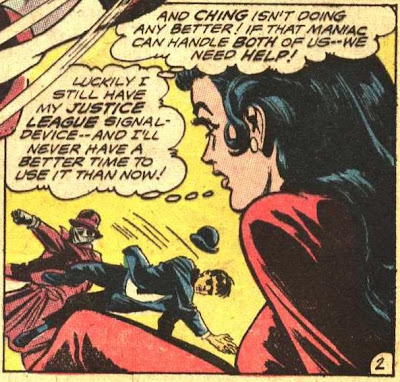
As luck, and Denny O'Neil's plot contrivance, would have it, there's some kind of crazy homeless person going berserk at the carnival!

"What causes commotion, Ching? Well, usually it's some sort of threatening disruption of...oh, you meant, 'what is causing the commotion'!"
"Yes, wise-ass. So it's a "man"? I guess I'll probably have to explain what one of those is to you, won't I?"


"Postpone our rest? Oh, really, Ching? And I was just about to pull up a lawn chair to watch!"


A crazy homeless person who is ....beating the
snot out of Diana and Ching.


Claude Raines 1, Emma Peale 0. And, YES, Diana, you did the judo move perfectly. You do everything perfectly, Princess. Yeesh.


"Ching, look out for--oh, wait, ha, ha! I forgot to warn him OUT LOUD. Pity. Still, he's getting the crap beat out of him. Why, it's like he can't even see the guy! Oh, wait... that's right...!"


As entertaining as it is to watch a violent homeless person bitch-slap Diana and Ching around, it's even more entertaining when you realize that that crazy, violent homeless person is, of course....

J'onn J'onnz, the Martian Manhunter


I think someone needs a cookie.


Yes! Godlike alien J'onn having a freakout and beating the tar out of a powerless dress shop owner and a tiny old blind guy. That's what comics are all about.

"This is it; I am never letting Ching pick out my outfit again!"
And, for the record, Diana; J'onn will NEVER regain his balance.


Oh, wait, there's only one more thing that will make this incident perfect:

Faceplanting Batman. "But... but I'm the goddaMMFFFPHHH!"
Eat sawdust, stupid Bronze Age Batman.


Wild man. Mad dog. J'onn J'onnz is insane, people.

Oh, but don't believe me; believe HIM.

That wasn't "something in your mind", JJ; it was your mind. How snapped is JJ? Let's just say that if his daughter is running for Homecoming Queen, pull your daughter out of the contest immediately.


So someone gives JJ a cookie to calm him down, and, while Diana and Ching are having their bones reset, he calmly reveals that,
"oh by the way, I've been lying to you about my backstory since I was introduced 15 years ago. I am essentially an escaped war criminal, and the Martian equivalent of Robert E. Lee."

That retcon is breezier than J'onn's Martian-breath. Still, the JLA is long since accustomed to rolling with whatever ridiculousness JJ spouts, since he's:

(A) powerful enough to kick any of their asses and
(B) crazy as a loon.

Therefore they do not say,
"What do you mean there's a planet-threatening war going on on Mars the entire time we've been working with you, during which we've jaunted off to about 30 different alien worlds and could have stopped off on Mars to lend a hand at any point, particularly since that war might threaten Earth? And why did you just beat the crap out of an old blind guy at a carnival? ARE YOU INSANE?" Because they already know the answer to that question.

So instead they say,
"Um, okay, J'onn sure. That sounds great; nice to know. Need a lift somewhere? Or will you just be wishing yourself into the cornfield now?"

There's never really any explanation why he's at the carnival, or dressed like the Invisible Man (particularly since he's a shapeshifter who can turn invisible), or freaks out violently just because there's a fire-eater there (dude; just walk away and get an ice cream cone, or better yet, just create one with your mind). But it's the Martian Manhunter, after all; if you are looking for sensible or even comprehensible explanations of his behavior then you've missed the point of the character.

Shhhhhuuuure, J'onn, whatever you say. Heh heh, yep, water is sure great.


Turns out that one of J'onn's previously unmentioned godlike powers is the ability to violate the Fourth Wall with his mind and telepathically influence comic book writers and editors, because they obligingly backed up J'onn's crazy story by retconning all of Mars to fit his babblings.


Suddenly there were two 'races" on Mars, the white and green, who'd been engaging in a long race war and J'onn had been exiled to the Martian desert wastelands by his enemy, Commander Blanx, for 13 years.

In a hilarious send-up of
The Lorax, Blanx basically sells off Mars to be strip-mined. In essence, Mars is the West Virginia of the solar system.


Denny O'Neil was fond of writing stories that contained veiled social commentary. If by 'veiled' one means "festooned in neon tubing, sparklers, and
'THIS IS OUR MESSAGE, STUPID!' arrows". This is one of the more subtle ones.

So JJ and the Leaguers go clobber B'illy Blanx's little mob of white Martians, but don't manage to stop him before he burns off everything on Mars including the atmosphere. A few Martians escape in a starship for parts unknown while J'onn, the perennially calm stable center of the JLA, beats Blanx to death with a Mars globe.
Yes, really.

Oh, and somewhere during all that, Hal falls asleep.

Yeah, well, staying up till 5AM with three Pan-Am girls will do that to you, Hal.


Unfortunately, Superman catches Hal right before he lands, or I'd be sharing with you a picture of
Hal getting hit in the head WITH MARS. Which would be impressive, even for Hal, particularly if, unlike Blanx, he survived getting hit in the head with Mars. Oh, how many licks does it take to get to the center of Hal Jordan's noggin? The world may never know.

The upshot of all of this is J'onn leaves Earth to search the stars for the S.S. Martian Minnow and the JLA lets him because he's

(A) powerful enough to kick any of their asses and
(B) crazy as a loon.

Don't let the door hit you on the way out, er, I mean, "godspeed!"


So, the Manhunter is put on a bus and Earth-2 rejects Red Tornado and Black Canary are sniffing around the campfire, begging for scraps of readership. What other disaster could befall the Silver Age Justice League?

I'll give you a hint: what is the sound of one hand snapping...?