Showing posts with label Penny Plunderer. Show all posts

Tuesday, August 11, 2026

JuJuBit Profile: The Penny Plunderer

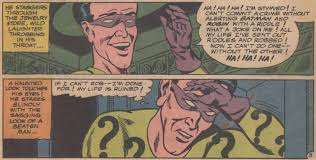
Naturally, I had to make myself a special JuJuBit sculpt of Joe Coyne, the Penny Plunderer, who is the epitome of a one-shot Golden Age thematic villain and source of the Batcave's Giant Penny. Honestly, who DOESN'T love the Penny Plunderer?

Sigh. I really DO deserve to get a better digital camera.

The sculpt was created on JuJuBit using this pic:

As I've said before, it's a crying shame that John Astin played The Riddler on Batman'66, when Joe Coyne is so clearly the part he was born to play.

I already have a previous Joe Coyne custom Heroclix, so I needed a new dial for the new sculpt.  I wanted a dial that would be a useful support piece rather than a strong one that could successfully take on Batman as a team centerpiece.

Because taking on Batman didn't turn out very well for Joe.

I specifically wanted him to be a useful assistant for Two-Face, Batman's (MUCH) more prominent coin-related villain.  So I chose the one dial almost perfectly designed (unintentionally, I assume) as a complement to Two-Face: 


The Gambler has TWO "coin-flipping" mechanics handy, one of which lets Two-Face re-do a coin flip (and Two-Face figures almost always have some sort of mechanic that depends on a coin flip).  Giving Two-Face a second chance whenever he flips a coin to do something in the game can be a very useful ability, indeed!

Once I "rebrand" this dial, it looks like this:


He doesn't naturally have the "Batman Enemy Team Ability" but he does have the "Team Player" Team ability (that's the question mark in the circle) that allows him to copy the Team Abilities of other friendly figures.  That lets him "borrow" the Batman Enemy TA from another figure (such as Two-Face).  His regular powers, without going into detail about them are general about be fast-acting, sneaky, and LUCKY (or unlucky, as the case may be), which is not a bad match with the Penny Plunderer.

His 'coin-re-flipping' power might also come in handy if I play him with the actual Giant Penny.

I'm not sure the Giant Penny would really be helpful, but it sure would feel good thematically.!


Monday, May 26, 2025

For your thoughts...

The Penny is dead.

Well, not DEAD.  U.S. currency is never sunset and can always be used as legal lender. But, finally, the U.S. has decided no longer to mint new pennies.

It's a logical decision I have long advocated myself.  Pennies, and the amount they represent, are a nuisance in modern-day commerce or, at best, superfluous.  They cost, I'm told, three times as much to make as their value.  And we already have gazillions of pennies in circulation, busy, well, not circulating, since their number far exceeds the supply needed nowadays.  

I rejoice for this sensible, realistic decision.  But, oh, how I weep for its implications for Joe Coyne, the Penny Plunderer! What would HE say?!

Something like that, I'm sure.

The Penny Plunderer is a favorite, not just on this blog, but across the comicsphere.  Although a one-off Batman foe, he was, ostensibly, saved from obscurity by the fact that the trophy from his adventure, The Giant Penny, is one of three most consistent and conspicuous of the Trinity of Trophies that identify the Batcave as not just any other hole in the ground.

It's why that penny is always drawn as a 1947 wheat-back penny; that is the year of its origin. 

I mean... it has its OWN Heroclix figure, for goodness sake.

I myself, however, think Joe Coyne's continued cultural currency goes deeper than that.  His fame comes not merely from his association with Batman's most prominent trophy, but from what he represents.  The Giant Penny itself represents all of Batman's Golden Age history. Palling around with Robin, the giant props era of Gotham City, and near-deadly confrontations with gangsters and thugs who are little more than barely amped up burglars.  It represents Batman's (comparatively) humble Golden Age roots, which anchor the character in a way no outer space adventure or world-saving omni-competence ever can.  Whatever else he is or becomes, Batman in STILL a guy you could knock off a giant postage stamp replica with a well-thrown roll of pennies, if you got lucky.
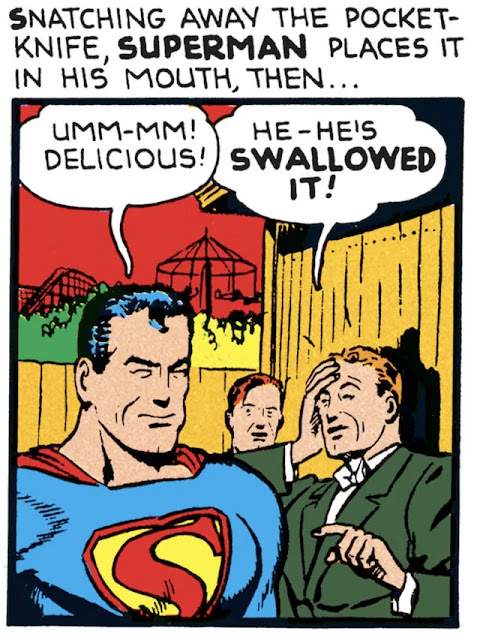
As opposed to SOME people, who would simply SWALLOW them.

Just as the Giant Penny represents Batman's Golden Age adventures and all their wacky glory, so does The Penny Plunderer represent an entire class of foe, the Thematic Criminal.

In the early days of comics, many crimefighters mostly just fought, well, criminals.  Guys in ties, armed with guns.  Golden and even Silver Age comics are FULL of them.

For example, the Martian Manhunter, even with his fantastic overage of powers, often just fought Guys In Ties.

Or, sure, some of them might have a "angle" or even a "gimmick".  But they themselves were completely unmemorable.  

And for some heroes that was challenge enough.

Supervillains, with their colorful origins, codenames, costumes, weaponry, and fixations, were very much the exception, rather than the rule.  But between the Guys In Ties and the Supervillains, both chronologically and conceptually, were the Thematic Criminals. Guys like Rocky Grimes, The Blaze, The Octopus.   

Like Ed Peale, a.k.a "The Gong".
He rebelled against bells; a severely disproportionate reaction to a common feature of society.

You can spot these guys a mile away. A prophetic real name; an over-reaction to some frustration for a backstory; a decision to adopt their fixation as their "crime symbol"; a thematic codename, outfit, weaponry, and, sometimes, choice of target. 

It's a sure-fire formula, still in use!

Such characters literally SHOW you, within the story itself, the transition of a Guy In Tie to a, well, if not a "supervillain", at least a "super-criminal".

They were ALWAYS called "super-criminals" on the Batman TV show. NEVER "supervillains" or even "villains".  

The "United Underworlders" up there are interesting examples. Each of them got "retrofitted" to be part of this pattern.  The Catwoman, originally just a thief and schemer, got a backstory where she was an airline stewardess who got amnesia in a plane crash, remembering only a vague affinity for cats from having grown up in a pet store.
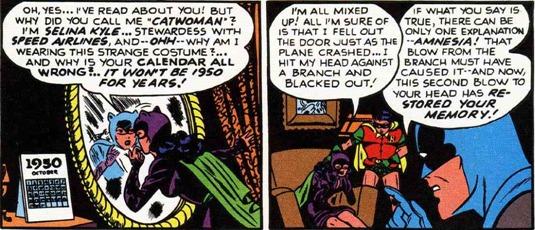
Batman #62 (1950). Just to prove I didn't make something that stupid uo.

The Joker, originally a context-free cipher of an archetypal character of Evil Clown, was given a semi-tragic backstory to explain his schtick. 

Detective Comics #168 (1951). Just to prove I didn't make something that stupid up.

As a later-introduced character (1948), The Riddler largely fit the mold already. But even he has his story "deepened" to make his riddling an obsession rather than mere vanity, as it originally was.

Batman #179 (1966). Just to prove I didn't make something that stupid up.

Even the Penguin, who was always just a pompous murderous snot, eventually accreted a more humanizing backstory to account for his various eccentricities.

A process which actually began HERE, in the Batman newspaper strip (February 17, 1946). Just to prove I didn't make something that stupid up.

Batman's other Great Golden Age Villains, Two-Face and the Scarecrow, fit the pattern from the start. as previously discussed.  In fact, one of the reasons for the longevity and utility of Batman's golden villains is that while they CAN follow the pattern when the author wants, they can just as easily DEPART into some other venture (with a different theme or no theme at all). Since these characters predate their own thematic fixations, they seem just as valid without them.  The Penguin or the Catwoman can embark on a series of criminal endeavors that have nothing at all to do with cats or birds, and we don't think twice about it. 

This is not true of the Purely Thematic Criminals. The Gong is unappealing without bells, Rocky Grimes must travel a rocky road, and the Penny Plunderer would be short-changed without pennies.

It is not for nothing that Joe Coyne is the perfect and enduring symbol of thematic criminal obsession and is its prime representative on TVTropes.

But perhaps, ironically, society's dismissal of the penny is the most thematic outcome at all. After all it was the niggling and nugatory nature of pennies that set Joe off in the first place:


Joe felt that he, like the penny, was treated as valueless and tossed away, unloved, in a jar.  The fact that we can no longer be bothered to mint pennies is just the logical end of the story.

Just as Joe Coyne being undone by his obsession and the uselessness of pennies,

was the logical end of HIS story.


The Penny may be dead, but I say,

LONG LIVE THE PENNY PLUNDERER.

Figuratively, I mean.


Thursday, August 22, 2019

Cinematic Greasepainting

Speaking of movies about the Joker...

The forthcoming Joaquin Phoenix film will probably be great.  Everyone involved seems good at their trade, JP's acting chops are unquestionable, and it seems so far to be rich and well thought out.

It's almost too bad it's not about the Joker.

Alternative interpretations of a character are fine; they are part of what makes a character mythic rather than merely literary.  I am not one of those people to complain "The REAL Joker would use more conditioner on his hair!"  Although that's probably true; he's rather vain.  


It's important to remember that these two pictures are of the same character.

But when an interpretation seems so entirely off-base that it lacks the character's central elements that make him recognizable, then I start to frown.  And that's the case with Joker.

The film tells the story of hard-luck stand-up comic Arthur Fleck in 1980s New York (even if they call it "Gotham") City.  After being dealt one too many bad hands by life, he cracks and becomes a clown-like public menace.  

The elements of this that miss the mark are pretty clear.  The Joker has a name, and a (tragic) backstory; he's a character for whom we will feel sympathy.  It's not surprising for a Hollywood film: these are near essentials for most cinematic storytelling, of course. They aren't a story so much as basic requirements for a protagonist. 

But those are elements that the character of the Joker, from a mythic perspective, LACKS and always has. It's part of the character's appeal--well, let's call it 'genius' or 'schtick', rather than appeal.  The fact that some characters (such as the Joker or the Phantom Stranger) do not have proper names, backgrounds and origins isn't some kind of oversight, a convenient lacuna that a later creator can "helpfully" back fill to suit their tastes.  It's an essential part of the character. Something that Dan Didio doesn't get, by the way.


"This" = Dan Didio

These characters aren't PEOPLE as much as they are concepts; the Evil Clown or the Mysterious Stranger. Much of their mythic power comes from that abstraction; if you rob them of that, there is little reason use to them. Unless they are just greasepaint to make your otherwise hard-to-sell movie suddenly salable, which the creators of Joker have nearly explicitly said it is what they are doing:

"[Director Todd} Phillips said it does not "follow anything from the comic books... That's what was interesting to me. We're not even doing Joker, but the story of becoming Joker." Rather, he used elements of the Joker lore to produce an original story." [Courtesy of Wikipedia.]


THAT is literary greasepainting. That's the kind of approach that turns the Phantom Stranger into one of Jesus's disciples or gives you Halle Berry's Catwoman.  You can focus on whether the results are good or not (Joker is likely to be a better film than Catwoman, for example), but don't ignore the role the 'greasepaint' method has in that and the longer term effects.  If the film is bad or flops, an opportunity was wasted and comic book movies take it on the chin.  If the film is good and succeeds, you are training creators that the key to using comic books as sources is to ignore as much of the original material as you can, except perhaps for the character's general appearance.

Not only does greasepainting happen with 'comic book movies', it's happening in comic books (writer Tom King's run on Batman isn't so much issues of Batman as is it Tom King's issues) and movies (Ari Aster's execrable work putting on a monster mask to pass as 'horror' rather than merely horrible). You could make the case that Bob Haney's body of work is almost entirely greasepainting.


Batman wants to live.
That's why he regularly jumps off tall buildings and gets himself put in a deathtrap every week,
same bat-time, same bat-channel.

In the case of Joker, Alan Moore is, of course, partly to blame for not getting the Joker right and in the vicious and crappy Killing Joke, convincing a generation of readers that the Joker is a tragic victim, the product of the world's callousness, and that at one time he was just like you and me. And if you don't believe my condemnation of what Alan Moore did with the Joker, maybe you'll believe Alan Moore himself:


"I’ve never really liked my story in The Killing Joke. I think it put far too much melodramatic weight upon a character that was never designed to carry it. It was too nasty, it was too physically violent. There were some good things about it, but in terms of my writing, it’s not one of my favorite pieces.  
"I was naively hoping that there’d be a rush of fresh and original work by people coming up with their own. But, as I said, it [my work] was meant to be something that would liberate comics. Instead, it became this massive stumbling block that comics can’t even really seem to get around to this day. They’ve lost a lot of their original innocence, and they can’t get that back. And, they’re stuck, it seems, in this kind of depressive ghetto of grimness and psychosis. I’m not too proud of being the author of that regrettable trend."
Pictured:
putting more melodramatic weight on a character than appropriate and
 being stuck in a kind of depressive ghetto of grimness and psychosis.

It IS an interesting story, it's just not the JOKER's story. It's much more like Harvey "Two-Face" Dent's story (normal guy cracks under the pressure of a hard knock and turns against society).  In fact, most of my criticism of the Dark Knight's plot would vanish if the entire plot had been Two-Face's story with no Joker to be seen.  Meticulous planning to manipulate both sides of the law?  Dismantling the mobs by stealing their money AND catching them on RICO charges?  Pitting a boatload of good citizens against a boatload of bad criminals in a "Prisoner's Dilemma" to make a point about the arbitrary distinctions between good and evil?  Really, what could be more Two-Face-y than that? Why is the Joker in Two-Face's movie at all?

The Joker's original origin (in the idiotic "Man Behind the Red Hood", Detective Comics #148, 1951) at least knew well enough to preserve several essential elements of the Joker (with the efficiency typical of Golden Age comics stories, I might add):


Specifically:

  • you don't get to know his name;
  • you don't get to see his face before he becomes the Joker;
  • he was already a crook and terrible person BEFORE his accident;
  • he was a schemer and inventor (he designed the red hood device to allow him to enter inhospitable environments like chemical plants)
  • he was goal-oriented ("I will steal $X and then retire!")
  • he had style and showmanship (really, even in Gotham, who dons a tuxedo to rob a chemical plant off-hours?);
  • he was opportunistic ("I'll use this to my advantage!"); and
  • he was thematically-oriented and brand conscious ("Ooo, the Joker is a much better schtick than the Red Hood!")


Even in this crappy throwaway detective story, Golden Age writers knew not to mess with the character's core.  Even Golden Age writers, the creators who gave us penny-themed villains and stories about milk racketeers, even THOSE people would have laughed at the foolishness of positing that the Joker, Batman's archenemy an all-around threat to society, was some poor schlubby hack who just had a bad day that somehow magically turned him into a criminal genius.  How can modern creators and readers have less common sense than the people who put giant props in every commercial property in Gotham City?!


This movie SHOULD have been Joaquin Phoenix as JOE COYNE, THE PENNY PLUNDERER.
Because THAT would have been awesome. That would have been ART.


The Joker is:

  • not a tragic figure; he's a figure who finds comedy in bringing tragedy to others;
  • not someone undone by his accident, he's someone who turned it to his advantage;
  • not normal or average;
  • not good or sympathetic;
  • not poor or pathetic.


The Joker is not society's victim; he victimizes society.  It may not be fashionable any longer to believe anything OTHER than the idea that society creates its own victimizers.... but that's not the Joker's story.


,