In Saturday's discussion on
"What gives a series impact?", the subject of catchphrases came up (and was oddly re-emphasized by last night's TV Land airing of
"the Top 100 TV Catchphrases!").
For me, the entire issue took a step up when commenter "Tadwilliams" said:
"(An aside: Jack Benny's signature joke, the "I'm thinking!" joke, seems like it's a tagline, but it's not -- it's a character piece. It works best because we feel we "know" Benny and how lovably stingy he is.)"
Now, I think it's fair to say that Tad knows something about writing (including dialog) because he writes books. Big books. Books so big that, really, if you're not careful, you can hurt someone with them. So I thought a bit extra about what he was saying.
What he's saying about Jack Benny reminds me of the series "Monk". Until I saw a "making of" show about it, I never realized that Mr. Monk has not just one but around seven or eight "catchphrases", and that he says most of them in every single episode. Yet I had never noticed.
Why? It could be simply because I'm unobservant (not a good trait if you're watching "Monk"). But I'd like to think it's because they seem to flow
from his character and not vice versa. Because the actor doesn't say them as catchphrases, just as things his character says alot without realizing it.
Literature aside,
every real person does in fact have pet phrases, characteristic constructions, and favorite words. Not coincidently, the previous sentence contains three of my own:
- an 'Ablative Absolute' construction ("literature aside");
- the phrase "does in fact"; and
- a Ciceronian triadic sequence (always giving three examples of anything you are talking about, arranged in parallel construction).
Each one of those is something that happened to my English writing because of studying so much Latin. So very much Latin. More than Latin than decent people should know.
Anyway, a good dialogist understands this phenomenon and uses it to his advantage. I remember reading a book once (a murder novel set at my college) where alongabout Chapter 3 the author stopped identifying which of the four main characters was speaking. It was many chapters later before I noticed it; you simply knew who was talking by the way they said things.
A good writer gives each characters his or her own voice.A not-so-good writer does not, and its one of those things an editor can't help much with. You can help somebody fix their plot, but if they can't write good dialog themselves, there's not much to be done (other than completely re-writing all spoken words and unspoken thoughts). I remember a good and well-read friend of mine, a talented musician, stage performer, and leader of men (an Air Force colonel, in fact), who was writing a book and wanted me to take a look at it for him with a critical eye. The plot was interesting, but everyone in the book spoke exactly the same way: the same way my friend did, right down to his pet phrases, characteristic constructions, and favorite words.
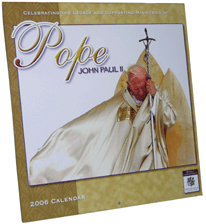
I finally couldn't help myself when I got to the Vatican scene (don't ask), in which the Pope says,
"Okay; clear my calendar."

After I picked myself up off the floor and started breathing again, I said in a loving and supportive way,
"Bob, the Pope does not say 'okay, clear my calendar',
or anything like it in whatever his native language is."
So great an impact did the event have on me (and some of his other friends) that to this day
"okay, clear my calendar" remains one of
our catchphrases.
"Catchphrases", I suppose, are the fastfood version of giving a character his own voice, a shortcut. Nor are they an
Evil Peculiar To Our Modern Degraded Age. Dickens, for example, is
loaded with them; Bah, humbug!
Now, it would be nice if it were possible for DC's iconic characters to speak with their own individual voices. That's pretty hard to do, when so many different people write those characters and when, through much of their history, no one saw a need to give each hero a distinct personality, let alone an individual voice to go with it. Take any old JLA story and draw the word balloons going to different characters; except for references to their powers,
it won't make much difference.
Occasionally, a catchphrase will accrete to a character, such as Superman's
"Up, up, and away!", Robin's
"And how!", or Hal Jordan's
"So ... you're a stewardess, eh?". In DC, however, catchphrases are usually confined to
Signature Epithets, as we've previously discussed. In Marvel, there's a greater tradition of dialog individuation, but it's usually just hollow ethnic dialects or
lumpy archtypes like
Brainspeak and
Lugspeak. I swear, just reading a conversation between Reed Richards and Ben Grimm makes me wish my eyes were deaf.
Still, in group books, it becomes really painful when all the characters are speaking with the same voice, particularly when you suspect (or know) that it's the voice of the author. In fact, there are a few DC books right now that are suffering from the problem; I'm not going to name names, but I'm not going to stop you from doing so.
All this said,
who do you think are DC's best and worst dialogers, judging them with a particular ear toward giving their characters individual voices?

 Uh ... okay. Thanks. But doesn't that need something else, like "A plane! A lifesaver! No, it's Scipio!"? I mean "A Plane! A Lifesaver!" sounds more like an unfinished palindrome than a signature saying, Wes. Let's try again...
 Whoa, sorry, Wes; didn't mean to interrupt one of your opium/absinthe binges; glad I wore the glove. Besides, I'm not really a gas-inhaling, Miraclo-popping kind of guy, so I don't think I'll find that saying very useful.
 Bingo! Thanks, Wes!