Monday, September 12, 2011

JLAOkay!


I've heard with interest and agreement many of your criticisms of the new Justice League #1: that the principals behave too poorly, that the story is badly decompressed, that the use of Darkseid betrays DC's professed fresh start, that it's too much like Marvel, etc.

I hear ya.

But, honestly, even with all that and worse, I will still continue to buy this comic every month just as long as I get to see...


SOMEONE BEATING THE CRAP OUT OF HAL JORDAN EVERY MONTH.


Cuz that's just something I can't get from Marvel, you know...?


1001 Ways to Defeat Green Arrow: #12:

1001 Ways to Defeat Green Arrow, #12:


Convince him to call Batman a fascist.

Then look out for flying limbs and body parts.

Friday, September 09, 2011

Justice League #1 Review

And now that I have a digital stack of new comics in my iPad, I can no longer delay my review of Justice League #1. In short… I liked it, and encourage you to read it.

There are so many panicked, pitchfork-wielding fanboys choking the streets lately , crying “The Continuity is falling, the Continuinty is falling!” To which I say, again… “eh”. The character I'm seeing are recognizable in a good way; that's all the "continuity" I really need

I open Justice League and I see Hal Jordan being an overconfident bozo and see Batman being, well… Batman. The two very different styles are highlighted and contrasted in the course of the story, resulting in yer basic “And Together They Fight Crime!” scenario.

You may not be a fan of Geoff Johns, in fact, you may be a Pantha Loyalist, and think he’s a bloodthirsty gore-hound who eats Rob Zombie films for breakfast (and possibly Rob Zombie himself). Be that as it may, ya gotta give him this: he’s no dummy. Of DC’s best known icons, the two with recent films under their utility belts and a steady and familiar characterization accompanied by surrounding elements are Green Lantern and Batman. So making them –the characters being ‘rebooted’ the least – the center of the first issue of Justice League is a smart move. Anyone who likes, or even knows, those characters will see something they are familiar with as the starting point for the New DCU.

The plot has some amusing naivety about it that almost reminded of those famous clue-sparked free associations sessions Adam West and Burt Ward used to have in the Batcave. “It happened at SEA! See? ‘C’ … for Catwoman!” If I were to discover a Mother Box in a Gotham sewer, my first thoughts would not be, “It’s alien! And so is that caped nut in Metropolis! LET’S GO, ROBIN—er, I mean, LANTERN!” But, hey, it’s young Bruce and Hal; they don’t have the perspective to say (as I did), “Kirby’s crackle! A frikkin’ Mother Box?! I, mean, STILL with the Fourth World crap? For THIS we REBOOTED…?!?!” Very little could please me less than DC’s unwillingness/inability to let sleeping Kirby Dots lie, but even I have to admit Darkseid makes a more appropriate threat for bringing together the Justice League than the Ersatzians, er, I mean, the Appellaxians.

It was interesting to see Batman and Green Lantern paired together with such dynamic contrast. Traditionally, that treatment has been reserved for Batman and Superman. In fact, the Superman/Batman comic did so with such relentless lack of subtlety that it nearly made me put my head and hand in a hydraulic press and beg Helene to throw the switch. Granted Superman and Batman do exemplify the Apollonian/Dionysian heroic disjunction rather neatly; but Batman and Green Lantern do so much more interestingly and amusingly.

Speaking of Superman… it’s good to see him back. I’m disappointed (but not really surprised) at all the fans-in-law (the pop culture hipsters who comment on comics even though they don’t actually read them) who are raising their eyebrows (with either approval, disapproval, or mere supercilious detachment) about Superman’s “new edgy” attitude (“Hey, kids! The new Superman’s a dick!”). Newsflash, hipsters: Superman’s always been a dick. As I’m sure you’ve read elsewhere, this “new edgy” Superman is, in essence, the character that actually debuted in the late 1930s, when people were poor and fed up with government’s inability or unwillingness to tackle the kinds of social justices brought on by untrammeled capitalism. Grant Morrison has decided to give us that Superman back and I agree with him 100%. Yeah… you heard me: Grant Morrison is 100% correct in this and I agree with him completely. The Golden Age Superman kicked butt and didn’t care what you, the police, or anyone else thought about it. He was, like every Golden Age hero, a smack-talking wise-ass vigilante.

Silver Age Superman (“Why is my face not on the quarter?”) was legendarily conceited, and the Bronze Age Superman was no slouch in the “sometimes it’s a drag to be infallible” department. Where DID all these youngsters get the idea that Superman was a “big blue Boy Scout”? Oh, of course…from Frank Miller and Richard Donner. “I never lie, Lois”; great Caesar’s ghost, Clark, you lie EVERY SINGLE FRICKKIN’ DAY. Your entire LIFE is a LIE. I’m fine with that, but Richard Donner kind of overlooked it. And since none of these youngsters have ever read a pre-Crisis in-continuity comic in their lives they bought this pabulum about Superman being super-nice. Yeah, tell that to the miniature rainbow Superman that he jealously sent to his death In Superman #125.

Tuesday, September 06, 2011

Thursday, September 01, 2011

JLA #1, Part I: MENE MENE TEKEL PARSIN

Last night, I read what will be -- already is, really -- heralded as the first comic of a new era in the history of DC Comics, a "New Universe", so to speak.

I'm going to save my opinion on the story's content for a "Part II" to this post. For now, I just want to talk about the experience of how I read it.

Because yesterday was a new era for DC not only with regard to content and continuity, but with regard to the medium itself: the new era of same-day digital release.

They say that porn is always the content that's on the cutting edge of communication technology, as far back as Gutenberg. In my case, however, it's always comics that push me to the next level of tech. For example, when I bought my first television. It was because Batman the Animated Series was about to air; before that, there just wasn't sufficient reason to own a TV. Heck, years ago I lived in an adorable, cozy English basement that I loved... which I eventually moved out of, in part, because there was not enough room for the frickin' longboxes.

In this case, DC's decision to go same-day digital pushed me over the edge of getting an iPad and "going digital" with comic purchases. So yesterday, I bought myself an iPad, set up Comixology, and bought some comics, JLA #1 included.

This is not a decision a former comic bookstore chain owner makes lightly. Stores that purvey entertainment "hard-copy" (e.g., video rental stores, bookstores, comic shops, computer game centers, record stores, video arcades, news stands) are, mildly put, not doing as well as they used to. The digitization of most forms of education/entertainment is a major coup for the accessibility of information of all types... but it's brick and mortar stores that are taking the blow. While many are making ingenious attempts at adaptation and leveraging of the new tech, the handwriting is on the wall. Or, perhaps, more accurately, on the screen of the touchpad. God has numbered the days of their reign and brought it to an end; it has been found wanting; its kingdom is divided and given to the Apps and the Netflix.

Steve Jobs -- the Uni-Friend!!


There are great downsides to this change. Naturally, there is the economic effect on multiple large industries. But there is a less calculable social effect as well, since these entertainment emporia have served as the "third places" in 20th century society that are so essential to the souls of our communities. Now we are left with the cinema -- which still offers itself as an "event" and a venue for outings -- and the cafe, where we all sit around consuming expensive stimulants while enjoying our digitized entertainment.

But the fact is that my wingman CobraMisfit and I only find ourselves near an LCS once a week...on a Tuesday night, when it's closed. The fact is that I've never been a comic book collector; I'm a comic book reader, and having stacks of longboxes is (and always has been) a HUGE pain in the patootie, and more of an impediment to reading back issues than an aid.

I suspect that most people don't want to have all those comics; they just don't want to throw them away. The same is true of books in general. One of the most common sights in an urban neighbor is the Sidewalk Box o' Books. You know, the cardboard box with the word "FREE" scrawled on the front, full of old textbooks, beach novels, and self-help guides.


Okay, just looking at those titles make me want to go shower. With a strigil.

I've been carting around several crates-worth of Classics textbooks since college simply because, well, you just don't throw away The Pre-Socratics. If you do, something bad will happen to you, like your atoms will turn into fire or you'll get shot by an Eleatic arrow (which may or may not ever reach you). Thank Jupiter one of my nieces is now at college for Classics, and I can dump this crap, er-- gift her these inestimably valuable repositories of our Greco-Roman heritage.


Oh, of course the Pre-Socratics have their own Dynastic Centerpiece Model.
They did
everything first.


So I read my first digital comic last night. And I loved the experience.

It wasn't just an enjoyable experience; it was a transformative experience. The power of the art, of the artist's efforts to use illustration to tell the story hit me like a ton of bricks. As I've mentioned before, I've always been a writing-over-art kind of comic book fan. That doesn't mean I don't care about the art, I just don't think about it much.

This experience changed all that. I used what is called the "letterboxing" option, which presents the story as a panel-by-panel experience, rather than a page at a time. This brought the art CLOSE. And it is detailed. Even though I have four pages of original comic book art framed and on my living room wall, it's easy to forget that comics themselves are "shrunken"; the original art is much larger. Suddenly I was seeing the art as the artist actually created it. And it was engrossing; it felt much more 'sucked in' to the picture, rather than just it being a schematic of action held at arm's length.

And it was beautiful. Never have the colors seemed more vibrant nor the lines more clear. Yes, the JLA artist is a good one, but it was more than that. The paper page never looked like this to me.

And it was meaningful. By presenting the story panel by panel the letterboxing focused my attention on what was happening (preventing me from 'taking the page in all at a glance', which is what I've been unknowingly doing for decades). I have, in essence, been wolfing down my comics for years, rather than actually savoring them. It also made me see how the artist wants me to see the action unfold. Sometimes the letter boxing will start with only part of a panel, and then zoom out or move over to show the rest, resulting a more dynamic and layered viewing experience. It was much more cinematic, actually. More than anything it reminded me -- a good way -- of the 1960s Marvel cartoons. Now, those were very crudely animated, to be sure. But as it result, watching them was less like watching a cartoon and more like actually reading a comic book; and that's a good thing. Similarly, reading JLA #1 on my iPad with Comixology set to letterbox opened my eyes to how cleverly and engagingly still pictures were being used to convey on-going motion.

Have you notice how much more common it is (post-Matrix) movies nowadays to slow down or freeze the action? Cinematography has caught on to one of the intrinsic powers of the comic book medium: to highlight one moment in a continuing action. Manga cartoons do this all the time, slowing or stopping an action at its apex. The fact that Batman does a multiple somersault before crouching into a batarang throw is certainly cool; but the significant action is the batarang throw (particularly to the head of the crook it's aimed at). Comic book artists are deciding what the significant part of an on-going action is in every single panel...! Maybe I always knew that intellectually (thanks to Scott McCloud)... but now I can actually perceive it.

While the experience of reading this comic book through digital letterboxing was obviously powerful and positive for me, it's not without downsides. One of comics' most interesting and unique artist options was innovative panel shape, design, and layout (as exemplified by the work of, say, McCay, Cole, Adams, or Steranko). That kind of creativity is not rewarded or well captured by this kid of digital presentation. However, perhaps artists will start to compose their art specifically to take advantage of this new format, just as previous artists took advantage of the full page.

There's an even broader aspect to my digital experience than just reading the comic book. It was the purchasing. No matter what you do at a comic book brick-and-mortar, it's pretty clear which publishers are the big dogs; as a result the little publishers tend to get lost in the melee of capes and eye-beams. But my screen can offer each publisher to me equally. This egalitarianism makes it easier to wonder, "Hey, what does Devil's Due publish, anyway?" and give it a look-see. Digitization may be quite a boon to small publishers, I think.

And for me, as a comic book bully, I've suddenly realized: I AM NOW ARMED. I can load this thing up with scads of comics which are now with me at all times (at least when I'm carrying my iPad in my man-purse). That friend who you know would like a particular comic if you get him to read one? BOOM, there it is to hand to him. That guy who always says you exaggerate what an idiot Hal Jordan is? BOOM, there's the panel of Hal thinking he can take on Superman without Batman's help. That young fool reading "The Fountainhead" beside you on the bus? BOOM, there's the Ayn Rand issue of Action Philosophers that'll make him throw it out the window.

I really want a hat like that.
Just to have something to wear at the next
philosopher-themed costumed party at Joe Cerutti's house.


It appears I've "gone digital". And I don't think I'm going back.

Wednesday, August 31, 2011

The General and the Cavalry


Ordinarily, I don't believe in just posting old panels without any sort of humorous commentary or insight as value-added. Because anyone can do that. And did.

But frankly I simply cannot thing of anything to add to the intrinsic absurdity of this panel:


P.S. If "General Schmutzpuss and the Rabbit Cavalry" is not the name of some indie band already, it really should be.

Monday, August 29, 2011

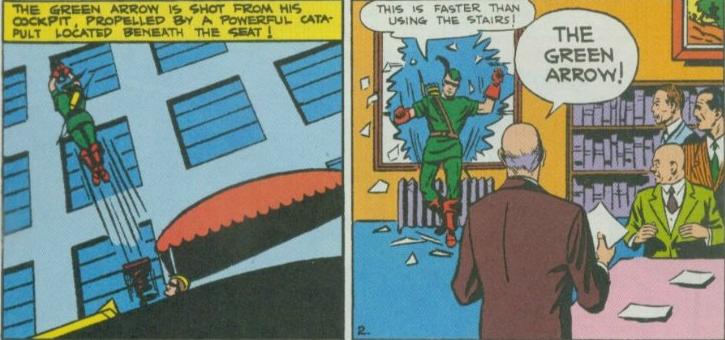
1001 Ways to Defeat Green Arrrow

Let's return to someone whom I and the rest of the world have abused a lot--but not nearly enough. Green Arrow. I figure I have to get my licks in now, because, frankly, I fear my worst nightmare is looming on the horizon: an acceptable make-over of Green Arrow (Oliver Queen). Yes, all the advance word I'm reading about how Green Arrow will be portrayed in the New 52 sounds like he just might be a unique, interesting, and likable character. Damnation! Is nothing sacred? But before we lose him forever, let us pay homage to one of comics' greatest and most enduringly and unendearingly unlikeable buffoons. My idea for doing so came from a story title that I recently stumbled upon in researching a previous, unrelated post: "1001 Ways to Defeat Green Arrow". "1001 Ways to Defeat Green Arrow"?! How delicious! Why, it sounded like something I myself might write! Here's a description of that story from the scholarly and extremely kind Dr. Mike Grost of Detroit:
1001 Ways to Defeat Green Arrow (1952). Writer: France E. Herron. Art: George Papp. A professor sells a book called "1001 Ways to Defeat Green Arrow" to the underworld, full of pre-planned schemes to defeat Green Arrow. Many of the schemes here involve understanding Green Arrow's psychology, then using his typical responses against him. This is a subtle approach. Green Arrow eventually understands this. Herron would write other tales of psychological manipulation by bad guys, such as "The Invasion From Indiana" (Strange Adventures #49, October 1954). Green Arrow's eventual call to abandon his predictable use of logic has a Rimbaud like feel.
Of the many astonishing things I have seen or might reasonably imagine seeing some day, a description of a Green Arrow story as having a "Rimbaud-like feel" was not one of them. Unless, of course, one focuses on the point in his life where...
Rimbaud's behaviour became outwardly provocative; he drank alcohol, spoke rudely, composed scatological poems, stole books from local shops, and abandoned his hitherto characteristically neat appearance by allowing his hair to grow long.. At the same time he wrote to Izambard about his method for attaining poetical transcendence or visionary power through a "long, intimidating, immense and rational derangement of all the senses.
Because that actually sounds a lot like Ollie Queen to me. "1001 Ways to Defeat Green Arrow" was originally published in this comic (Adventure Comics 174):
As much as I want to focus on Green Arrow, I'm also dying to find out about How Lana Lang Invented Lesbian Chic. Some other day, perhaps.
"1001 Ways to Defeat Green Arrow" was reprinted in this Bronze-Age issue of Brave & Bold.
Because when you've got to put a Haney-penned B&B story that makes Batman look ridiculous in the front of the book, there's only one way to make him look better: put a Green Arrow story in the back.
Anyway, so this Professor of Evil writes a book with 1001 chapters, each one of which tells you a different way to defeat Green Arrow. If I had such a book, I would read a chapter every day, like a quotidian devotional, a veritable The Upper Room for Green Arrow haters. Except "1001 Ways to Defeat Green Arrow" is really more like asubtitle; it needs a catchy title like "Easy Target: 1001 Ways to Defeat Green Arrow". But, sadly, I do not have 1001 Ways to Defeat Green Arrow the book; I don't even have 1001 Ways to Defeat Green Arrow the story. I don't own it, can't get a copy, and can only find this one page on line: So with your help I'll just have to make it up! What are 1001 ways to defeat Green Arrow? I want this to be an ongoing series, something to soothe our souls with the stupidity of classic Green Arrow during these lean and hungry years to come while we must endure this new, cool and interesting version of Green Arrow in the New DCU. I'll need YOUR suggestions, either here or emailed to me at scipiogarling@gmail.com. Here, let me start the ball rolling!
1001 Ways to Defeat Green Arrow, #1: Window bars. 1001 Ways to Defeat Green Arrow, #2: Mock the 'Arrow-Car'. 1001 Ways to Defeat Green Arrow, #3: Take away his arms.... and his teeth. 1001 Ways to Defeat Green Arrow, #4: Ice cream man suit + bad hair day = fail. 1001 Ways to Defeat Green Arrow, #5: Report him to Child Services. 1001 Ways to Defeat Green Arrow, #6: Wait for him to expose himself. Or, at least, his secret identity. 1001 Ways to Defeat Green Arrow, #7: Bring a gun. You don't even have to fire it. 1001 Ways to Defeat Green Arrow, #8: Use a circus clown. 1001 Ways to Defeat Green Arrow, #9: Require him to use the donut arrow. 1001 Ways to Defeat Green Arrow, #10: Judd Winick
See how easy it is?! Now it's YOUR turn....!

Wednesday, August 24, 2011

The Hangman's Dark Vein of Humor

The Odious Hangman has a frequently faintin' black minstrel-talkin' sidekick named...

wait for it...
Anthracite.

My, my! Now if tha' doan beat all!

Sunday, August 21, 2011

Wonder Woman versus the Indigenous Genre


Okay, ordinarily I try to avoid being rude on here. And, yes, ordinarily I fail.

However, today I think I will have to be intentionally rude, or at least unkind, to my fellow comic book readers who seem utterly mystified by a recent statement that Wonder Woman is going to be, in essence, a horror comic.

Brian Azzarello said in a recent interview:
"People need to relax, she's not wearing pants. But it's not going to be a superhero book. I can guarantee you that, it's not a superhero book. It's a horror book."

First, we are not talking about pants here, so, um, keep your pants on.

What we are talking about is something we've noted earlier: DC is using the opportunity provided by the new 52 to expand the genres and tones in what they offer beyond "just superheroes".

"More than superheroes" was a successful formula for DC in the past. Marvel did it to some degree, but by the time Marvel came along "superheroics"--comic book's indigenous genre--had more or less taken over the comic book medium. DC used to publish romance comics, war comics, horror comics, humor comics, funny animal comics, science fiction comics, mystery comics, adventure comics, crime comics, cowboy comics, fantasy comics.

But those genres faded as the superheroes grew in literary power. For most of the genres, readers could get their fix in other mediums... but superheroes reigned supreme in their publishing ghetto. During that transition, during the evanescence of the other non-superheroic genres from mainstream comics, something odd, yet perfectly logical happened:

everyone became a superhero.

Sci-fi hero Adam Strange started palling around with the Justice League and saving them from Kanjar Ro.

Oh, yeah, that's right; Dinah wears a WIG.


Sgt Rock did crossovers with Batman.

Wait, does that say, "1001 Ways to Defeat Green Arrow"?
Oh my gods, it's like shooting fish in a barrel...


Jonah Hex went to the sci fi future.

If this had been the Silver Age he would have been protecting Superman,
who'd lost his powers under that red sun.


The Blackhawks put on those ridiculous costumes ("Howdy, y'all ... I'm the Listener!").

So, is the Golden Centurion armed with a yellow wrist parasol or a lemon jello cube? Because either one is funny. And a serious threat to Hal Jordan.


Patsy Walker became Hellcat.

Yeah, Buzz, Patsy Walker just came in to Ye Soda Shoppe;
and she's coming to KICK YOUR ASS.


Really, every time I say or read that sentence it amuses me; Patsy Walker became Hellcat; it's more ridiculous than, say, putting Pureheart the Powerful into the JLI.

And classic horror character Swamp Thing started working with (and against) superheroes (which actually turned about to be a dromedarian back-breaker, leading to the creation of the Vertigo line of characters who, while still in the DCU, were "walled off" from its superheroic antics). Pity; I was hoping one day to see Swamp Thing in camouflage spandex, swinging around Gotham City on self-grown jungle vines, helping Batman bring Poison Ivy under control, like "Swamp Thing, the Sprout Wonder".

Yes, everyone became superheroic and those who didn't were seen only during huge universe-threatening crossovers, usually surrounded by scads of superheroes, with nothing more important to do than to remind readers, "Hey, DC used to write stories about me!"

Cinnamon says to Zatanna, "Don't go sliding up to strangers!"
Cinnamon thinks, "Jeez, can't I just shoot this saloon-whore and be done with it?"


And, now, that era is over. The success of non-superheroic graphic novels and indie comics have convinced DC that comic books are once again a medium where a variety of genres might flourish and recombine into new forms. As discussed in our look-ahead toward the New 52, there's clearly a lot of genre-mashing going on.

In fact, DC is pressing boldly forward...
back into the Golden Age, where a wide variety of genres were often found within one title. One issue of Pep Comics might contain the patriotic superhero the Shield, the detective in cape adventures of the Odious Hangman, the fantastical Danny in Wonderland, the sleuthing of Bentley of Scotland Yard, the supernatural horror of Madam Satan, and the military adventures of Midshipman Lee Sampson or Sgt. Boyle.

It wasn't just that there were anthology titles during the Golden Ages. The "superhero" genre had not yet coalesced out of other genres; while there were plenty of costumed adventurers (super or not), their tones varied widely and they were modeled after different genres. Batman was clearly a "detective comic" (duh)... at least, when he wasn't fighting vampires. Superman was more sci-fi, Wonder Woman was a war comic that quickly turned to fantasy, and Aquaman (as I've said before) was kind of an underwater Western starring Sheriff Curry. The superhero genre-- if there really is such a thing -- was born out of rampant mashing up of other genres.

The superhero genre threw itself together--well, kind of like Swamp Thing, by using scrips and scraps from whatever genres the seed of an idea happened to ground itself in. The rise of the Dynastic Centerpiece model in the Silver Age was part of the evolution of the genre toward some kind of unity. Crossovers and character interaction across titles were also part of that evolution.

But, unlike Marvel, DC's characters were not originally designed with that in mind. They weren't designed to interact with one another and it created cognitive dissonance when characters with different tones and from essentially different genres were 'forced' to work together. There are many examples of this problem throughout the decades. I won't enumerate them (this is a post, not a book), but we'll let one example stand for them all: Captain Marvel.
"How do you fit the Marvel Family into the DCU?" is one of the Great Conceptual Challenges of all comics (apparently), akin to Fermat's Final Conjecture or one of the Hilbert Problems. Why, it's like putting Pureheart the Powerful into the JLI.

Now, interestingly, DC is actively embracing that dissonance not as a problem but as a
solution. Rather than forcing every character into a "superhero genre", why not let the "superhero" concept expand again to encompasses any genre or combination of genres that it can? Why try to make Wonder Woman fit a pre-existing "superhero model"? It certainly never fit her very well; why squeeze into constraining literary pants that don't fit and limit plot movement? Wonder Woman doesn't fight Dick Tracy -style gangsters while patrolling a 1930s-style city; she never did. Wonder Woman's roots are Graeco-Roman mythology; she's a Greek hero. And what did Greek heroes do...?

They fought monsters. You know... like in a horror movie.

Which I why I am having very little patience right now with dullards sitting around scratching their heads about "Wonder Woman as a horror comic". Especially since you know every damned one of them used to watch "Buffy"...

Saturday, August 20, 2011

The Comet's smoking gun


Just keep repeating it:

There is NOTHING sexual about this Comet panel.


Friday, August 19, 2011

The Hangman Kills Baby Seals


One of many reasons to hate the Odious Hangman:

He causes the death of adorable seals.


By using them as meat shields.

Thursday, August 18, 2011

The Shield: Beware the Pebble!


Lorenz? Kurzweil? Poincare`? Puh-lease!

Joe "The Shield" Higgins was the true Father of Chaos Theory:


Wednesday, August 17, 2011

First Comes Love


I want to finish up my little series on marriages in the DCU2 by looking at how it all fits into the bigger picture.

It helps a comic company when it has great or even good characters. Even I am happy to admit that Marvel, for example, has some great characters (although I don’t often like what Marvel chooses to do with them). But the overall mythic appeal of a comic book – or any fictional – universe is also dependent on how well it represents various aspects of human experience through archetypical characters.

One example of this concept that I’ve discussed before is parenting. The DCU’s ‘trinity’ (Superman, Batman, and Wonder Woman) represent, well, many things. Intentionally or not, one of the things they represent are three basic modes of being raised as a child:

  1. by two parents (the Kents and their son Clark),
  2. by a single parent (Queen Hippolyta and her daughter),
  3. and as an orphan (young Bruce Wayne).

If we include a fourth, adjunct member in that “trinity”—Robin the Boy Wonder—then we get an even fuller representation of possible parenting:

  1. by a mother and father (the Kents),
  2. by a single mother (Hippolyta),
  3. by a single father (the Golden and Silver Age Batman is, for all intents and purposes, a father figure to his ward, Dick Grayson),
  4. and as an orphan (remember, the whole idea that “Alfred raised Bruce” is a completely modern invention, and pre-Crisis Bruce pretty much just raised himself… I guess when you’re really wealth you can get away with stuff like that).

Who knows? Perhaps DC will one day see fit to complete this particular puzzle and create characters with two mothers (Super-Heather!) or two fathers (like Connor Kent, but, um, we probably shouldn’t think about that one too deeply). Perhaps Apollo and Midnighter will adopt? Oh, I hope not. Gay couples always adopt Asian girls, so their child would surely be a Sword-wielding Kick-Ass Asian Ninja Chick. There’s too much of that cliché in comic books already; editors think that all fanboys love SKANCs, apparently.

Returning to the “trinity” again, they represent not just the three basic modes of parenting but the three basic modes of becoming a parent:

  1. Natural birth (the Waynes)
  2. Adoption (the Kents)
  3. Artificial means (Hippolyta)

I’m well aware that the uniquely mythological means of Wonder Woman’s birth—pygmalionization—isn’t really an option for those of us not in really tight with the gods. But it serves to symbolize all instances where someone becomes a parent through extraordinary means (artificial insemination, cloning, macro-mytosis… you know, that stuff).

Interesting though this may be… it’s not my current point; it’s just background. You are welcome to discuss it, but I mention it only as an example of how DC's iconic characters can be used to display the variety of human experience.

As the song goes, first comes love, then comes marriage, etc. And marriage and romance (or the lack thereof) are the subject of our current series.

My actual point is that, just as DC's Trinity & Co. represent modes of parenthood, so do DC’s icons—at least, potentially—represent modes of relationship status.

Clark Kent: The Unwilling Bachelor

Clark “not getting the girl” was part of his schtick for sixty decades. Now, Clark is no sad-sack like Peter Parker, so I’m not going to call him an “unhappy bachelor”. Superman’s not really “super” if he’s consistently unhappy. But it was always made clear that being Superman, wonderful though it was, meant giving some things up , or at least putting them on the back burner, including romance.

Bruce Wayne: The Willing Bachelor

I would call Bruce Wayne a “confirmed bachelor” but nowadays that’s just code for “gay”, which Bruce is not. Marriage or even a serious romantic relationship is not for everyone. Bruce has a fulfilling life full of purpose and on-going accomplishment, has close emotional relationships, and surely takes care of his, um, needs with other like-minded singles. But having—or looking for—a girlfriend has never been essential to his character. To the degree that one considers Bruce “happy”, he is a happy bachelor. Bruce is, at heart, a “Down With Love” Girl. It’s just that instead of eating chocolate he beats the tar out of demented freaks and dangerous criminals, which is better for society and much less fattening.

Hal Jordan: Man-Whore

C’mon; we all know it. Hal hooks up; Hal gets booty calls. It’s not just being played by Ryan Reynolds in a movie; it’s not just a post-Rebirth Geoff Johns’ characterization of Hal. Although both of those certainly help. Even Pre-Crisis Hal… well, let’s just keep this simple: Arisia.

Barry Allen: Player

Barry Allen, as recently discussed, was kind of a “player” (at least, had great potential for it, dampened only the Ever-damning Evil Eye of Iris West, Meanest Woman Alive). And he’s a known magnet for Sexy Extra-Dimensional Action Scientists and the occasional Oscar-winning actress. But he’s not a man-whore like his best bud, Hal Jordan. Barry Allen’s not a ‘hook-up’ kind of guy; he’s more of a ‘speed dater’. I’m sure Barry make every woman think she’s the only woman in the world … when he’s with her. Only Iris West knows better, because she knows What Evil Lurks in the Hearts of Men.

Arthur Curry: Husband

However one feels about Mera, Arthur Curry was the first married superhero, the king who found his queen. The tragic end of their storybook romance was the truly end of the Age of Innocence in the DCU. For better or for worse, Aquaman stands for The Married (and sometimes Divorced) Superhero.

J’onn J’onnz: Widower

Most of what current readers think of as J’onn’s essential background consists, in fact, entirely of post-Crisis inventions and retcons. That’s understandable, given that J’onn pre-Crisis backstory was, well, I think “difficult to work with” is the kindest way I can put it. So nowadays one of the strongest elements of J’onnz background is the lost of his wife and children on Mars. J’onn is one of the most significant widowers in DC comics (perhaps in all comics, second only to—of all people—Frank Castle).

Discuss!