Friday, June 16, 2017

LIBRARY OF AWESOME!

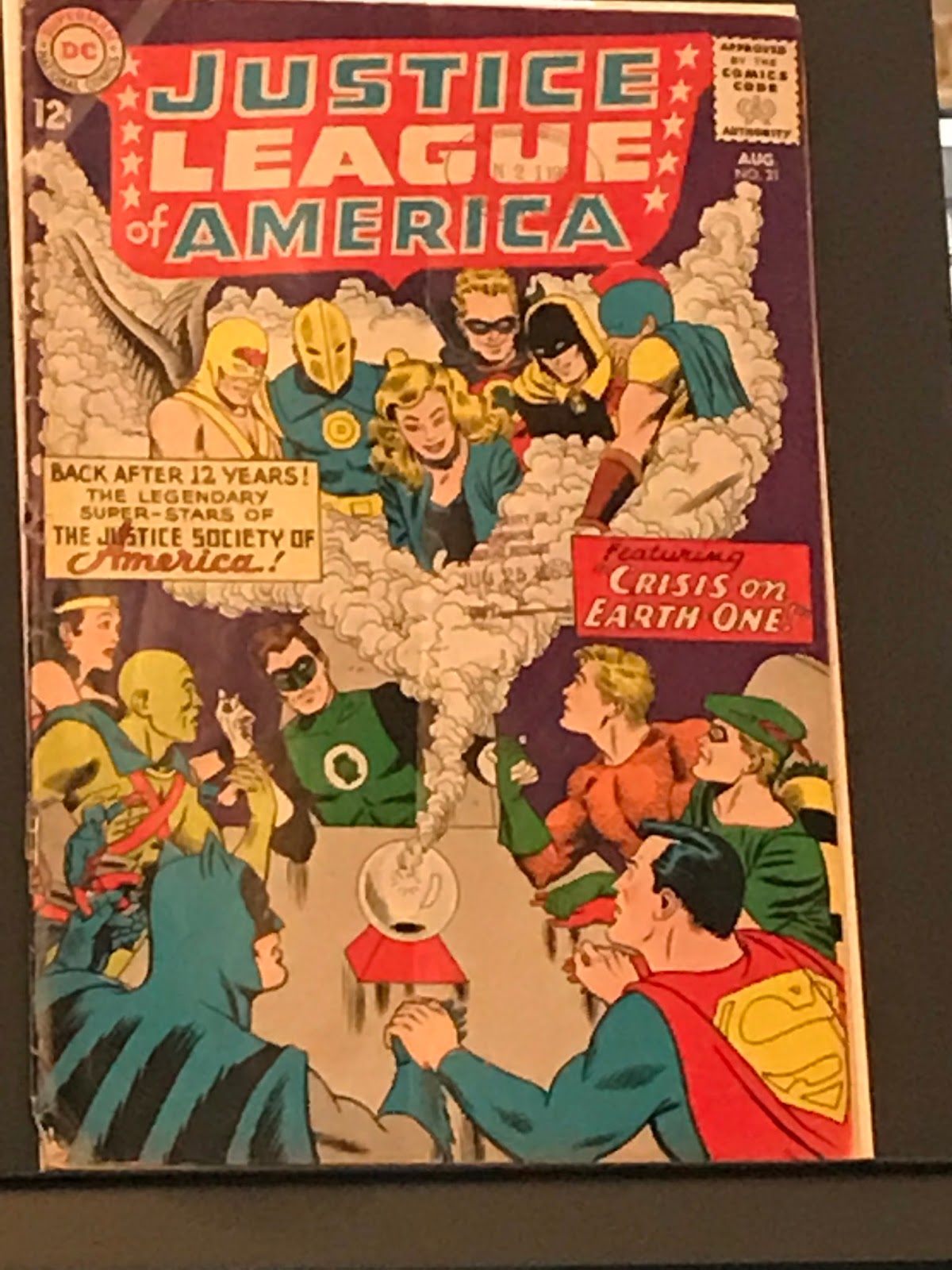
If you live anywhere near the DC metropolitan area, go to the Library of Congress tomorrow, where, in the Jefferson Building, they have an exhibit of some of their comic book collection.

Including a few you might recognize:


The Capitol actually glows just like that. It glows with freedom.


"Back off, boys, I am WAY more popular than all of you combined, and still will be 70 years from now."

"Don't worry, after my sassy entrance, I'll break down in tears remembering that my entire world has been destroyed!"

Angry-Black Lantern's origin!

It took Batman hours with a whip to train him to do that.

"Well, see, that's yer problem right there; a leak in your crystal ball's radiator."

I still hate you.

Oh, yeah; I went there.
If they let them touch they would break through the fourth wall into the multiverse and a host of characters would pour in until the Jefferson Building looked like the JLA satellite during the Crisis.

Despite having lived in DC for 30 years, despite working on the Mall, despite having been to the Madison Building where these are stored about 10,000 times, I have never seen these comics. Until today.

I tried not to be That Guy went I showed up, wading through the streams of school groups in identical tee shirts.  But...it just kept happening.


"Here's a sheet that explains what the comics on the display are, sir, if you'd like." 
" !!!! Thank you, but that won't be necessary. I know what they are."

And, yes, I said "!!!!" out loud.


"Oh, I'm a history teacher and I use comic books in my classroom; did you know the Captain America was fighting World War II before we were?" 
"Uh-huh. And other characters were fighting thinly-veiled substitutes for the Axis even earlier, such as Superman versus Rakhal the dictator of Oxnalia or MLJ comic's The Shield versus the Moscovians.  You should read The Shield."
Well, he SHOULD. Everyone should.


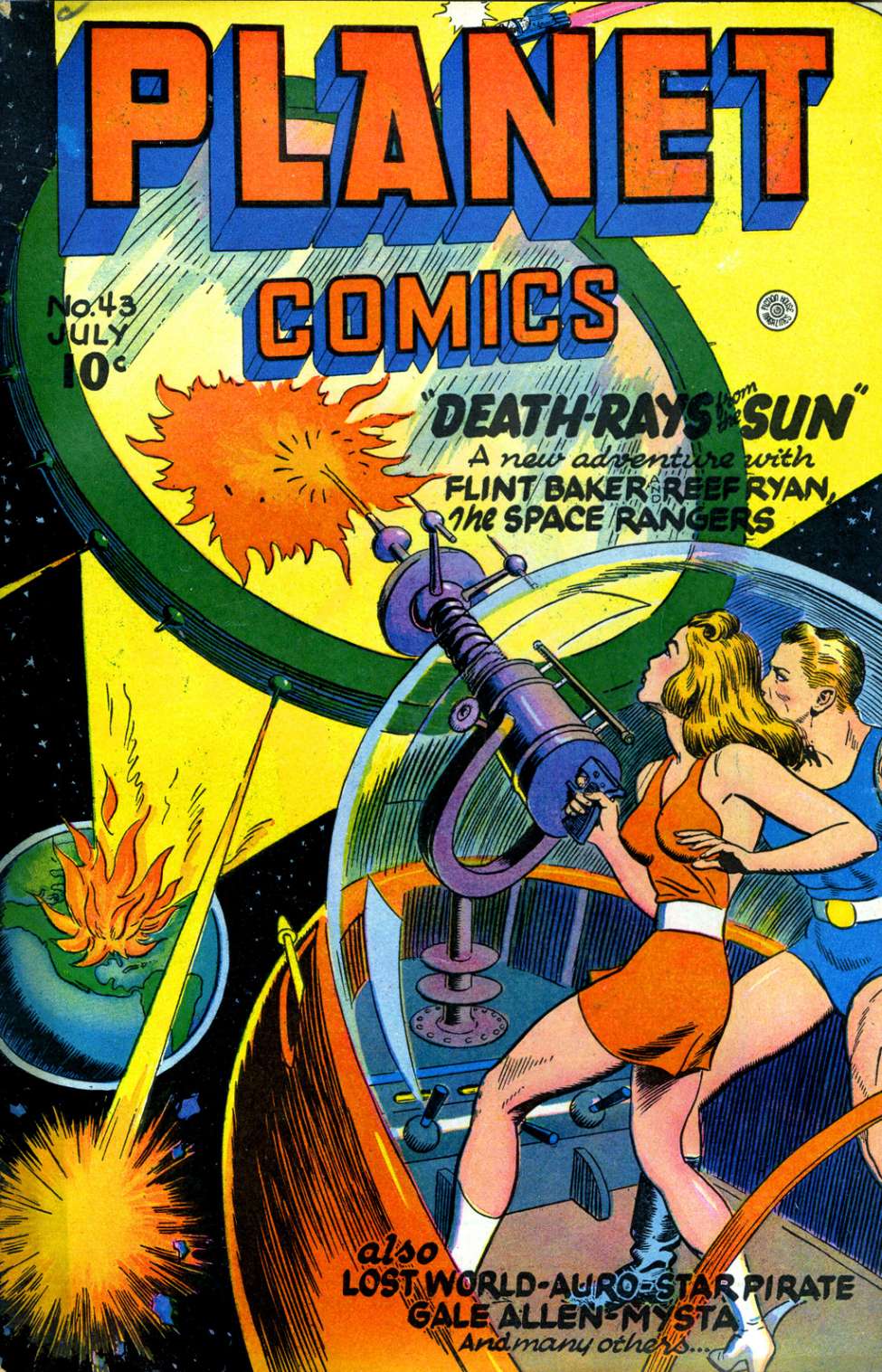
"And with that modern cover of Princess Leia compared to this early space comic book you can certainly see how the role of women in such literature has changed!" 
"The princess is posing.  THIS women is firing a laser cannon at the threat. AND her clothes are less revealing than her male sidekick's.  There are certainly examples of sexism in Golden Age science fiction comics, but this isn't one of them."

Yeah.  I was TOTALLY that guy.

But it was okay. When some of the librarians realized what an obnoxious know-it...
I mean, a useful resource I could be, we exchanged info so they could consult with me about online sources for current comic book analysis and criticism.  I think they were also impressed by the fact that I was the ONLY person who said, "NO, I don't want to TOUCH the comics, are you MAD?!"

I don't think you should touch them, either. But I do encourage you to go to the exhibit, whose last day is tomorrow.

Wednesday, June 14, 2017

Adam West, in memoriam

As the entire world mourns and remembers Adam West fondly, what more is there to say about the man? I was a very very little boy when the Batman live action show aired, it entranced me, and sparked my lifelong interest in DC comics. So if you have ever enjoyed ANYTHING on this blog, your thanks are owed entirely to Adam West.

Thousands of pages are being written about how his portrayal brought the character back from the precipice of obscurity and put 'camp' into the ordinary person's vocabulary.  I don't feel a need to add to those.

But a lot of discussion focuses on how different and unique(ly amusing) West's portrayal of Batman was.  I want to focus on something he brought to the character that is NOT unique, but he brought it with such strength that it has informed every single portrayal of Batman since.  Simply put:

(Adam West's) Batman did not care what you thought about him. At all.

Adam West didn't 'play' camp. He didn't wink at the audience or his fellow actors. He didn't wink at anything. Or blink, even.  You want cute winks? Be a Superman fan.

Adam West took Batman with deadly earnest.  Which is exactly how Batman takes Batman.  A billionaire dressing like a bat to beat up muggers at night and throw boomerangs at deranged criminals is a RIDICULOUS concept. Intrinsically.  The only thing that saves it from feeling ridiculous is the sincerity with which Batman does it. And nobody, I mean NOBODY, radiated sincerity more than Adam West.

It didn't matter what they made him do as Bruce Wayne; he was committed to its veracity 1000% percent.  Dancing the Batusi was exactly as sincerely in character for West's Batman as recounting his parents' murder....BOTH of which happened in the first episode, in case you didn't know.

West's Batman (and most subsequent Batmen) don't care whether you think dressing like a bat is ridiculous. He doesn't care whether you cynically deride Virtue, the Constitution, Mercy, Caution, Civic Duty, Driving Safety, Dancing, Nature Studies, or Foreign Language study.  HE understands and believes completely in these things and their value, and if you do not, he merely pities you (in a non-judgmental way, of course).  He takes those things seriously.

Michael Keaton's and Diedrich Bader's interpretations of Batman were dead-on and well received. Why? Because those comedians understood the importance of Batman remaining serious...whether you want him to invoke fear OR laughter.    Even LEGO Batman, the most overtly humorous screen interpretation of the character, has one central characteristic that is source of nearly all its humor: he takes himself very seriously, no matter how ridiculous his behavior or situation might be.

I have always felt that this is the essential conceptual conflict between Batman and the Joker; that Batman takes everything seriously and the Joker takes nothing seriously, without regard to the situations.  That's why, objectively, Batman is hilarious and the Joker is terrifying.  But that is perhaps another story for another time.

For now, I thank the late Mr. West for bringing sincerity to his role as Batman... and to everyone else's Batman, too.

Thursday, June 08, 2017

A rising Star City!

Speaking of Green Arrow...

One of the most interesting things I have even seen in comics is happening (as predicted) right now in his comic: a real world city is being overwritten by a fictionopolis.


Built around a star. 
A teeny tiny star.

How did this happen?

When Green Arrow was brought back in Rebirth, he was left in the hands of his late-New52 writer Benjamin Percy.  With 12 issues of Green Arrow under his belt, Percy was already an accomplished expert in botching Green Arrow. And "botching Green Arrow" is not a phrase I use lightly.  


And bite it did.

So, naturally, being That Type of Writer (you know, the kind who grounds Green Arrow in gritty realism by making him a werewolf), Percy set the Rebirth versions of Green Arrow in the real-world Seattle.


Which is, admittedly, not as bad for Green Arrow as the Real World San Francisco turned out to be.

This ran strongly counter to much of the point of Rebirth, which was to the recalibrate the DCU and its icons back to their basic core features from which they had wandered far too quickly in the aborted New52 universe.


Oh, gods help me, I'm calling Green Arrow an "icon" now someone please me get back to my native universe...

Clearly in Green Arrow's case one of the essential features should have been the restoration of his personal fictionopolis, Star City.  Not only was it his base of operations for the bulk of his adventures from 1959 through 2011, it's also the setting of his long-running hit televisions series that's the bedrock of a major network's primetime programming.


Who has trapped me in this madhouse world? Lord Morpheus? Mxyzptlk? Cary Bates?!

As any reader of this blog knows, I am big fan of fictionopolises.  I believe that they are not only desirable but necessary settings to a thriving superhero icon in the DCU.  In its very early days, most DC heroes were in unnamed cities or, in a few instances, Manhattan.  Green Arrow himself lives in Manhattan in his first story.


Pictured: the Manhattan city limits.

The advantage of using real-world cities as superhero settings is supposed to be that it lends the stories a grounding in reality (in the same way that the stories are set in "the USA" and 'on Earth').  


See how much more realistic that seems?

And in the short run, perhaps it does. But over time as the character and his mythos grows, a hero's first sport-coat becomes a confining straight-jacket: significant landmarks cannot be added or removed, people and events in the city don't match, and there's too much tension between the fantasy of the hero's life and the reality of the real-world city.


Welcome to Earth-616.

You can't tailor a real-world city around its hero the way you can a fictionopolis.  Metropolis and Gotham City aren't the cities that Batman and Superman happen to live in; they are cities DESIGNED for them to live in. So, if you want Green Arrow to thrive -- I mean, in a comic book, as opposed to all other media -- he deserves to have his own fictionopolis.  

But Rebirth stuck him in Seattle with no Star City in sight; what's to do?  Well, I'm sure that Geoff Johns at some point called Percy into his office, tented his fingers (covered with the Green Lantern rings of all previous DC editors) and told Percy, in a loving and supportive way that would have made Mort Weisinger proud, that Green Arrow needed to be (1) not set in Seattle and (2) set in Star City. Now.


"I need loyalty. I expect loyalty."

Percy, master of the subtle approach (which is, no doubt, why he was given Green Arrow), has chosen, therefore, rather than to move Green Arrow to a newly introduced Star City or retcon him there, to DESTROY SEATTLE and OVERWRITE IT with 'Star City" taking its place on what I like to call 'RebEarth'.

At first I thought this was lunacy (at which Percy seems to excel).  And to some degree it is.  But I see now that it is beautiful, brilliant lunacy, for a reason I'll get to at the end of this post.

Now, Seattle is not, as the plot now dictates, built over any star-based pattern.  Not like SOME artificially designed cities I could name.


This may explain that black goat I keep seeing on the North Lawn.
Or it might be Spicer.

But Percy is not letting reality stop him!  He's wisely destroyed Seattle's only landmark recognizable to anyone who doesn't live there (the cheesily named Space Needle)...


Seattle broadcasting assigns reporters based on how well they color-coordinate with what they are covering.

... is putting the city's rebirth in the hands of private corporations (setting up for traditional storylines like "Green Arrow calls people corporate fat cats" and "Ollie runs for mayor")...


Seriously: "Let's privatize everything instead of trusting the federal government!"
is delightfully current and cogent political satire, and Green Arrow is a good place for that.

... and is ham-handedly shoehorning "Star City" in as having been there all along, just waiting to be discovered.


Discovered through the transformative power of bad prose.

And you know what? GOOD FOR YOU, PERCY.  I still hate your writing. But this is a bold approach to bringing back Star City, which succeeds on several levels:


  • It finally gives Star City the unique identity it has always lacked;
  • That identity is particularly keyed to Green Arrow's personality and history;
  • It clearly mimics the 1998 Batman storyline "Cataclysm", and Green Arrow should always baldly imitate Batman;
  • and, most important, by having Star City supersede Seattle it makes it impossible for any subsequent writer ever to return Green Arrow to Seattle.  No matter what horrible literary things you have done or will do with Green Arrow, I shall always revere you for this.


P.S.   Mr. Percy, thank you also for ripping off Batman villain Black Mask to create the newest member of Green Arrow's crime calvacade, Pizza-Face:


And burns it does.


Thursday, May 25, 2017

Solving the Merlyn Mystery

If you are like me, the Green Arrow villain "Merlyn" has always mystified you.  'Malcolm Merlyn' is, of course, a fixture on television's Arrow (and the second season of Legends of Tomorrow).  Mostly this seems to stem from some sort of Satanic pact made by actor John Barrowman that everyone (but me) will love him, no matter how bad at or inappropriate for a role he is.

CW asks a lot of me.  They ask me to believe Barry Allen could become so evil at some point that he wouldn't pompadour his hair.  They ask me to believe that Josh Segarra, who sounds like the illegitimate child of Ray Liotta and an Italian restaurant in Queens, is a genius litigator, deceiver, schemer, and supervillain.  They ask me to believe that Caity Lotz is awake.

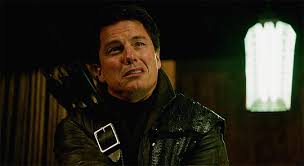
But trying to make me believe THIS guy is a threat to, well, anyone is the hardest thing the CW asks of me:

EVERY time he says something like "I YAM the head of League of Ass-ass-ins, you know" in his Snitty Bank Manager Voice, I laugh.

His teeevee threat level aside, "Malcolm Merlyn" is, like most of the secondary characters in the CWverse shows, loosely based on one from the source comics: Merlyn the 'dark archer'.


It's still true: the best indicator of any character's lameness is their Who's Who illustration.

Merlyn debuted in November 1971 (JLA #94) in the stupidly named "Where Strikes Demonfang?" (titling stories in the Marvel-style of faux-Shakespearean/epic prose was a big thing in the '70s). A (painful) synopsis follows:

A sniper, M'Naku, has Aquaman, the Batman, and the Green Arrow in his sights. At the last second, the Green Arrow sees the sun glint off the barrel, and scatters the heroes. The Green Arrow disarms M'Naku, while the Batman attacks. Once M'Naku is subdued, Aquaman interrogates the would-be assassin. M'Naku reveals nothing. The Sensei, of the League of Assassins, angered at M'Naku's failure, tasks Merlyn with carrying out the assassination. 
Television anchorman, Clark Kent, is out on assignment, tasked with filming a news documentary on pollution. Kent asks the Atom to accompany him, as his assignment will take him near to Porttown, where Aquaman, the Batman, and the Green Arrow went missing. Merlyn disables Kent's news van. Kent confronts Merlyn, as Superman. Using specially designed arrowheads, Merlyn subdues both Superman and the Atom. Merlyn assassinates M'Naku. 
The trademark arrows, and distinctive laughter, tip off the Green Arrow to Merlyn's presence. Earlier in his career, the Green Arrow faced off against Merlyn, and lost. Aquaman, the Batman, and the Green Arrow track Merlyn to an abandoned house. Suddenly, Aquaman collapses from extreme dehydration. Using his size and weight control belt, the Atom disables the arrow immobilizing Superman. The Batman submerges Aquaman in a fountain, until the King of the Sea recovers. 
The Batman suspects that the Deadman has taken possession of Aquaman's body. The Green Arrow is caught inside a vacuum tube. The Batman hurls a batarang at the tube, to no effect. Still recovering his strength, Superman, and the Atom, hitchhike to Porttown. Spying the Green Arrow's dilemma, Superman hurls the Atom at the vacuum tube, shattering it. The Green Arrow squares off against Merlyn. This time, the Green Arrow is the victor. 
Having failed to assassinate the Batman, Merlyn flees, knowing that the League of Assassins will be coming after him for his failure.

The version of Merlyn always seemed...off.  In more than just a 'Stupid Bronze Age" way.  Why name a dark archer after a ...medieval wizard?  Why does he look like, well... a geek?

In fact he looks remarkably like another JLA villain, Headmaster Mind, who had debuted unspectacularly in 1964.

Sometimes you don't need a Who's Who page to tell how lame a character is.

You remember Headmaster Mind (whom I've written about here before); he was a 'professor of crime' who taught criminals how to be successful, even against such foes as the Justice League members.That's why he looks like a professorial stereotype. But why on earth would Merlyn look that way?

And then I discovered this:

More Fun Comics #75 (1941) , in case you were wondering.

And it all clicked into place.

The reason that Bronze Age Merlyn looks like a evil professorial type ... is because that's what he originally was.  That, kids, is "Professor Merlin" who runs a crime college in the third Green Arrow story.  

"Crime college/school" is one of those inevitable concepts that comics CANNOT let go of.  Given enough time, every hero will find and fight one.  Why? Who can say.  Perhaps it's the tension intrinsic between crime, usually though of as an occupation for the ignorant, and schooling, or society's fear that criminals, properly focused on self-improvement, could be unstoppable. Me? I think comic book writers just have some unresolved issues with their teachers.

When Professor Merlin does capture Green Arrow (which is almost immediately) he chooses to spend time tickling him.  Which isn't fey AT ALL.  Then he ask Ollie to throw in with him and be his partner and rule the world with him.  Then Ollie says no because Merlin's type can't last long enough. Then Merlin says, "I'm tired of playing with you!"

"What happened to Speedy? Usually Speedy is the one who ties me up and tickles me with a feather!"

Then, in a scene too embarrassing even for Green Arrow, Ollie is saved by a motorcycle cop who pulls Merlin over because his tail-light is busted.  "The law will get you soon," indeed.  

In Green Arrow's first story, his foe, Ezra Sampson, dies (as we saw).
In Green Arrow's second story his foe, The Voice, is caught.
In Green Arrow's third story his foe, Merlin, escapes.

And that is the key.  Merlin is Ollie's first villain that gets away. And then becomes the first villain to return.  Merlin was Green Arrow's first recurring villain in his rogues gallery (aka the Crime Carnival).  So when writers wanted to make a basic recurring archenemy for the newly-revised Bronze Age version of Green Arrow they took the most basic concept -- an anti-Green Arrow, an evil archer -- and simply lay it on top of Ollie's earlier recurring foe -- Merlin.  


It was a dumb thing and lazy thing to do, of course, and resulted in a character that doesn't make a lot of sense.  But at least now I understand WHY.


Tuesday, May 23, 2017

YEOW!

We left Green Arrow at what was obviously the end of his first story:  arrows have been shot, Ollie had been catapulted in a burning building, the mystery had been solved, the bad guy had been revealed and caught.


Would've gotten away with it, too, if it hadn't been for those meddling archers and their catapult.

But if you think that's the end of the story, well, then, you simply don't understand one of the most powerful forces in the DCU:

THE INCOMPETENCE OF GREEN ARROW.

The now-unHooded Claw, revealed as tiny Ezra Sampson, simply jumps out a window and runs away laughing at Green Arrow all the way.

If only Ollie and Roy had some sort of non-fatal medium-range weapon handy.

Everyone sing!  
"Arrow fails, Speedy bails, Batman rolls his eyes; 
the Arrowplane's quite insane, Ezra Sampson got away!"

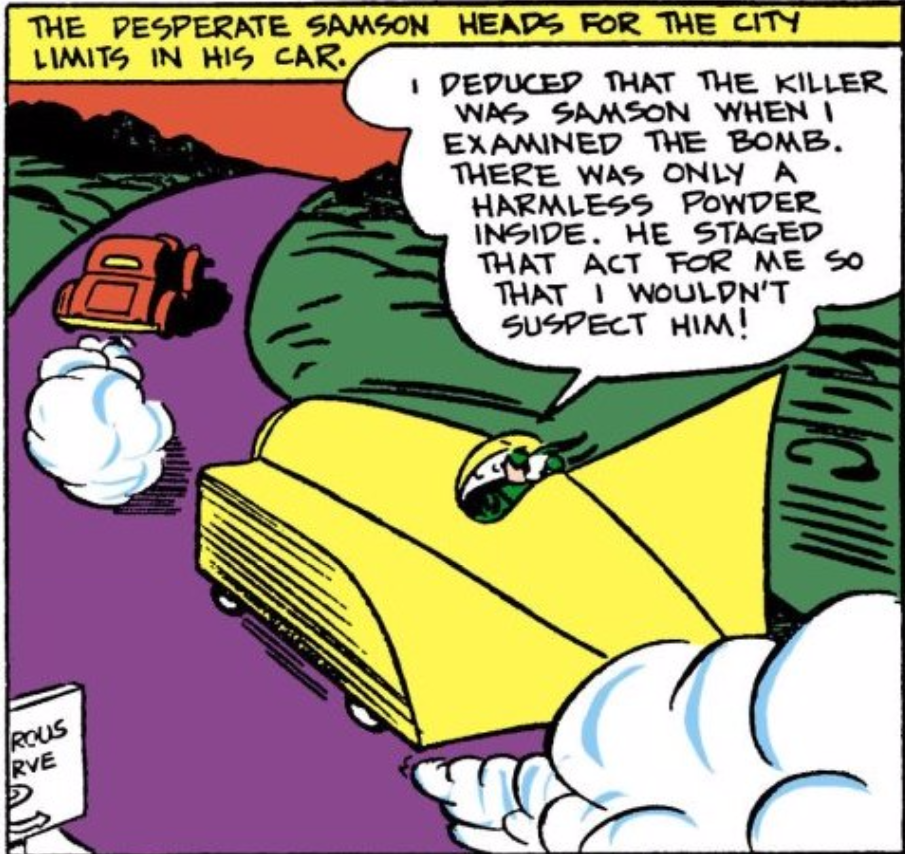
Sampson heads toward the city limits, which is an urgent problem, because apparently Ollie's vigilante license isn't valid outside his municipality.  Kind of like a notary.


Ollie's vehicle grows larger with each panel.  That's why at some point the DMV notified him he could no longer call it a 'car' and it became "The Arrowplane", even though its less able to fly than a tank is.


So Ollie shoots out a tire on Sampson's car as a simple safe way of halting his getaway.


To the degree that "Oliver Queen steering the Arrowplane with his knees" can be considered "safe".

Ollie seems oddly insistent that this is a permanent solution and Sampson seems to have a strange symbiotic relationship with his car, since he cries out in pain when its tire is shot.

How did Lichtenstein miss this panel? It's beautiful.

The Sampsonmobile glides to a gentle stop and Ezra finally gives up gracefully..


Wait....whuh-uht?!?!

HOLY ****!


Do NOT fail Green Arrow's city.

Holy CRAP that was horrible and grim. Welcome to the Golden Age of Comics, kids.


Green Arrow: facilitating failure since 1941.

Ollie keeps the cartoon bomb as a souvenir, presumably because a coffin-forming mass of twistled and tangled steel doesn't fit neatly into his curio cabinet.


I am DYING to know what those other trophies are from. And how many people died to put them there.

NOW ends the case of the Namesake Murders. Until next month, kids, enjoy this teaser panel of Ollie shooting an arrow through a man's hand, blood gushing from the wound!

I hereby declare "Crime Carnival" as the official moniker for Green Arrow's rogues gallery.

Sunday, May 21, 2017

Green Arrow Loves His Cartoon Bomb

When last we left Green Arrow, Ollie was dashing to his local dealer because he was out of marijuana.


No wonder the writers moved him to Seattle.

Okay, actually, he was there trying to stop the next History Club member from being murdered by fire (in emulation of the death of Jean D'Arc).  Since there's not a moment to lose, Ollie does the logical thing (if you're Green Arrow):

CATAPULTS BLINDLY IN A FLAMING HOUSE-FIRE.

Don't worry, Ollie; I'm sure those little red gloves will protect you.

Fun fact: the unofficial multiverse name for this universe is 'The Only One Where Green Arrow Survives".

Since this is Ollie's first adventure he hasn't yet invented awesome devices like the fire extinguisher arrow, the freeze arrow, or the personal lubricant arrow.  So rather than try to put out the fire he does an extraction on its intended victim.... Green Arrow-style!


Oh, god, this is going to be something stupid with ARROWs, isn't it...?!


Yup; it's something stupid with arrows.

Wanna bet that Green Arrow's 'signal' to Speedy was screaming "NYAAAOHMYGODI'MONFIIIIIIIIIRE!"?

Ollie practiced that joke for WEEKS.
Speedy is a true enabler.  Eventually, I'm sure he get tired of this sort of thing and invents the ladder-arrow. In fact, even in this first Green Arrow story it's becoming clear that Ollie is basically Inspector Gadget and Roy is Penny, running around trying to keep Green Arrow from killing himself and secretly solving the case without Ollie noticing.

The list of 1001 Things Green Arrow Can't Afford includes "butlers" AND "Bible camp".
And 'four-wheel drive'.

Note that at some point between panels, the "Arrowcar" became "the Arrowplane".  Probably the point at which Ollie became unable to keep the front wheels on the ground.

Truly thoughtful villains match their victims, crime scenes, and cartoon bombs to the hero's color scheme.  Remember that on St. Villainstime Day!

Boy, the Hooded Claw sure is an efficient villain!  Our heroic bowmen arrive JUST as the cartoon bomb is about to explode, bringing the entire building down on Samson (and them).

But this is, after all, The Only Universe Where Green Arrow Survives, so they manage to put out the bomb with a well-placed Acme water cooler. I mean, arrow.

Ollie is the world's luckiest superhero. At least, until Child Services catches him.

Samson saved, GA takes the bomb back to his Manhattan apartment, where by holding it and using his arrow-senses he hopes to divine the identity of the killer: "Eenie-meenie, chili beanie... the spirits are about to speak!"


High on the list of 1001 Things You Don't Expect Green Arrow To Say:
"But let's go visit Socrates."

This is, you'll note, 'the most puzzling case' Green Arrow has ever encountered. That's certainly true from our perspective, since it's his first case.  Of course, as previously noted Green Arrow is also puzzled by shoes with laces.

So, obeying the Magic Eight-Bomb, the Brave Bowmen arrive just as the Hooded Claw is trying to make Socrates drink poison (because god forbid you should kill anyone non-thematically).  

But then again, isn't "I'm getting out of here!" the general reaction to Green Arrow?

Then, in a panel guest-drawn by M.C. Escher, Green Arrow shoots the Hooded Claw in the leg (FINALLY!).

"Just as I thought....arrows are nearly useless in fighting crime!"

Now we learn why the Hooded Claw wears a big hat and pointless cape: so that Ollie can more easily do his "pin you to the wall with arrows like a dead butterfly" schtick. Yet another reason Killer Moth needs to be moved to Green Arrow's rogues gallery.

Rhopalocerrific!

Turns out the Hooded Claw was one of the History Club members, who was killing off all the others (and faked an attack on himself) to cover up his embezzlement of what could not possibly have amounted to more than $10,000 from the Club's treasury.  

No WONDER Scooby-Doo teamed up with Green Arrow.

Once that's revealed, I'm sure the Hooded Claw goes to jail, the case is closed, and the story is over...

OR IS IT?!?!?!?


Next: It isn't.