Showing posts with label Joker. Show all posts

Thursday, March 05, 2026

The Not So Secret Message of The Joker's Outfit

Okay, a YouTube video, professing to explain the history of all the Joker's costumes, made me mad enough to write this post.  Why am I continually surprised at the shoddy scholarship on YouTube?!  Why do I keep imagining that I will learn something by clicking on these videos?

BAH! FOOLS!


In this case I never got past 01:10, where the video describes the Joker's original costume as "straight out of film noir gangster films".

This, for those of you who are not familiar with sartorial history, is incorrect.


"Gangsters" did not wear TAILCOATS.  Nor flat-topped hats, nor vests, nor wing collars, nor string ties. These are elements of clothing from 40 to 50 years earlier than the "Gangster Era".

Nor dress gloves.

I get it. When you are a child every four-legged animal is "doggy" for a while, until you learn more terms and details to distinguish among quadrupeds.  So, too, if you are a contemporary unstudied person, you lump together decades worth of clothing styles in a big box labelled "OLD".

I am more empathetic than I sound. My husband is a costume designer (his work above), and compared to HIM, what I know about clothing can't fill a thimble.

So I will explain to you what the Joker's original outfit is meant to evoke (which would have been MUCH clearer to people in 1939). In short, the Joker is outfitted AS A CARDPLAYER.

Are you familiar with the Gambler, from the Injustice Society?
Does his outfit look familiar?


The hat that the Joker wears? It's not a "fedora"; it's literally CALLED a "Gambler's Hat".

Its top is FLAT and low, unlike a fedora or trilby.

The string tie? Its common name is a "Kentucky tie", and it's associated with Southern cardplayers (and those who drifted to the Wild West with their style intact).

Such as this guy in this Western film.

And WHY is the Joker dressed this way? It's obvious: he's coded as a CARD PLAYER. 

John Carradine ("Stagecoach"1939) would have made an interesting Joker.

And a sneaky one, not a good honest cowboy type, but a sneaky, sneering, aristocratic SOUTHERN one.

The first image of the Joker is from the splash page of his first story shows him...
dealing a hand of cards.


The time we see the Joker smile is when he self-identifies as a cheating card player.

The pinstriped pants and spats...

Or the "stirrup" pants, another old-school element 

...are also part of the look. Everything about the Joker's outfit says "shady gambler."

There are some echos of the Wild West UNDERTAKER, but the hat, the color of the suit, and pants and spats undercut that association severely, leaving "gambler" the only on-target association.

Thanks to period films and closer proximity to the era, the Southern/Western Gambler was a more familiar trope when the character of the Joker was introduced. This type of clothing (particularly in a usually "villainous" color) was really all the Joker needed to be thematically costumed.  

With due deference to the artists of the Bronze Age, a lot is lost by outfitting the Joker in contemporary styles and there is a reason these looks don't stick (despite their effective color scheme).


Tuesday, October 08, 2024

Joker: Folie a Deux, The Odyssey, the Brave Little Toaster, and Drag

Sit down for some shocking news you may not be ready to handle:

The sequel to Todd Phillip's Joker film, Joker: Folie a Deux, is not doing well at the box office.

Sorry if I was the one to break it to you.  But, if THAT bit of news actually did shock you, then there's certainly nothing I could have done to prepare you for it mentally. It's not just "not doing well", it's doing worse than Sony's Morbius did.

So perhaps Jared Leto isn't the problem, after all.
Merely "a" problem.

Many have identified the fact that the "Arthur Fleck" character of the original movie is in the sequel revealed to be obviously a shell, just an empty figurehead for a bunch of gratuitously aggrieved numbskulls. You know, just like in real life.

To me, the problem with JFAD isn't that it's a semi-musical or that it seeks to undo the misinterpretation of its predecessor.

Because you know what else was a semi-musical sequel that sought to undo the misinterpretation of its predecessor?  Homer's Odyssey.  But audiences ate that **** up.

Homer, it is deduced, was displeased that dullards in his audience took The Iliad as praise of the Greek Heroic Ideal, rather than as the condemnation it was intended to be.  Thus, its "sequel", the Odyssey, took to deconstructing that "ideal" more explicitly and aggressively.

And it takes some effort to do anything more aggressively than The Iliad.


It's clear that the creators of JFAD were making a Homerically heroic attempt to undo the misinterpretation of the first film as an endorsement of destructive nihilism by an aggrieved audience of dullards.  It's only natural that it would thus alienate fans of the first film and attract exactly no one else, since sensible folk don't really need to hear that message.

Similarly, The Brave Little Toaster would not be a beloved classic if its message had simply been "don't stick your finger in a toaster", because that's not a message sufficient to sustain a feature-length film.

But as a comics fan, I see the real problem of Joker and JFAD much more broadly. To me the problem is "Villain Drag".

No offense intended, guys.


The problem, in short, is when DC (or any IP-owner), allows an independent creative entity (a person or another company) to a tell story about a character that wouldn't otherwise get funding by draping it in the disguise of a well-known character they own.  This character is often a villain, because the company is less invested in the "purity" of the portrayal of such characters.


There's three easy examples right there of characters who have been put in villain drag to capitalize on the Q rating those villains have built up over 80 years.  It's not a sure-fire formula for failure; "The Penguin" seems well received so far. But nothing could symbolize the fact that it's just Villain Drag better than the show runners changing the character's name to "Oz Cobb", rather than Oswald Chesterfield Cobblepot.

The Penguin's name is SUPPOSED to be stupid. That's part of the point of his effete but fatal "gentlemen burglar" routine.


Adaptation is one thing, and variants are necessary and helpful mechanism for building a truly mythical character long-term. That's just how ancient myths were developed, too.  

I mean, this guy killed a hobo for a sandwich, fell in love with the Riddler, and was nearly emaciated. But he was still definitely The Penguin.

But there is a palpable difference between wanting to do a new take on a well-known comic book-based character and simply creating a character you want to tell stories about and then covering them with a coat of paint to make them LOOK like the comic book character.

As I mentioned, this phenomenon is not confined to villains, but the less the company has invested in the purity of the character's portrayal, the more likely a target the character becomes.


Sometimes this can be happening without anyone really noticing it.

"Batman versus Superman" is a good example of Anti-Hero Drag.  The essential thing wrong with that movie is that well-known characters chosen specifically because they are well-known characters are acting completely out of character.

You really can't have your cake and eat it, too. If you want to tell a story about BananaMan, then, damn it, you have to be prepared to tell a story about a man who throws Bananarangs, has a pet monkey, and adopted a kid sidekick named Second Banana. These characters aren't just COSTUMES; they come with stories and personalities BUILT INTO THEM; it's why everyone knows who they are already. It's the source of the popularity that opportunistically parasitic outside creators are hoping to leach.

Putting on a little grease-paint and faking a smile doesn't make someone the Joker.


So don't be surprised when "comic book adaptations" that think it does wind up failing hard.

Friday, August 23, 2024

This will hurt me more than it'll hurt you!

Do me a favor: bookmark this page.

Now.

Next time you read someone online asking,

"Why don't they just execute the Joker?"

Give them the link.

And remind them that.

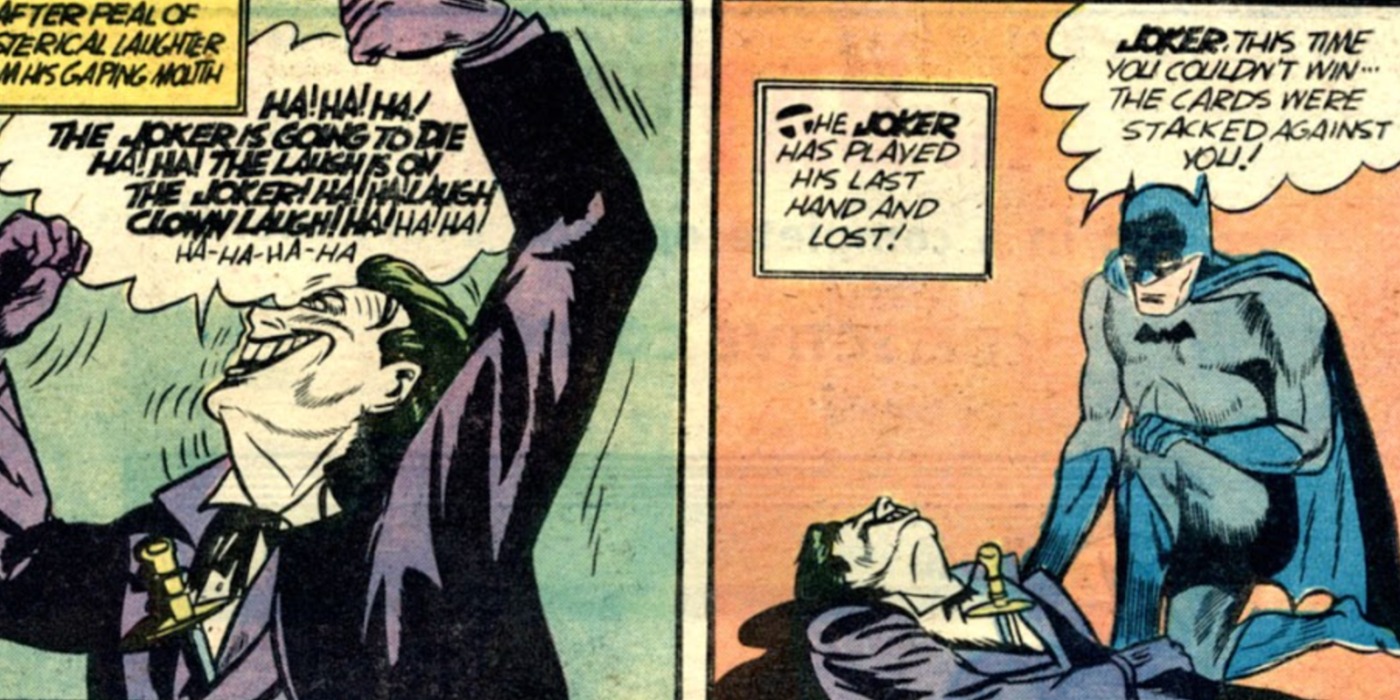
"The Joker Walks The Last Mile", Batman #64, 1942

They already did. 81 years ago.

He got better.

Saturday, June 08, 2024

Bachmotifs for Batvillains


Shirley Walker, the composer who did the music for Batman: The Animated Series, was a skilled crafter of leitmotifs (musical themes to used as the signature music for particular characters).  Sometimes she missed the mark a bit (what possessed her to give Two-Face a theme that's in THREE, I cannot imagine).  But the fact that themes for the Penguin, Two-Face, and (especially) the Joker are all based on Elfman's Batman theme is simply genius.  

In this episode ("The Strange Secret of Bruce Wayne", Oct. 29, 1992), the three themes are all played in immediate succession as they get off the plane to visit Hugo Strange.

But what if Walker had not been available and we had to rely on an earlier musical talent? Say...

J.S. Bach.

Batman may merit a more serious composer.
But I have still chosen Bach.


That is to say, what pieces of J.S. Bach would one use as leitmotifs for Batman's most iconic villains? Here are my choices.


The Joker 

Die Kunst der Fuge, Contrapunctus IX, BWV1080

Bach wasn't exactly a free spirit.  A obsessively hard working perfectionist with anger issues, who still had a tender side.

Reminds me of someone else, seen here firing Alfred's predecessor. 

Bach was pretty strait-laced. But if there is any Bach piece that can be said to sound unhinged, it is Contrapunctus IX.  Boldly themed, it leaps out of the gate with an octave jump and pell-mell scalar run that always remind me of a madman's laugh, its theme punching through frequently, almost mockingly, above the melee of the voices. 

The exemplifying performance I offer you is by the modern madman of the keyboard, Glenn Gould.  I find it easy to imagine this version playing as the accompaniment to scenes of chaos perpetrated by the Joker as he is chased by Batman.  In fact, when I listen to it, I find it hard to picture anything else.


The Penguin

English Suite #5, Prelude (BWV 810: I)


This piece, like the Penguin, has a peculiar rolling gait. Bach's having a bit of fun with the "English" style; it's a bit precious and seems almost to take itself too seriously. It's trying to be dignified with its pompous theme, but can't help coming across as risible.  


However, the repeated reassertions of the theme give it a diehard dignity with a dark undercurrent. This is still Bach, after all, and despite his rolly-polly appearance, his ability is not to be underestimated. And genius disguised as gentility is the hallmark of the Penguin.

This harpsichord version by the impish Chiara Massini captures this feel.  The Prelude is the opening part, but you might enjoy the rest of the suite as well.


Two-Face  

Now, some people would have gone right to Bach's Two-Part Inventions, which are all about the interplay between two voices with related themes.  But I am not among those people, because I think Two-Face is a much more complex character than that.

I mean, c'mon; it's music for KIDS.

Instead, I have thematically chosen not one, but TWO pieces that could serve as leitmotifs for Two-Face.; one is for keyboard, the other is choral.

Canon 1 à 2 from J. S. Bach's Musical Offering (BWV 1079).

You don't see the Soprano Clef often.
Let alone a REVERSE Soprano Clef.

This deceptively simple-looking piece is more commonly known as Bach's Crab Canon.  A crab canon is a piece that can be played forwards or backwards, and --

here's the tricky part--

forwards and backwards SIMULTANEOUSLY.  Let that sink in a bit.

If you are old enough to, like me,  have suffered through the painfully baroque Goedel, Escher, Bach, you will already be familiar with this piece, or at least its structure.

The forward and backwards versions of the canon are like the obverse and reverse of a continually flipping coin. They are two opposite melodies that nevertheless fit perfectly together, both balanced and inextricably intertwined. Neither can "triumph" over the other, since they are the same thing. As such I think they well represent the "good" and "evil" sides of Two-Face and how he views those as merely two sides of the same coin, each implying the other.

It also sounds pretty creepy, and I have chosen Jos Leys' version for your listening AND watching enjoyment because it illustrates its unique nature well.

That is my cerebral, "amoral" choice of theme. My other (also creepy) choice is a more emotional and morally charged choral piece: the opening motet-style chorus from the cantata Siehe zu, daß deine Gottesfurcht nicht Heuchelei sei (BWV 179).

Mein Gott, what a terrible translation.


Boy, this baby had them squirming in their pews in Leipzig on August 8, 1723! "Mind that your fear of God isn't hypocrisy" is a rather scoldy title, even for a hard-ass JSB church cantata.  But he wasn't kidding around here; the work is considered his musical condemnation of, well, people who were two-faced.  Being Bach, he built that into the musical structure. Each time the theme enters, it is answered (in stretto!) by an inversion of the theme as a counter-subject, with some chromatic spin, which is Bach's nifty (and salty) way of demonstrating (and condemning) two-facedness.  

It can be hard to pick out by ear if you aren't looking at the score and lyrics can be distracting, so I offer you a malinowskigram of the piece that may make it easier to perceive and, if you really want to get into it, here's a detailed analysis of the chorus.


The Riddler 

The Fugue in A minor (BWV543, No. 2)

What were you expecting: Schubert's Ave Maria?


This one was easy.

It's a fugue, because only a fugue could convey the complexity of the Riddler's schemes. It's in A minor, because the Riddler is weird and creepy.  It's relentlessly driven yet still capering, like the Riddler; its hiccuppy melody evokes Frank Gorshin's manic giggle; its frequent suspensions mimic the tension of confusion that the Riddler causes in those he challenges.

For decency, I must present you with music-stud Matthias Havinga's definitive organ interp, for atmosphere, I offer you Michele Bianco's plangent accordion version; and for clarity, a version that follows the score AND an especially helpful malinowskigram.

And, no, don't be silly: I didn't consider any of his "riddle" canons. Those are "riddles" only in historical context and nothing in their musical nature is appropriate to the Riddler.


The Catwoman

Ricercar à 6 from Musical Offering


Like the Crab Canon, this six-voice fugue is from Bach's Musical Offering (BWV 1079), which has a bunch of separate but related pieces.  It's a little sad, a little slinky, with an oddly jumpy melody that's a bit like a cat walking on a keyboard.   Being a ricercar, it's not strict and formal like Baroque fugue, so it's got a meandering quality, as if it simply can't be bothered to follow the rules.  And that reminds me of Catwoman.  Like Catwoman, the piece is actually more complicated than it might seem. 

Ordinarily, I don't approve of Bach played on a piano, but this version captures the Catwoman feel I get from the piece. Stretch out and relax to listen; it takes its time.

Monday, October 31, 2022

What is: The Joker? A Beautiful Butterfly

This week I'm going to lay down the law on what Batman's five most iconic foes are and are not, starting at the top: the Joker. 


The Joker is highly intelligent and methodical.

The invention of Joker venom (below). His "cure" of the Weeper.  His undoing of the Silver Age Justice League.  The 48 Jokers (WAY better than just three).  Crime in Reverse.  The list of evidential stories and schemes is long.

Pictured: Evil. Not crazy. Evil.

And it doesn't stop at comics.  His bank heist planning (and about 9 other incredibly complex schemes) in Dark Knight Returns. The binarization and distribution methods for Smilex (Batman 1989). I mean: the work that must have gone into BTAS "Christmas with the Joker" ALONE, people.  

This isn't really a point for much debate but it's an essential underpinning for several of my subsequent points.


The Joker is not an "agent of chaos."

The Joker doesn’t stand for chaos. The Joker doesn’t stand for anything. If you think otherwise, then you've fallen for one of the Joker's tricks, or you have been indoctrinated by a writer who has.  

The Joker isn’t trying to make a point to Batman or to anyone else, because he doesn’t care what anyone else thinks.  This is one of the principal reasons I hate Heath Ledger's Joker: he's an insecure ideologue desperate for attention, trying to prove the validity of his worldview.  That's a very weak figure, no matter how much dust he throws in your eyes or how impressive his schemes, because his motivations are based on caring about something rather than not caring about anything.

Writers are always desperate to make the Joker MEAN something. 

The real Joker told us exactly what he stood for when he painted
"Death of a Mauve Bat".  And we loved him for it.

They are missing the point and defanging the Joker in the process. What makes the Joker scary is precisely that he stands for nothing.  His only motivation is to have fun, which just might mean killing you; it's nothing personal and he doesn't care what you think about it.

Now, it's easy to make the case that the Joker, therefore, symbolizes the impersonal chaos that can ruin our lives in a second at any point; he's a bogeyman. But that's a far cry from chaos having anything to do with the character qua character and having chaos being HIS rallying cry.  


The Joker is not obsessed with Batman.

The Joker is already obsessed with someone: himself.  There's zero room for anything else. If you read Joker stories from the Golden Age and Silver Age, you understand that the Joker has only one true enemy and it's not Batman.

It's boredom.

The Joker's not crazy.

The idea that the Joker is insane -- now considered by most to be most essential characteristic -- is an invention of the Bronze Age, specifically of one of DC's least subtle writers, Denny O'Neil, in 1973 (Batman #251, "The Joker's Five-Way Revenge"). 


And, no, Batman #74 doesn't count.

Certainly, the Joker has always been... non-normal.  His sense of humor is especially so.  But, no matter how many times a writer tells you the Joker is" crazy", the evidence is strongly against it.  The Joker could not function at the incredibly high level he does and meet any traditional real-world definitions of insanity (a severely disordered state of the mind usually occurring as a specific disorder). 

I'll admit his repertoire of reactions has always been ... non-standard.  Most people do not laugh when they realize they are dying. But having an unusual worldview doesn't mean you're insane.
 

The Joker doesn't have a severely disordered state of mind and good luck trying to figure out which specific disorder(s) he has.  Some mental pathology? Sure. Questionable taste in clothes and decor? Yup. Anti-social morals and a lack of empathy? No doubt.  But if those were qualifiers, half of all celebrities would be eligible for Arkham.

We don't need to talk about him.


The Joker has no backstory.

The Joker is a bit like the Phantom Stranger: the things that make him a bad character are part of what make him a great character.  He has no origin and no name; he just is.  It's not an oversight: it's an essential part of the character. The Joker isn't a person so much as he is a concept, an archetype.  

The Joker is a blank canvas, as it were.

He doesn't need to be more; he shouldn't be.  The more you try to make him some else, something more specific, the less he becomes.  

He's like a talkative Art the Clown.  
Trying to give him a backstory with a pregnant wife will not improve the character.


I'm not just a comic fan, I'm a huge horror fan. And in scary cinema, you make the distinction between horror and terror.  Terror is what you feel BEFORE you open the scary door in the scary place; horror is what you see after you do.  Horror is specific and concrete and known; terror is the infinite fear of all the things that MIGHT be behind that door, a fear of the unknown or unknowable.  

You want terror?

Too many clumsy modern writers write the Joker as horrifying and insist on increasingly graphic depictions of his huge and constantly growing body count.  What the Joker should be is terrifying; an unknown evil, without origin or goals or relatable emotions. 


The Joker holding a baby is terrifying.

Giving the Joker an origin was stupid when they tried it the first time.

Admit it; you haven't read this story. 
Do; then you'll realize how stupid it is.

Why writers and fans are wed to this stupid story and the impulse to pin down the Joker's origin.  It's not just that THIS story is stupid; ANY origin story you give to the explain the Joker lessens him.  

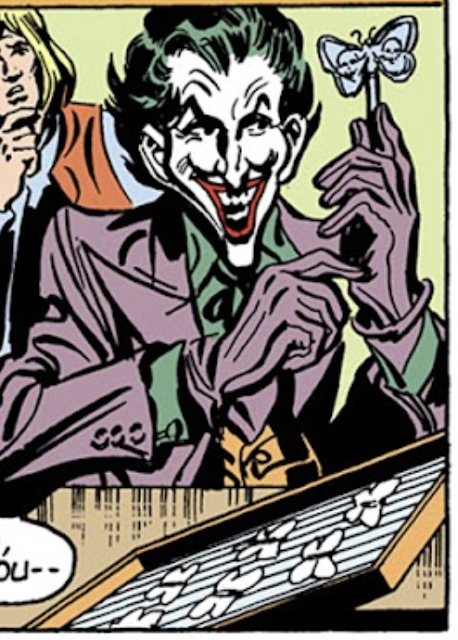
The Joker's just like a beautiful butterfly. Free to be the simple creature it is, it's one of the world's most colorful, elegant creations.  Try to pin it down, to add to your collection and all you get is a dead bug.


Fine, it's a death's-head moth, not a butterfly.
I have to work with what's available.